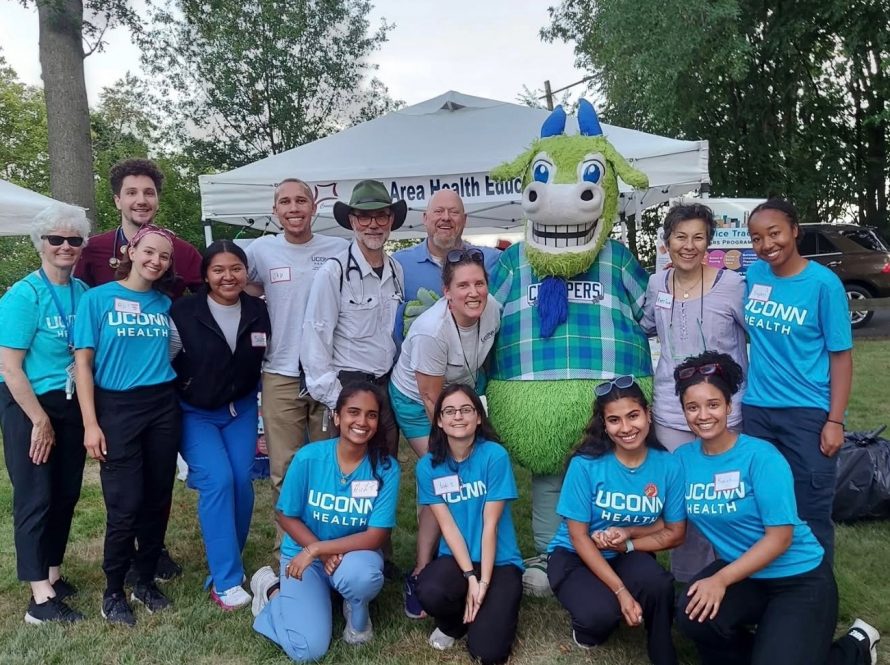
Three UConn Urban Health/Area Health Education Center scholars stepped up as team leaders for the Connecticut Area Health Education Center’s (CT AHEC) summer outreach program. Together they organized ten community health events and connected with more than 2,000 community members throughout the state.
The Urban Service Track/AHEC Scholars Program student leaders were second-year UConn School of Medicine students Jasmine Maggio ’29 MD and Sophia Fernandes ’29 MD, and Ali DePaolo ’29 DMD from the UConn School of Dental Medicine. The students managed logistics and services, recruited volunteers and preceptors, and packed the materials needed for each event.
“I signed up for the summer program to re-engage my ‘why’ for medicine,” said Fernandes.
Their team also included CT AHEC summer interns Bryana Wilson (Yale University) and Emily Silva (Central Connecticut State University). Urban Service Track/AHEC Scholar alum, Azucena Zecua Herrera ’26 (NUR), served as a coach.
The events were scattered throughout the state and included Chapel on the Green in New Haven, Keney Park in Hartford, and New Milford’s Back to School activity. At the events, the team provided pertinent health education and conducted basic clinical assessments, including 287 blood pressure and 271 blood glucose screenings.
“We met with 447 people at the REACH Family Fun Day in Hartford on August 8,” said Fernandes. “That was one of our busiest days!”
“Our summer team did an outstanding job bringing health promotion into our communities, which is exactly what CT AHEC is all about,” said Petra Clark-Dufner, director of CT AHEC. The CT AHEC Network, which includes four regional centers, works to improve access to health care by building a strong cadre of primary care professionals and linking together local community groups and resources.
The team also presented handouts and giveaways on topics such as mosquito/tick-borne illness, “gym germs”, active lifestyles, sun protection, and lead information, depending on the location and population.
“All the materials were targeted to an 8th grade reading level,” said Kara Anastasiou ’09 MSN, who served as advisor to the team. “We are conscious of meeting the community where they are at and engaging them with the information,” says Anastasiou, who is also a 2009 Urban Service Track alum.
The team leaders partnered with different community-based organizations such as the Keney Park Sustainability Project, an environmental and food-system nonprofit initiative; the Urban League, a nonprofit whose mission is to promote racial equity and reduce economic disparities in Hartford; and Angel of Edgewood, a nonprofit that responds to crises facing individuals and families across greater Hartford.
“Being able to participate in such a variety of community events and to collaborate with these partners helps to reinforce the importance of interdisciplinary teamwork and shared values to create more equitable access to health care,” says Anastasiou.
Wilson agreed this was the case. “As an aspiring physician, it was empowering to partner with a multidisciplinary team to tackle issues related to health care, medicine, and accessibility. I also enjoyed expanding my knowledge of public health and preventive care while serving local Connecticut communities,” she said.
The Urban Service Track, based at CT AHEC’s program office at UConn Health, is a two-year “add on” inter-professional student program focused on underserved urban and rural communities that is available to students in the UConn Schools of Medicine, Dental Medicine, Pharmacy, Nursing, and Social Work, and Quinnipiac University’s Physician Assistant Program. A rural track program has been added for students from the University of Saint Joseph. Eight to twenty students per program are selected each year from among qualified applicants who have demonstrated a commitment to community engagement. Developing leadership skills is a major focus of the program.
“I enjoyed the leadership opportunities at community events where we had to balance leading a team with direct interactions with community members at certain stations,” said DePaolo. “Each community event was a unique experience based on the people who were part of our inter-professional team and the people who came to the event, so flexibility and creativity were always part of the process,” she said.
The summer team was also invited to participate in other events, such as sharing their experiences and insights as guest panelists at the HealthPath Summer Launch: AHEC Health Careers Experience program at UConn Waterbury where they talked with high school students about pursuing careers in health care. They also participated in the End Hunger Connecticut Policy Summit at Wesleyan University, where the focus was food insecurity, policy initiatives, and community solutions.
Wilson and Silva also served as coaches at a two-hour workshop on public health careers for students as part of CT AHEC’s Public Health Infrastructure Grant program. The workshop was held at the Pathways/Senderos Center in New Britain.
“My team, which was a wonderful mix of health professions students, utilized their expertise and skills through each outreach event, focusing on a part of the curriculum and taking every opportunity to engage with the community members. I was inspired by their ability to use every minute with the community members as an opportunity to build trust and rapport and make them feel heard,” says Anastasiou. More information on AHEC Scholars Urban Service Track can be found on the website.