UConn Experts Discuss Climate Change’s Impact on Connecticut
As part of the UConn Foundation’s Impact Series, four researchers, including two from CLAS, discussed their research on climate change in Connecticut — and what the state can do about its impacts
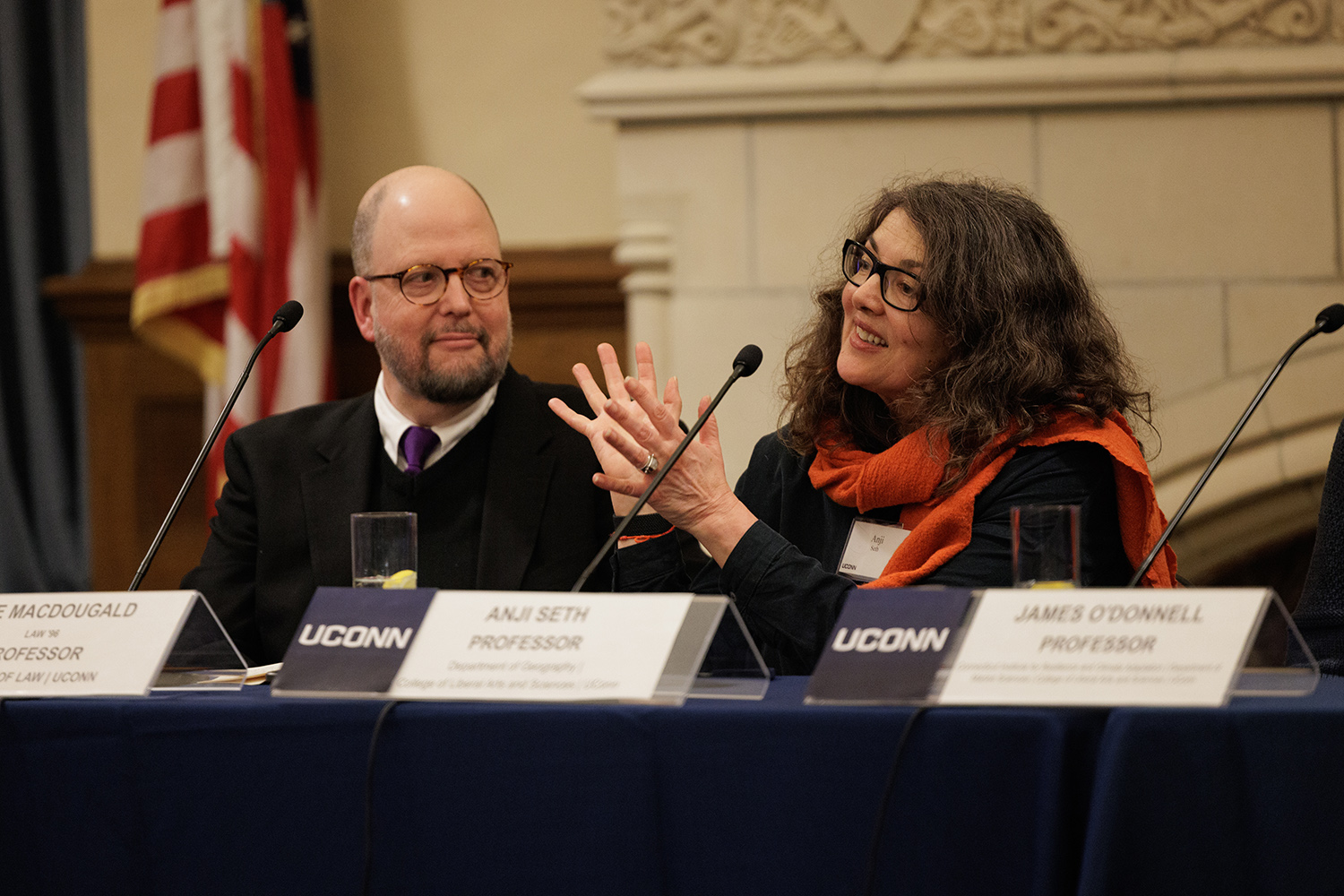
Researchers studying climate change spoke to UConn alumni and community members on a panel at the UConn School of Law on Feb. 8, 2024, as the first installment of the UConn Impact series. (Matthew Hodgkins/UConn Foundation)
As part of the UConn Foundation’s Impact Series, four researchers, including two from the College of Liberal Arts and Sciences, discussed their research on climate change in Connecticut on Feb. 8. The professors discussed its local impacts and what the state can do about them.
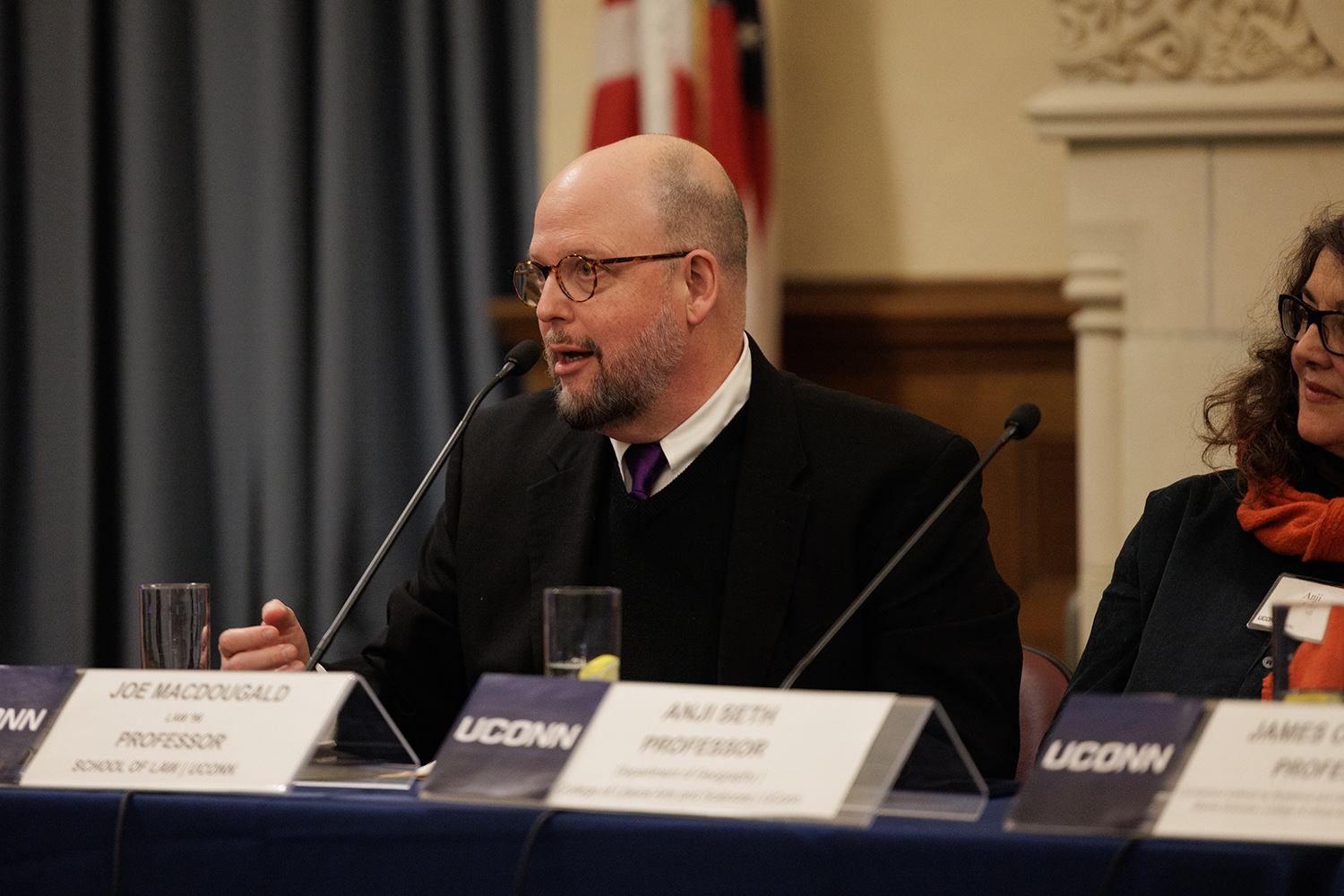
The talk, titled “Climate Change in Connecticut: Threats and Responses” was moderated by Professor-in-Residence Joe MacDougald, executive director of UConn Law’s Center for Energy and Environmental Law.
The panel included Professor and Head of Geography, Sustainability, Community and Urban Studies Anji Seth, who studies how regional climates are likely to evolve under global warming, and Professor of Marine Sciences James O’Donnell, executive director of the Connecticut Institute for Resilience and Climate Adaptation, who studies ocean circulation.
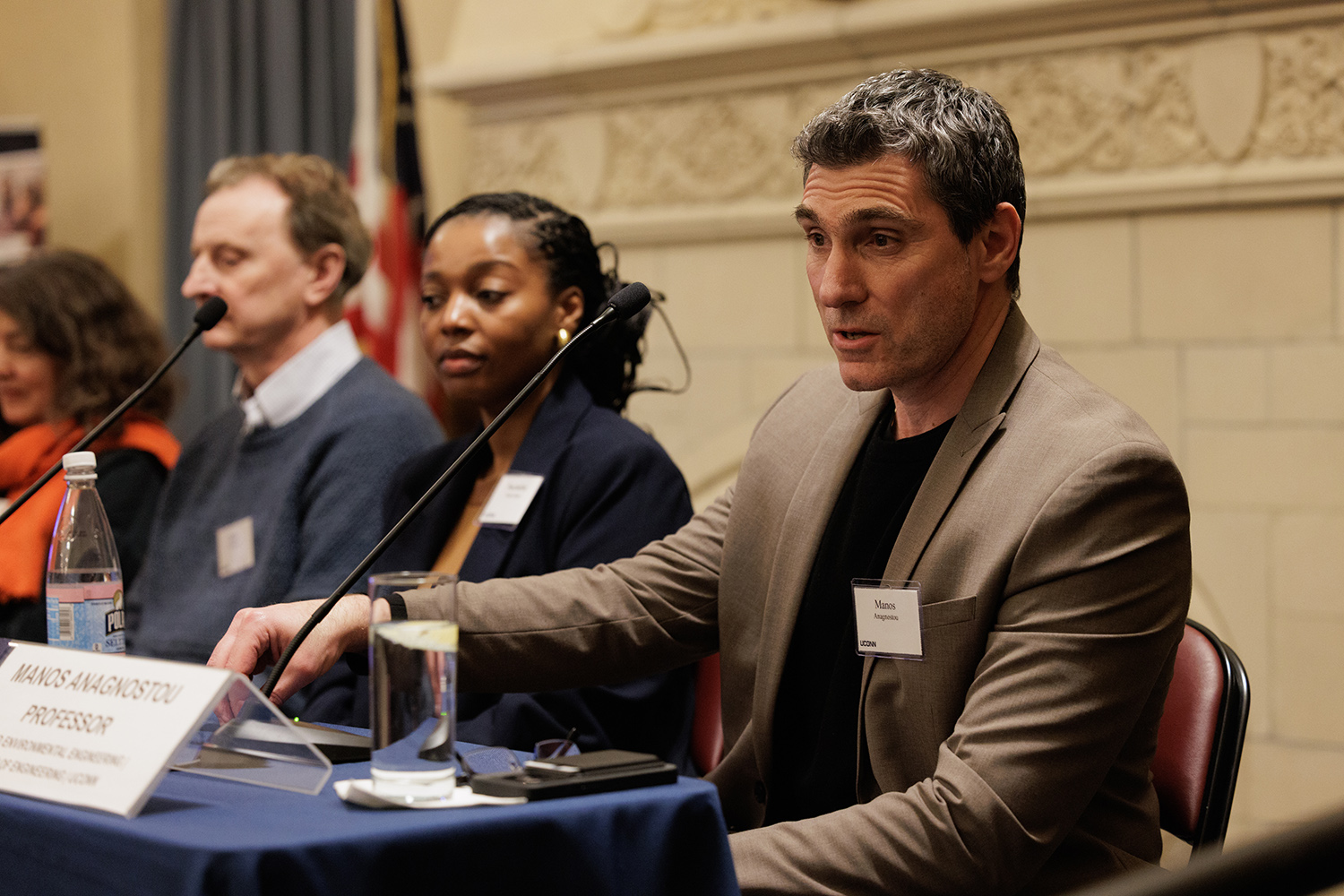
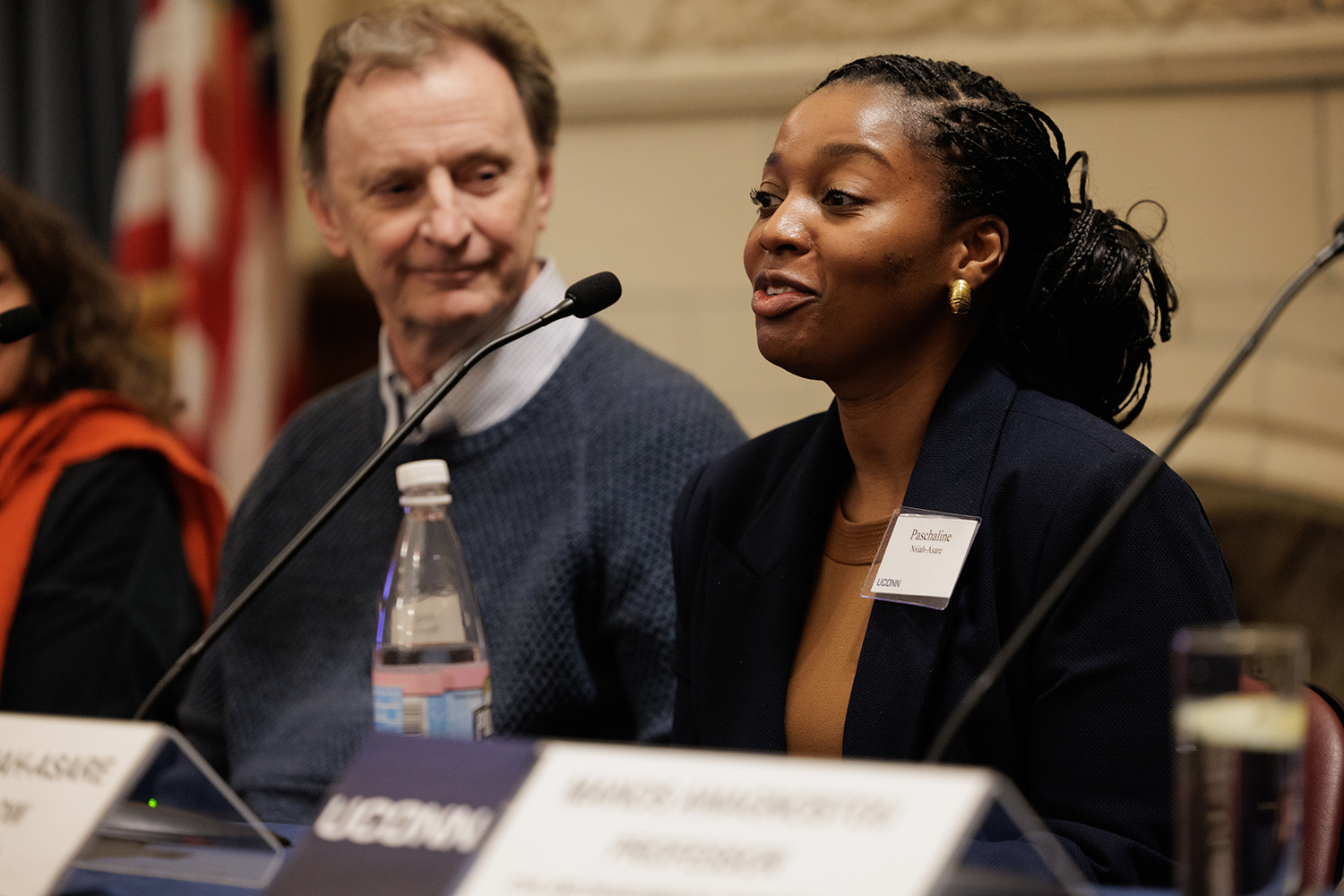
Also on the panel were Paschaline Nsiah-Asare, a teaching fellow at the UConn School of Law and an attorney with a special interest in comparative energy and environmental policy, and Emmanouil Anagnostou, Board of Trustees Distinguished Professor of Civil and Environmental Engineering in UConn’s College of Engineering.
The event gave attendees the opportunity to learn about the multifaceted challenges posed by climate change in Connecticut and the proactive responses led by UConn.
Panelists spoke about the interdisciplinary perspectives of climate science, energy and resilience policy, and environmental justice. Seth emphasized that though we are already adapting to the impacts of climate change, it is still “never, ever” too late to mitigate.
“Everything that we can do will help,” she said. “There’s no point at which we give up, because the more [carbon dioxide] we put into the atmosphere, the worse things are going to get.”
The next UConn Foundation Impact Series event will take place on May 22 at the UConn Health Center. Check back with the Impact Series web page for updates.
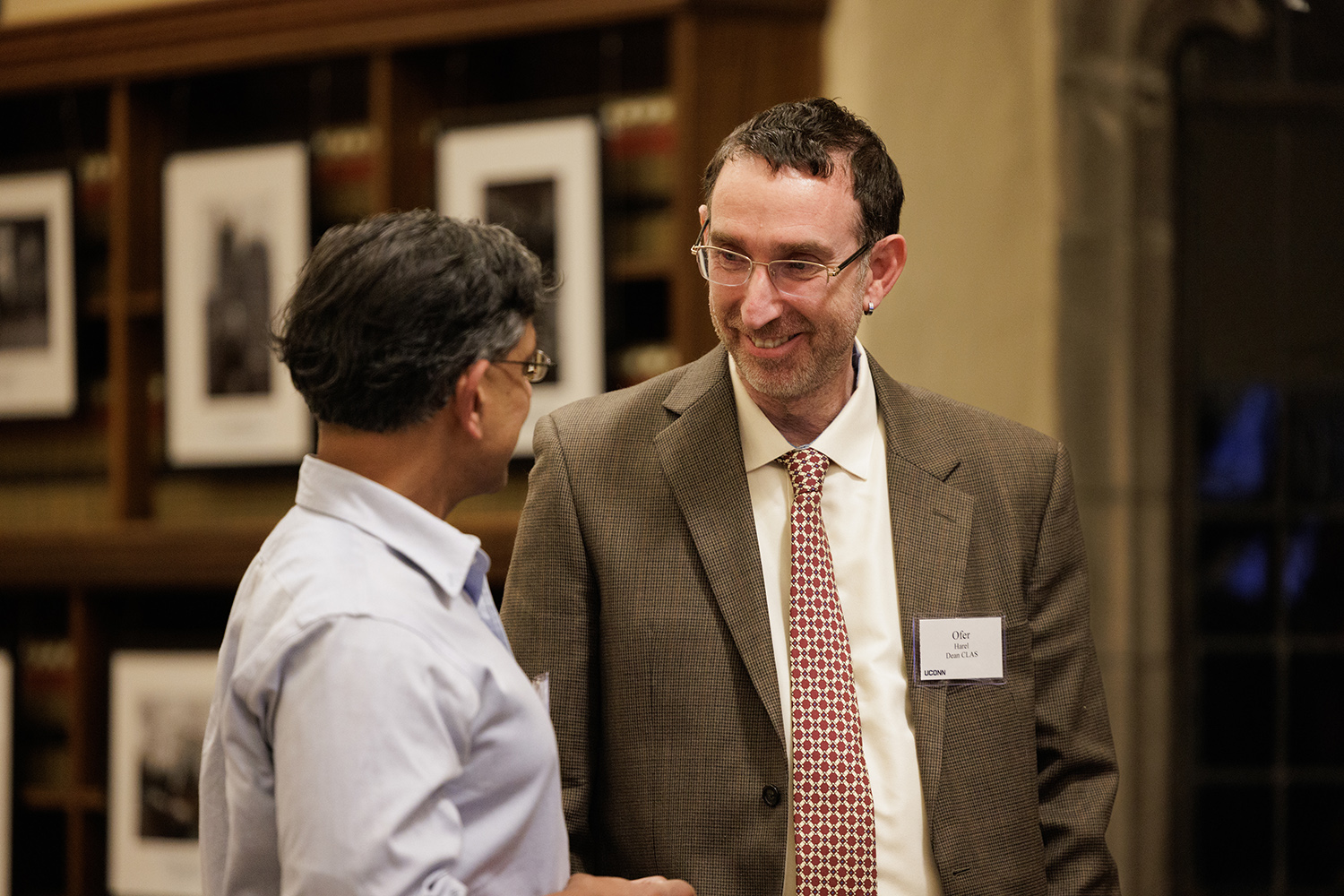
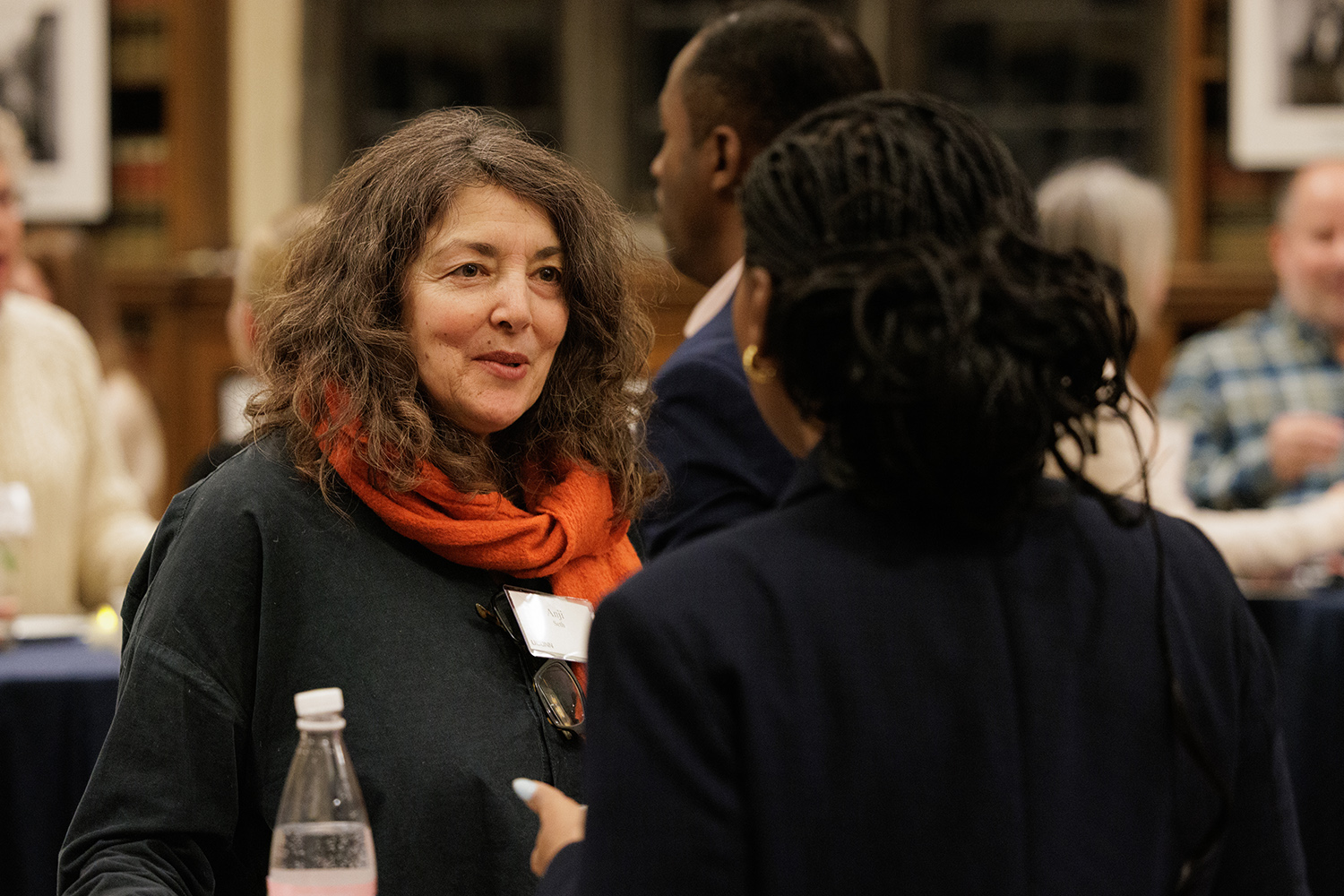
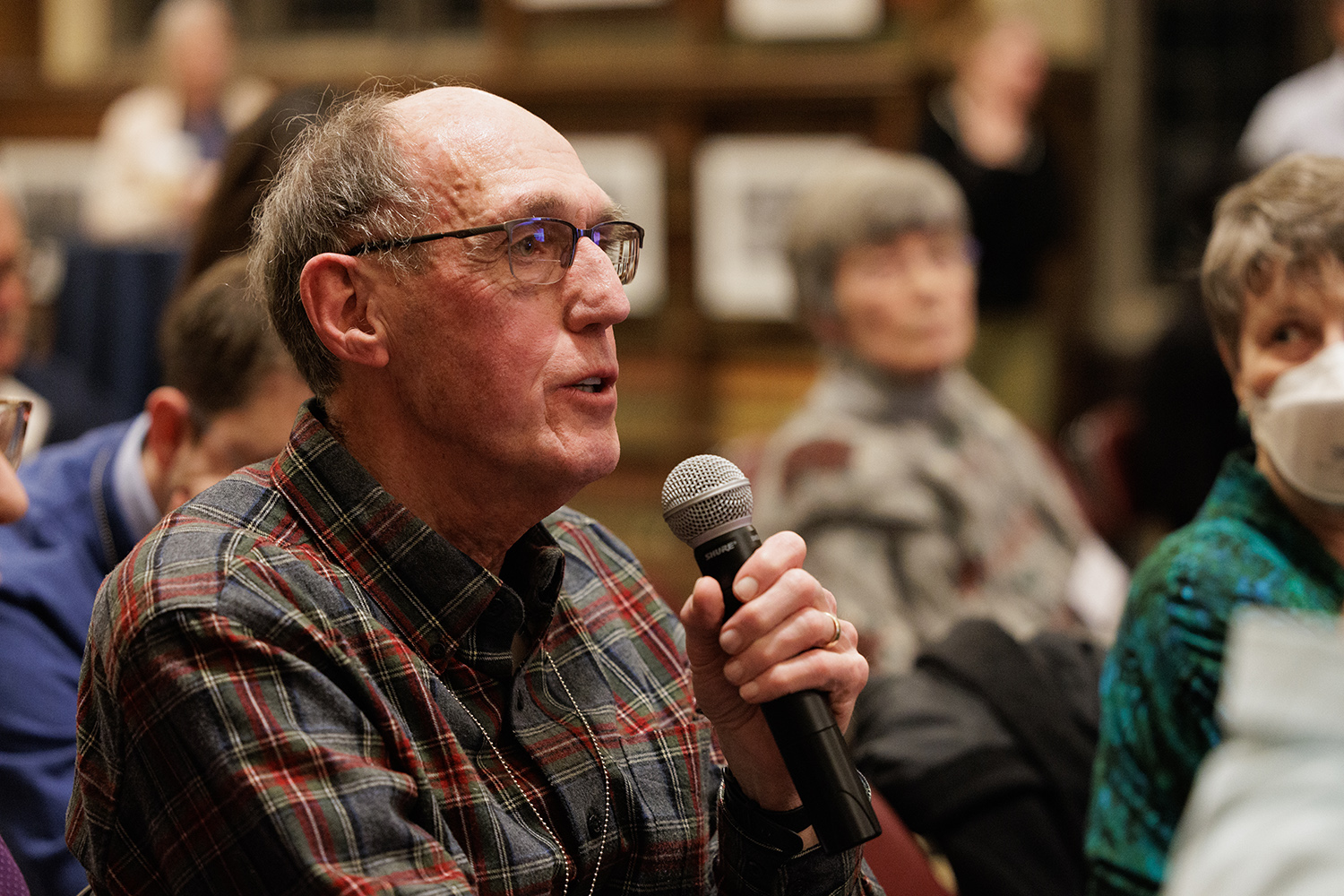
College of Liberal Arts and Sciences Interim Dean Ofer Harel speaks with an attendee of the first UConn Impact series event on Feb. 8, 2024 at the UConn School of Law. Harel said the event would provide “a glimpse of how UConn is making a difference in our state, our nation, and our world through groundbreaking research and collaboration to solve some of the greatest challenges facing our communities.” (Matthew Hodgkins/UConn Foundation)Joe MacDougald ’96 (LAW) is a professor-in-residence of law and the executive director of UConn Law’s Center for Energy and Environmental Law. “I think you’ll be impressed with the scope of the way we approach climate change and climate policy at the University, but also in the way that we are impacting the state,” he said. (Matthew Hodgkins/UConn Foundation)James O’Donnell speaks to CLAS Interim Dean Ofer Harel at the Feb. 8, 2024 event. O’Donnell highlighted that his work is not just to do academic science work, but to also provide solutions and policy advice to legislators and leaders around the state regarding Connecticut’s response to climate change. (Matthew Hodgkins/UConn Foundation)At the Feb. 8, 2024 UConn Impact series event, Emmanouil Anagnostou answers a question from the audience. He noted that UConn students are “eager” to see the state take steps to mitigate climate change. (Matthew Hodgkins/UConn Foundation)During the Climate Change in Connecticut: Threats and Responses event on Feb. 8. 2024, Paschaline Nsiah-Asare, a teaching fellow at the UConn School of Law and an attorney with a special interest in comparative energy and environmental policy, emphasized the need for climate justice. “In Connecticut, we all know the impacts from climate change impact a marginal section in our community in terms of health and sea levels rising and other issues,” she said. (Matthew Hodgkins/UConn Foundation)Panelists Anji Seth and Nsiah-Asare engage in a conversation at the Feb. 8, 2024 event at the UConn School of Law Starr Hall. Seth co-led the writing of a physical climate change assessment for Connecticut that led to the Governor‘s climate change steering committee. (Matthew Hodgkins/UConn Foundation)Charlie Whynacht, of Glastonbury, Conn., asked the panel on Feb. 8, 2024 what they’ve noticed students at UConn think about the future regarding climate change. (Matthew Hodgkins/UConn Foundation)During the Feb. 8, 2024 panel, Seth answered an audience question highlighting, as she’s noticed, a “very real” student anxiety regarding climate change. “But I think the best thing we can do is make changes so that they can feel more hopeful,” she said. (Matthew Hodgkins/UConn Foundation)
Our websites may use cookies to personalize and enhance your experience. By continuing without changing your
cookie settings, you agree to this collection. For more information, please see our University Websites Privacy Notice.
What are cookies?
Web cookies (also called HTTP cookies, browser cookies, or simply cookies) are small pieces of data that websites store on your device (computer, phone, etc.) through your web browser. They are used to remember information about you and your interactions with the site.
Purpose of Cookies:
Session Management:
Keeping you logged in
Remembering items in a shopping cart
Saving language or theme preferences
Personalization:
Tailoring content or ads based on your previous activity
Tracking & Analytics:
Monitoring browsing behavior for analytics or marketing purposes
Types of Cookies:
Session Cookies:
Temporary; deleted when you close your browser
Used for things like keeping you logged in during a single session
Persistent Cookies:
Stored on your device until they expire or are manually deleted
Used for remembering login credentials, settings, etc.
First-Party Cookies:
Set by the website you're visiting directly
Third-Party Cookies:
Set by other domains (usually advertisers) embedded in the website
Commonly used for tracking across multiple sites
Authentication Cookies
Authentication cookies are a special type of web cookie used to identify and verify a user after they log in to a website or web application.
What They Do:
Once you log in to a site, the server creates an authentication cookie and sends it to your browser. This cookie:
Proves to the website that you're logged in
Prevents you from having to log in again on every page you visit
Can persist across sessions if you select "Remember me"
What's Inside an Authentication cookie?
Typically, it contains:
A unique session ID (not your actual password)
Optional metadata (e.g., expiration time, security flags)
Analytics Cookies
Analytics cookies are cookies used to collect data about how visitors interact with a website. Their primary purpose is to help website owners understand and improve user experience by analyzing things like:
How users navigate the site
Which pages are most/least visited
How long users stay on each page
What device, browser, or location the user is from
What They Track:
Some examples of data analytics cookies may collect:
Page views and time spent on pages
Click paths (how users move from page to page)
Bounce rate (users who leave without interacting)
User demographics (location, language, device)
Referring websites (how users arrived at the site)
Opt Out
Here's how you can disable cookies in common browsers:
1. Google Chrome
Open Chrome and click the three vertical dots in the top-right corner.
Go to Settings > Privacy and security > cookies and other site data.
Choose your preferred option:
Block all cookies (not recommended, can break most websites).
Block third-party cookies (can block ads and tracking cookies).
2. Mozilla Firefox
Open Firefox and click the three horizontal lines in the top-right corner.
Go to Settings > Privacy & Security.
Under the Enhanced Tracking Protection section, choose Strict to block most cookies or Custom to manually choose which cookies to block.
3. Safari
Open Safari and click Safari in the top-left corner of the screen.
Go to Preferences > Privacy.
Check Block all cookies to stop all cookies, or select options to block third-party cookies.
4. Microsoft Edge
Open Edge and click the three horizontal dots in the top-right corner.
Go to Settings > Privacy, search, and services > cookies and site permissions.
Select your cookie settings from there, including blocking all cookies or blocking third-party cookies.
5. On Mobile (iOS/Android)
For Safari on iOS: Go to Settings > Safari > Privacy & Security > Block All cookies.
For Chrome on Android: Open the app, tap the three dots, go to Settings > Privacy and security > cookies.
Be Aware:
Disabling cookies can make your online experience more difficult. Some websites may not load properly, or you may be logged out frequently. Also, certain features may not work as expected.