The University of Connecticut is becoming a central hub for separations technology experts, thanks to a growing industrial network gathering annually to learn, network, and brainstorm.
The Industrial Workshop on Separations Technology was held earlier in October by the Connecticut Center for Applied Separations Technology (CCAST), in partnership with the UConn Center for Clean Energy Engineering and the UConn Tech Park.
This workshop, which was the fourth in the last 5 years, was led by General Electric Professor of Advanced Manufacturing in the chemical and biomolecular engineering department Jeffrey McCutcheon. He is also the CCAST director.
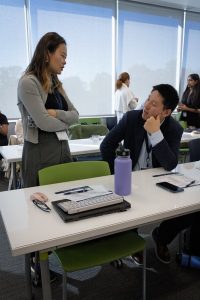
“This year’s events drew our largest number of attendees yet,” said McCutcheon. “Our response from industry has been better than ever. There is a strong interest in developing separations technology amongst industry, and one key takeaway for our attendees is that financing is available to help the best ideas translate to the market.”
On Thursday, Oct. 2 organizers held the Early Career Workshop on Separations Technology. More than 30 Ph.D. students and postdoctoral researchers from six universities attended. The students and researchers later engaged in a poster session and startup pitch competition.
The pitch competition was won by Recovered Potential, pitched by Kindle Williams from Stanford University. This company spun out of Stanford University from the lab of newly awarded MacArthur Foundation recipient William Tarpeh. They are developing innovative approaches to recover ammonia and other critical materials from wastewater. They are the recipient of a $1,000 cash award sponsored by Verico Technology.
The runner up was OsmoPure Technologies (pitched by Kian Lopez). Spun out of the University of Colorado Boulder from Anthony Straub’s lab, they are developing a unique pressure assisted membrane distillation process to enhance recovery of concentrated brines.
Then, on Friday the Industrial Workshop on Separations Technology occurred, bringing people from 60 companies, 10 universities, three national labs, and a half-dozen venture capital firms and accelerators.
During the event, attendees learned about new major opportunities for separations in critical materials recovery. According to McCutcheon, this is becoming increasingly important as trade barriers increase around the world and domestic supplies of rare and in-demand materials are stressed.
“Separations is an innovative market space that is constantly evolving,” McCutcheon said. “The technology touches nearly every industry, and addresses challenges across the disciplines of water, solvent, vapor, and gas.”
Global Water Intelligence’s Tom Pankratz delivered Friday’s opening keynote on the early history of wastewater treatment technology as conventional physicochemical processes gave way to early membrane technologies that hybridized bioreactors with micro- and ultrafiltration membranes.
Friday’s events included several presentations with industry experts from Osmoses, Membrion, Pall, NEXT Membrane, ZwitterCo, DuPont, NALA Membranes, and Xylem.
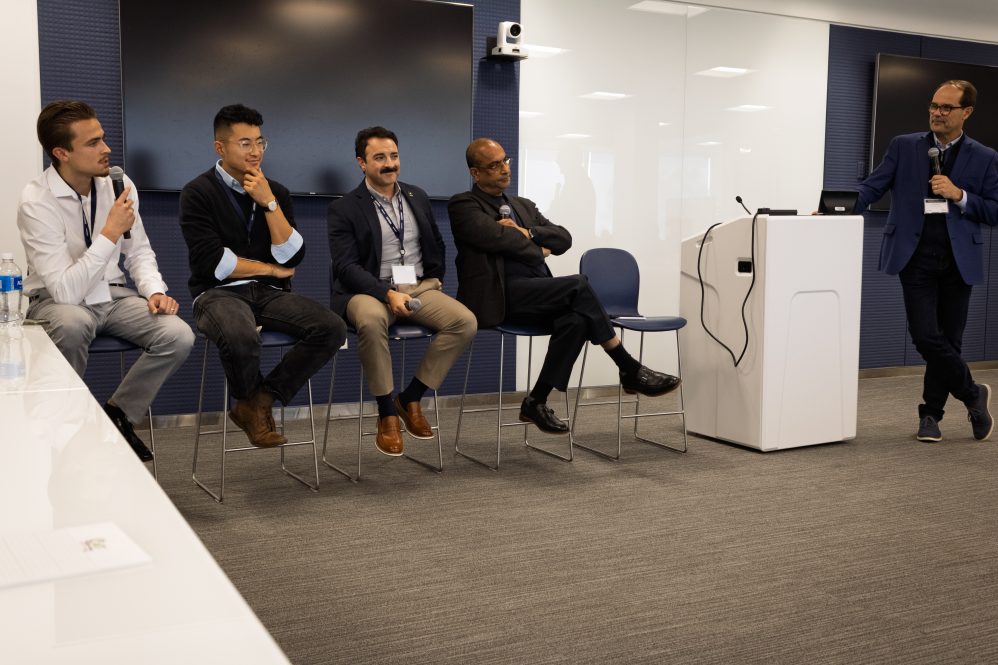
The first afternoon panel was dedicated to venture capital in the sustainable separations space. Featuring Burnt Island Ventures, Azolla Ventures, PureTerra Ventures, and Terramount Infrastructure Partners, the panel, which was moderated by UConn chemical and biomolecular engineering undergraduate student and Hillside Ventures analyst Kristen Foell, discussed challenges and opportunities for investing in the sustainability space. Topics including intellectual property, portfolio management, and fundraising strategy were discussed.
The panel on critical materials was moderated by Matthew Ringer from National Renewable Energy Laboratory. He led a panel comprised of innovative entrepreneurs including those from ChemFinity Technologies, Recovered Potential, KMX Technologies, and from Elateq. This panel discussed opportunities in lithium, ammonia, and other metals that have become essential to supply chains for electronics, energy, agriculture, and military needs.
The last afternoon panel on water technology featured Eden Tech, Kira Desalination, Active Membranes, and NEXT Membranes discussing challenges facing the water sector and where new technology could make the best impacts in a commoditized, low margin market.
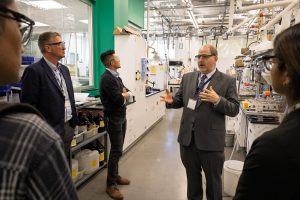
Between the workshops and panels, attendees toured the Innovation Partnership Building and the state-of-the-art laboratory dedicated to a broad spectrum of membrane processes. CCAST labs have the capability to synthesize and characterize membranes for water treatment, gas separation, pervaporation, brine dewatering, and electromembrane processes. McCutcheon and his staff work at both the “bench” and “element” scale, offering the ability to design and build complex membrane testing equipment customized for client needs.
More information about CCAST is available online, and photos from the event are also available.