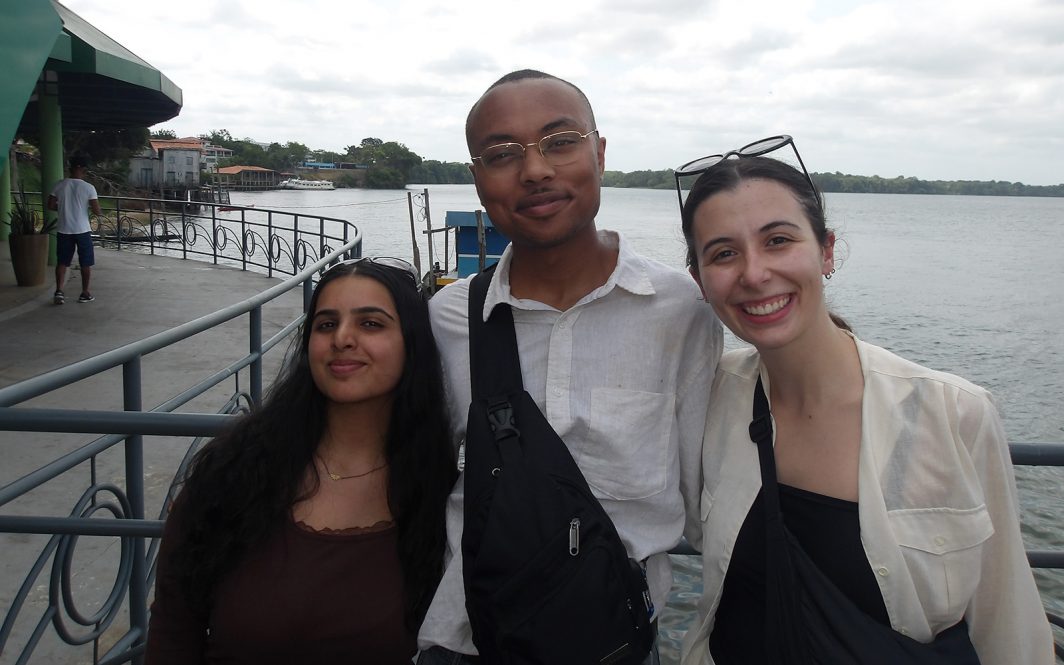
Two UConn business students who are passionate about sustainability and a healthier planet, attended the COP30 climate conference last month in Belem, Brazil, adjacent to the Amazon rainforest.
Both graduate student Caroline Keary ’25, ’26 MS and senior Aminieli Hopson ’26 said the experience was one of the best of their lives, and that what they learned will benefit their careers.
They left with a new network of like-minded climate advocates and an appreciation for both the enormous challenges of climate preservation and renewed respect for those who dedicate their lives to it.
Keary is completing her master’s degree in Social Responsibility and Impact in Business and is a graduate intern in the UConn Office of Sustainability. Hopson is a Real Estate major who developed a globalized mindset in part due to growing up in both the U.S. and Tanzania.
COP, an annual UN climate conference, invites world leaders, scientists, activists, diplomats and other communities to work together to solve global sustainability issues. This year’s conference focused on accelerating global climate action and greater focus on climate justice, forest protection, and climate finance. Hopson and Keary participated in the program from Nov. 14 to Nov. 24, along with seven peers from the UConn COP Fellowship Program.
Arminda Kamphausen, Director of Global & Sustainability Initiatives at the School of Business, said in the past students have traveled to Scotland, Egypt, and Azerbaijan to attend the COP event, and returned with new perspectives.
“Caroline and Aminieli represent a growing mindset among students who want to use their skills and experience in purpose-driven business to create positive impact, not just for their companies but for the people and communities those companies serve,’’ she said.
“COP is an eye-opening experience that allows students to wrestle with and understand critical global issues up close and personal, learning approaches from different cultures, continents, and ideologies, and gaining additional inspiration as they work out their own career and personal goals,’’ she said.
The School of Business interviewed Keary and Hopson about their experiences.
How exciting was it to attend COP30?
Keary: Attending COP30 was the most wonderful and insane experience of my life thus far. I interacted with people I would never have gotten the opportunity to meet if I wasn’t at COP30! It is still all a little surreal…visiting the Amazon, talking to people from indigenous tribes that live in that same jungle, and meeting environmental experts from around the world at a conference in Brazil.
Hopson: Having the opportunity to be on the ground in Belem was incredible! We got to venture into regions where Açaí is made, learn how the environment is integrated into the local economy, and see the famous Amazonian River dolphins. The conference itself was inspiring: at every turn, you heard 20+ languages, with active translators facilitating meaningful relationships and dialogue across continents.
Tell me about one of the great presentations or conversations that you experienced there.
Hopson: “Regeneration Generation: Youth Action against the Climate Crisis,” hosted by the Thailand Pavilion, was a fun one, as three students from other universities in the U.S. invited me to watch them on a panel with other students from Argentina, Thailand, and Japan. It was workshop style, where they each gave pitches for their impact projects that included marketing techniques to raise funds for conservation in the Amazon, establishing innovation hubs related to solutions for Coral Reef Hubs, and the new economic mechanisms to aid countries that experience significant economic and humanitarian loss or damage as a result of these pressing issues.
Keary: The greatest presentation I attended was given by the Cote d’Ivoire pavilion on the work that they and other countries in the Congo Basin do to create climate resiliency for their local communities. A majority of the work that they do focuses on meeting farmers in their local towns and working directly with then on ways to improve their crop yield and seed preservation. They are able to use that work to inform policymakers about what is happening on the ground in their countries.
The talk itself was amazing but what was so special about it was that the hosts actively translated the talk into English for us. It was also given by three women to a room of predominantly men. And beyond all that, it was truly amazing to have access to the information and stories of climate action happening across the world in a language I do not speak, without a western bias. I felt overwhelming grateful to all the people in that pavilion for taking the time to meet us where we were, only knowing one language, and letting us understand their amazing work. It was truly a moment where I was so proud of humanity.
After spending time with all these sustainability experts, do you feel more excited or more pessimistic about the future of the planet? And why?
Keary: I would say that I am more optimistic about the climate work being done across the world, but I am more pessimistic about our ability to collectively do that work together under the United Nations. It was truly amazing to see the amount of innovations and growth areas that everyone across the planet has been excelling in.
However, I recognize the struggle that countries have in putting aside political ideologies and stances to come together and admit that climate change is an issue. It goes deeper than just political ideologies to different foundations of economies, but it is so disheartening to sit in these negotiations with delegates representing different countries denying basic human rights because that is not what their country wants, or brushing over pressing concerns because their country does not want to give money to a climate fund. I have lost faith, I guess, in international diplomacy and negotiations because it never seems to get anywhere. I have more faith that people are actually going to get this work done and will not stop until it is done though.
Hopson: I remain optimistic about the opportunities for the recent financial mechanisms to create climate-resilient economies and workforces, and to protect endangered resources for populations that need them. I am cautious about the dynamics of the diplomatic negotiations, as countries that faced the adverse effects on a much greater scale raised issues that did not receive adequate representation in some of the final action items. Meeting with all the students who were eager to learn about connecting across cultures, ethical leadership strategies, and taking meaningful action gives me hope for the future.
What is your intended career path and will this help you in that pursuit?
Keary: I would really love to work in social responsibility in business, helping manage supplier relationships. Ideally, I would love to be able to leverage a company’s power to help create a better quality of life for their supply chain workers.
I think this conference really helped me understand the distinction between areas where countries can make change and where businesses can really excel. I was able to see areas where business can capitalize on areas in sustainability and use that to better their business and the planet.
Hopson: During my time in undergrad, I’ve become quite passionate about real estate development. Through discussions with delegates and pavilion hosts at COP, you can see how unique sectors incorporate international sustainability topics into the niches of their local regions. This experience taught me a great deal about how to potentially blend my passions for culture and sustainable development with my interests in business strategy, economics, and international collaboration. These sectors spanned retail, healthcare, manufacturing, real estate, entertainment, and so much more.
Tell me about a crazy, unexpected or unusual encounter or experience you’ve had at COP30?
Keary: The craziest experience at COP30 was definitely when the main area of the venue caught on fire and flooded throughout the week! I was in the side event area, so I was not close to the fire at all, but the area that I got evacuated to was completely separate from everyone else. It also was in a fenced-in area, so people really started freaking out that we would not be able to escape if the fire got out of hand. So, for a moment there, I was a little worried but then I was thinking the fire cannot spread that fast because we are in a completely different building.
But then I turned around and saw this woman crying and going through a mental health episode, and was I helping her calm down and prevent her from losing consciousness. Then once she was able to get back inside, she was fine. But then I had to make the long journey outside the venue to find the rest of the group. All- in-all it was a crazy time but thankfully no one was hurt and everyone was safe.
Hopson: In COP30’s green zone, a booth showcased long-term solutions for building hurricane-resistant greenhouses so a local community could continue to expand its agricultural economy. It was exciting for me as a Real Estate and Urban Economics major, although it was also an unexpected encounter. It was a 45-minute discussion with the developer, who spoke only German. We spent that time passing Google Translate back and forth and finding other ways to get the messages across effectively.
He shared how the community was at the center of every decision. Hence, he needed engineers, scientists, financial analysts, and marketing professionals to take the reins and help bring this innovation to life. It was a testament to how making global connections at these conferences can really make a difference, regardless of what you study or where you work.