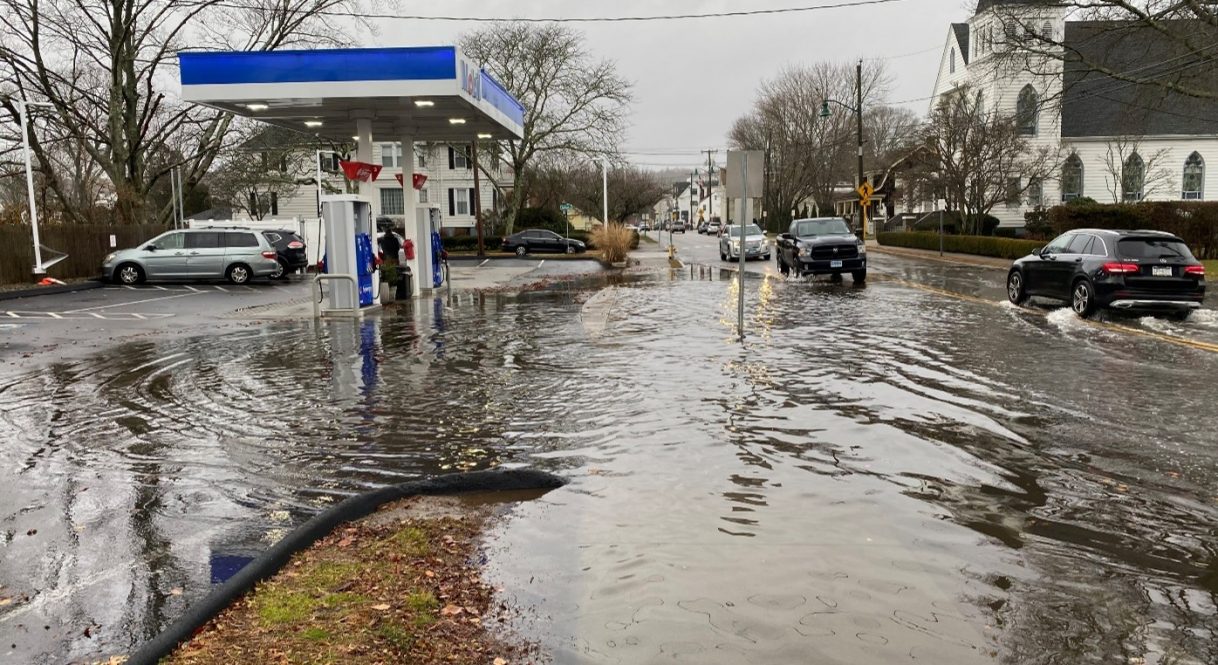
Rising sea levels, intensifying storms, and increasing flood risks are impacting coastal communities of the northeastern United States in unprecedented ways. The magnitude of projected sea level rise in the region is among the largest of any in the world, threatening millions of Americans and billions of dollars in infrastructure.
Mounting a coordinated response to the threat is far from simple. Among the many barriers to such efforts is a lack of access to tools and expertise communities need to translate Earth system science into practical mitigation strategies.
A team of researchers from UConn-based Connecticut Institute for Resilience and Climate Adaptation (CIRCA) is working to close that expertise gap. They have created a collaborative network of scientists, engineers, policy experts, and other stakeholders to provide communities with the critical data, improved models, and technical standards they need to develop and implement climate-resilient policy and strategies. Other partners include the University of Maine, Stevens Institute of Technology, and Brooklyn College (City University of New York),
The project – Identifying Community Need-Based Adaptation and Resilience Priorities in the U.S. Northeast – recently won a $500,000, two-year award from the National Science Foundation (NSF). Its goal is to identify obstacles to using the results of modern earth sciences required to accelerate the adaptation of neighborhoods and municipalities to the effects of severe weather and climate change.
The funding will support the development of the network of scientists, engineers, policy experts, community leaders and contractors, who will work cooperatively to identify and prioritize research needs, and then chart a research plan for future projects. Ultimately, researchers hope the project creates a replicable model for environmental adaptation nationwide.
UConn Marine Sciences Professor James O’Donnell is the lead PI on the project and Executive Director of CIRCA. He says that UConn faculty spearheaded the initiative to ensure that communities have access to the advances and modern methods in geosciences – and the resources of leading Research universities – to increase their resilience to the effects of extreme weather and climate change.
“We want to make people safer, ready for the future, and effectively protect the environment,” O’Donnell says.
The network would be a regionally coordinated entity spanning Maine to New Jersey. Researchers will employ a 10-step plan that engages collaborators from academia, the private sector and government agencies and promotes knowledge-sharing through specialized Technical and Policy (TAP) and Municipal, Agency, and Private sector (MAP) teams.
Collaboration will take place through a series of structured meetings, working groups, and other consensus-building activities. Teams will address environmental challenges such as coastal erosion, flood prediction and risk reduction, localized heat-risk assessment, and regulatory barriers.
The project will emphasize the development of practical solutions using environmentally friendly or “living” designs that employ natural materials, like plants, sand, and oyster reefs, to stabilize coasts, offering a more resilient and ecologically beneficial alternative to hard structures like bulkheads and seawalls. Academic partners will contribute expertise on high resolution wave and flood modeling, machine learning-enabled flood alerts, and the latest policy protocols.
Awards through Regional Resilience Innovation Incubators (R2I2) – a cross-directorate solicitation led by the National Science Foundation’s (NSF) Directorate of Geosciences and the Directorate for Technology, Innovation and Partnerships – differ from other NSF grants. They leverage recent advances in Earth system science research with projects that address a specific regional climate challenge and proposed solutions that can be effectively applied in real-world settings.
“The intent is to support the development of a bridge between basic geoscience and climate research, and local knowledge to support informed decision-making and technological innovations that have direct societal implications,” O’Donnell says. “CIRCA and UConn have been at the forefront of the approach within Connecticut, and the project will broaden collaborations across the northeast.”
Coastal zones and river valleys of the northeastern U.S. are being flooded more frequently due to an increase in the occurrence of high-precipitation events and extreme coastal water levels, according to the proposal. Using an optimistic estimate of reduced emissions, the projected cost of flood-related damage in the U.S. is around $32.1 billion a year. By 2050, the figure is expected to rise to $40.6 billion, an increase of approximately 28%.
Based on a 2019 study led by O’Donnell, Connecticut has adopted a requirement that coastal municipalities include an increase in mean sea level of up to 20 inches by 2050 in their plans. Though sea level rise is unlikely to reach 20 inches by 2050, “we should design for the upper bound of what’s possible in the near future,” O’Donnell says. Similar studies in Massachusetts and Maine recommend planning for a sea level rise of between 1.5 and 2.5 feet by 2050.
O’Donnell says Phase I of the project will create the framework for a separately funded Phase II proposal focused on implementation. Phase I results will include prioritization of the environmental challenges of the region that geosciences can help address, co-designing solution strategies, a workforce needs assessment, workforce training and development plans, and creating a blueprint for sustainable continued collaboration. Sixteen groups across the country will compete for the Phase II projects which will have a duration of up to five years and budgets of approximately $10 million.