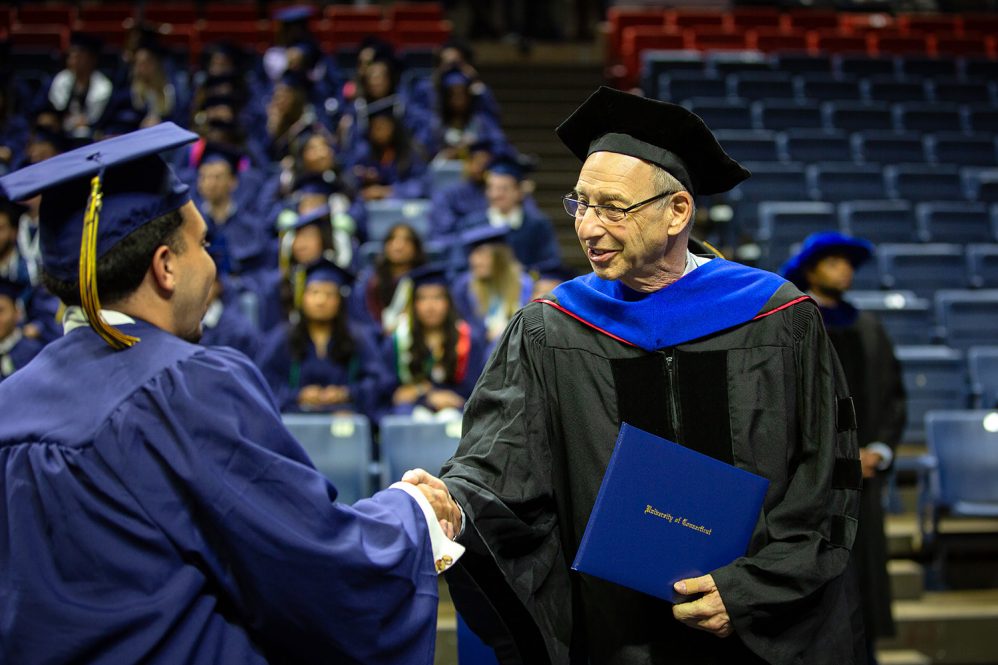
After more than four decades at UConn, including 12 years as an associate dean in the College of Liberal Arts and Sciences, Andrew Moiseff stepped down from the Dean’s Office at the end of 2025. His career offered a rare view of the University’s administration and its broader impact.
Moiseff, now a professor emeritus of physiology and neurobiology, arrived at UConn in 1983 after earning a Ph.D. from Cornell University and completing a postdoctoral fellowship at the California Institute of Technology. At the time, he says, UConn was widely viewed as a commuter school with a modest national profile.
Over the years, Moiseff watched the University transform physically, academically, and in reputation, alongside his own evolving path. His diverse portfolio has included service as interim department head; a longtime member of the University Senate; work on dozens of committees on subjects ranging from space allocation and animal care to use of artificial intelligence; and senior administrator in CLAS, with responsibilities spanning undergraduate programs, graduate affairs, and research.
In this Q&A, Moiseff reflects on a career shaped by curiosity, service, and a lasting impact on students.
You arrived at UConn in 1983. What’s changed the most about UConn since then?
UConn was considered a rural school. The joke was that you go to UConn and do cow tipping. I’m sure a lot of students today wouldn’t know what that is. Outside Connecticut, if you mentioned UConn, people thought Yukon and would ask, “Isn’t it cold there? Are there a lot of huskies?”
What’s changed the most, I have to say, is that our national recognition grew significantly — and a lot of that is because of basketball. If you go anywhere wearing your UConn hat, they ask you about athletics. You do a crossword puzzle and the answer to the clue is UConn. That didn’t happen in the ’80s.
What brought you to UConn, and what ultimately kept you here for more than 40 years?
It looked like the place for me. I’m from New York, so it was the area I wanted to be in. At the time, the physiology section of the biological sciences department had people doing fun and really interesting things, and my colleagues were great.
With the hindsight of history, UConn offered me freedom that you don’t have in a lot of places. I never aspired to be a department head, chair of the University Senate Executive Committee, or a member of the Dean’s Office. These opportunities just happened at the right time. If you look at my research, in some ways I was able to have several separate careers. But to me, it always felt connected.
How did your research interests evolve over your career?
The common theme throughout has been a curiosity about how the nervous system deals with real-world environments and then controls behavior. My training was in neuroethology, the intersection of animal behavior and neuroscience. Alongside that work, I’ve always been deeply interested in electronics and computing.
As a graduate student, I started out working on crickets and how they process sound. Males and females use sound to find each other, but crickets also fly at night, which raised a question: Do bats eat them? That question connected to earlier work showing how moths detect bats and evade them. A colleague and I wondered what would happen if we played bat-like sounds to crickets. That led us to discover that specific neurons behaved very differently depending on whether the sound matched cricket song frequencies or bat echolocation frequencies.
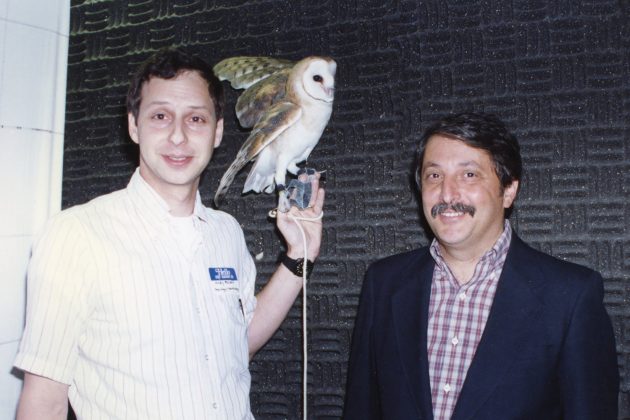
For my postdoc, I went to Caltech to study barn owls, which had just been found to have an area of the brain that correlates to directional hearing. I had the idea to make two small earphones that we could place in an owl’s ears to see how different cells responded to natural sounds. That helped us create a neural map of auditory space. That’s the work I brought to UConn.
Later, I became involved in studying synchronous fireflies, building field-portable systems for experiments on timing and synchronization. That work shifted my focus from physiology toward animal behavior and computer science. Interestingly, much of the software I had developed for owls, where timing was in the realm of microseconds, was exactly what we needed for fireflies — just a lot slower.
Over time, my research evolved from crickets to owls to fireflies, but the core questions stayed the same: how organisms use biological signals to interact with their environment, and how nervous systems process information in meaningful ways.
How did your experience in the University Senate shape your understanding of leadership?
Being on the Senate Executive Committee gives you a very different view of the University. You’re not just reacting to decisions; you’re involved in making rules and action items. We met monthly with senior administrators and had private, confidential meetings with the provost and the president. Those conversations were very frank. You get insight into how decisions are made, what pressures exist, and how much context matters.
That experience really shaped how I thought about leadership. You start to see that each level — the Board of Trustees, the president, the dean — and every administration has its own distinct personality. It’s not about good or bad, better or worse. Everyone is different.
You served as CLAS associate dean for 12 years. What did that role show you about the University that you hadn’t seen as faculty?
The responsibilities are very different. On the Senate Executive Committee, you have a lot of insight into how decisions are made. In the Dean’s Office, you operate in a different context, and your focus is on the College and its mission.
The Dean’s Office must be responsive in both directions, supporting faculty and departments while also working within the constraints set by the people above you. Balancing those things, and communicating effectively in both directions, is hard. That’s why having a good team matters so much. You need different perspectives, and you need to stay true to what you believe the mission is.
What do you consider your most lasting impact at UConn?
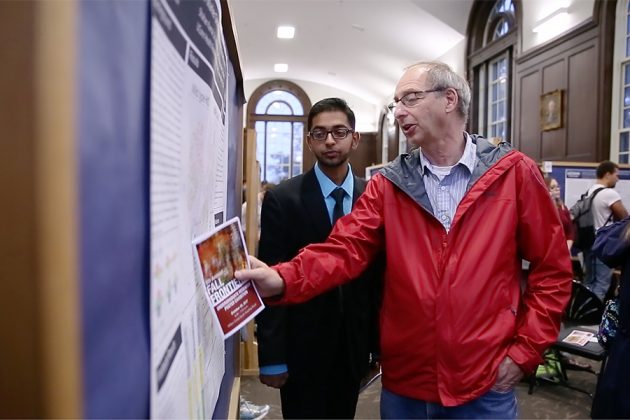
What I’m most proud of is my impact as an instructor. When you think about what really matters, what has the longest-term impact, it’s the impact we have on students.
College is an impressionable time. I taught a lab class, PNB 3263: Investigations in Neurobiology, for 40 years. I’ve had students who have gone on to medical school, taken jobs, or pursued graduate degrees based on experiences they enjoyed in my class.
I sometimes get emails from former students telling me what they’re up to. It has also happened at open house. Parents come up with their son or daughter and say, “This is Dr. Moiseff. I took his lab course. I worked in his lab.” Those moments stick with you.
Now that you’ve retired, what’s next?
There’s so much stuff to do! I can still do a little research in the field, which I intend to do. One of the best things is that I have the time and freedom to read books just for fun. Capital-F fun! And I just restored two cuckoo clocks.
I don’t have a checklist, but I’m not bored — and I don’t intend to be.