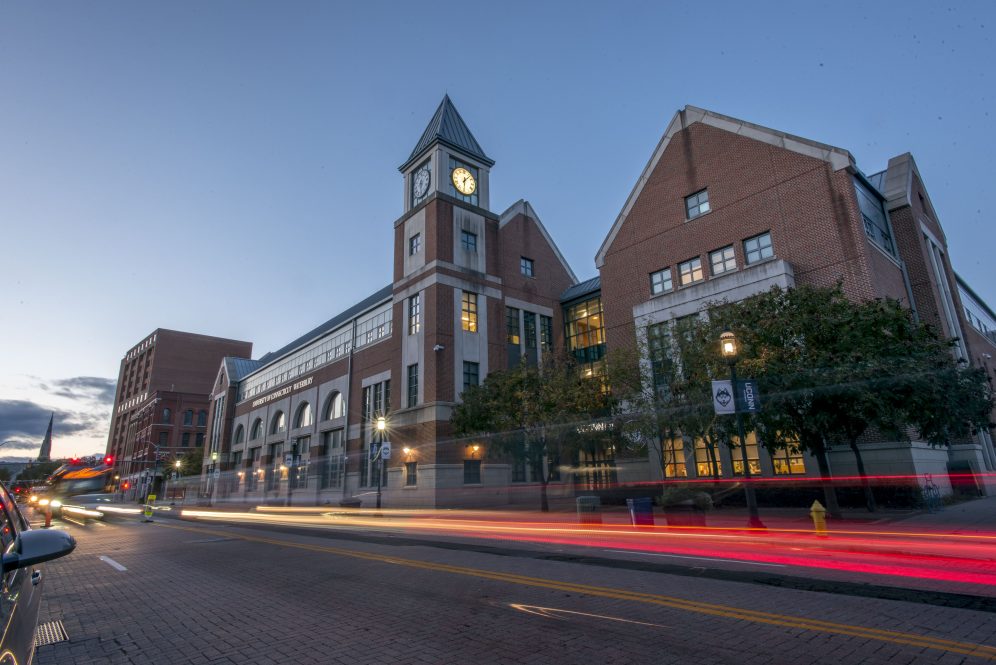
“Building community” is an oft-cited goal of businesses, local governments, and nonprofit organizations, and now an innovative new course at UConn Waterbury is offering students the opportunity to do just that – literally.
Launched in partnership with the Connecticut Department of Housing (DOH), the UConn Waterbury Housing Clinic for Thriving Communities is a signature experiential learning course designed to prepare students to tackle real-world affordable housing and neighborhood revitalization challenges.
Developed as part of DOH’s statewide Urban Investment Pilot Program, the clinic was intentionally created to connect undergraduate students with local housing developers and active community projects, translating state housing priorities into hands-on academic learning. Introduced in Fall 2024 as a four-credit course, the clinic blends policy, planning, and practice to equip students with the tools needed to support equitable, community-driven development in Waterbury.
This initiative is supported by the Harold Webster Smith Foundation, whose generous funding provides faculty and student stipends, and strengthened through strategic partnerships with the Connecticut Department of Housing and NeighborWorks New Horizons. Together, these collaborators create a dynamic learning environment where students gain practical skills while advancing equity-driven solutions for local neighborhoods.
“By partnering with our academic institutions, we are turning classrooms into engines for broader community impact,” says Connecticut Housing Commissioner Seila Mosquera-Bruno. “These student-led efforts help advance real housing solutions, while inspiring the next generation to see affordable housing as meaningful, impactful and achievable work.”
“Across this initiative, we’ve worked with more than 100 students statewide, many of whom are now considering careers in affordable housing development, clear evidence that this model is working,” says Marina Marmolejo, Director of Housing Innovation at the DOH.
As part of a growing statewide model, the DOH has now launched three housing clinics at Yale University, UConn Waterbury, and most recently Trinity College in Hartford, each designed to connect students with real-world affordable housing and community development work. Together, these clinics expand access to experiential learning in New Haven, Waterbury, and Hartford, while cultivating a pipeline of emerging leaders in housing innovation.
A Unique Model in Higher Education
The Housing Clinic for Thriving Communities offered at UConn Waterbury parallels Yale’s Urban Design Workshop, which involves graduate students from the Yale School of Architecture, Yale Law School, and Yale School of Management. What makes UConn Waterbury’s approach distinctive is that it offers this experience at the undergraduate level, providing early exposure to urban planning, housing policy, and community development.
The Housing Clinic course is open to all students at UConn Waterbury as an elective. Those with interests in allied or public health, housing and community development, urban design, engineering, business, or the social sciences will find this course especially valuable for its interdisciplinary approach and real-world impact.
“Being part of this course has given me the confidence to envision a future in urban planning and housing,” says Adriana Figueroa ’26 (CLAS), a senior majoring in Urban and Community Studies.
Fall 2024: Building Foundations
In its inaugural semester, UConn Waterbury students immersed themselves in revitalization efforts in Waterbury’s Willow Street neighborhood. Guided by faculty and community experts, students analyzed zoning regulations, property ownership, demographic trends, and neighborhood needs to propose redevelopment strategies for seven sites. Their work included:
- Transforming vacant properties into affordable housing
- Reimagining storefronts as vibrant small businesses and healthy community assets
- Enhancing neighborhood safety through improved lighting, sidewalks, and transit
Spring 2025: Expanded Impact
Students had the opportunity to continue their work through paid internships with NeighborWorks New Horizons, deepening their understanding of housing development and nonprofit leadership. One intern, Alexia Foster ’26 (CLAS), a senior Urban and Community Studies major, says her experience at the Frontiers Undergraduate Research Seminar was transformative, underscoring how the clinic has shaped her career aspirations.
“The Housing Clinic provides students with an opportunity to understand the real dynamics of community development. Seeing them apply their stills to address local needs gives me great confidence in the future stewards of our communities,” says Kathy Luria, Executive Director of the Harold Webster Smith Foundation.
Fall 2025: Expanding the Vision
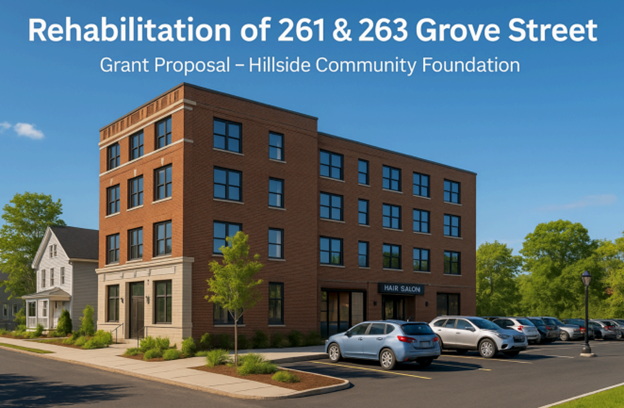
This past fall, the Housing Clinic returned with an expanded focus on Waterbury’s Hillside neighborhood, integrating housing, health, and economic development. Students are not only conducting research and planning but also engaging in grant writing, collaborating on a funding proposal to the Department of Housing alongside NeighborWorks New Horizons.
Students concluded the semester by presenting a comprehensive redevelopment plan to stakeholders, demonstrating how their learning informed practical, actionable solutions.
“Learning grant writing and project planning as an undergraduate has been an incredible opportunity,” says Amy Fanini ’27 (BGS).
Why It Matters
The Housing Clinic represents a transformative approach to higher education, where innovation meets community impact. By offering an interdisciplinary, hands-on experience at the undergraduate level, UConn Waterbury is preparing students for careers in urban planning, public health, housing development, business, and social policy; fields critical to addressing today’s most pressing challenges.
At the same time, the program strengthens neighborhoods through research-informed proposals and collaborative partnerships. This model demonstrates how universities can serve as engines of social change, fostering equity, sustainability, and economic vitality while equipping students with the skills and confidence to lead.

Connecting Classroom to Community
The Housing Clinic exemplifies UConn Waterbury’s commitment to innovation, equity, and community partnership. The Housing Clinic introduces students to foundational skills in areas such as project coordination, budgeting principles, and community engagement.
The course fosters critical thinking and applied learning, enabling students to contribute informed perspectives and preliminary strategies that support local efforts to strengthen neighborhoods.
“The Housing Clinic reflects UConn Waterbury’s mission to connect academic learning with real-world impact,” says UConn Waterbury Dean Fumiko Hoeft. “Students are not only preparing for their careers, they are also helping to build a stronger, healthier, and more vibrant Waterbury.”
Dale Kroop, adjunct professor for the course, says, “It is rewarding to see how the students integrated the course content into their understanding of why affordable housing is critical to the health of a community. Their presentations demonstrated that they learned that you can really make a difference and a good living in this field. That is the perfect job.”
Looking Ahead
The Waterbury Housing Clinic for Thriving Communities will be offered again in Fall 2026, continuing its mission to connect academic learning with meaningful community engagement. As the program evolves, it will remain a cornerstone of UConn Waterbury’s commitment to innovation, interdisciplinary education, and collaborative problem-solving. By preparing students to address complex housing and neighborhood challenges, the Housing Clinic reinforces the university’s role as a partner in building stronger, healthier, and more equitable communities.