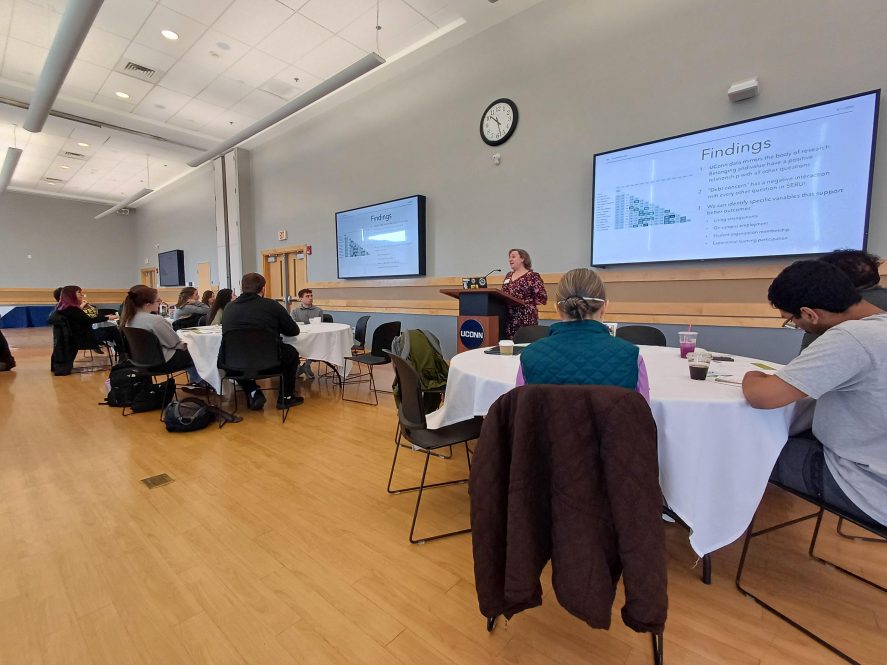
The Health Promoting University Well-Being Symposium was held on March 11 at the Student Union as an opportunity to combine data with testimonies and self-reflection, all with the intention to create meaningful systems for the student body. Discussing well–being, there was emphasis on students’ sense of value and belonging.
Survey data was presented at the symposium. Data points like: “Students who identified as a LGBTQIA+ community member had a 32% lower sense of value at UConn”; “Students who identified as African American were 63% more likely to report feeling symptoms of depression on a daily basis than their peers who identified as White”; and “Students who use the recreation center at least once per week have nearly a 10% increase in their sense of belonging than their peers who did not,” were then used to prompt self-reflection.
Only 10.2% of undergraduate students completed the Student Experience in the Research University (SERU) survey in 2024. The survey captures students’ perceptions of their academic, institutional, and social experiences at R1 universities nationwide. It serves as a tool to highlight trends in undergraduates’ academic engagement, well–being, personal development, overall satisfaction, and educational experience. As the next SERU undergraduate survey will soon be released on March 24, students are being asked to complete it to inform administrators what needs to be done to improve their well–being.
Allison Johnston is a graduate student studying Higher Education and Student Affairs. She is also a graduate assistant for the residential Wellness Community, supporting first- and second-year students’ holistic well-being as they acclimate to the college experience. She encourages her students to be engaged with community initiatives such as attending the symposium, while participating herself to learn about students’ needs.
After listening to students report they had slightly increased feelings of loneliness and isolation after their first year of college, Johnston shared how she too felt lonely during her sophomore year after parting ways with her friend group. She began to feel a sense of belonging again after applying and working as an orientation leader.
“I created some lasting friendships. I was able to connect with incoming students, and I felt I was having an impact on incoming Huskies,” Johnston said.
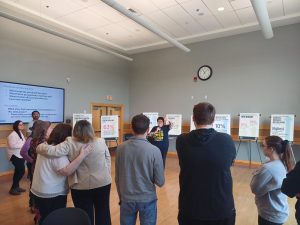
After examining quantitative data and listening to personal reflections, the symposium included a data-ranking activity. Student participants ranked data based on various posted questions on one side of the room, and faculty and administrators did the same on the other side of the room. Students agreed that out of all the available data, “Students reporting feelings of loneliness and isolation increasing slightly after their first year at UConn” was something they believed their peers who did not attend the symposium should be aware of. They also believed that if the University could improve this outcome, it would have the greatest impact on undergraduates.
Renee Gill, who leads community engagement for the health promoting university movement at UConn, was the main facilitator and planned the seminar’s agenda. Gill said the goal for the symposium was to translate what administrators, faculty, and staff know using the survey trends into brainstorming action steps to improve the campus environment.
One of the new insights gained was students’ concerns for debt accumulation during their undergraduate years.
Liza Boritz, the director of planning, assessment, and evaluation, presented data that shows that students who report higher levels of concern also report less favorable outcomes in other areas such as academic satisfaction, social satisfaction, and classroom engagement. “This finding, along with the other data shared in the workshop, underscores the importance of taking a holistic view of the student experience when trying to understand student success,” Boritz said.
Nishelli Ahmed, program manager for the Mental Well-being and Health Equity Initiatives at Student Health and Wellness, kicked off the seminar with a 50/50 mindfulness exercise. Participants were asked to focus on their breathing, briefly disconnecting from their external environment. The 50/50 approach helps individuals consider their internal thoughts and feelings as they navigate different interactions in the external world. Ahmed emphasized the benefit of this body-mind awareness exercise, which “keeps the body in mind while interacting with our environment” and is “a great way to be connected with one’s self-care.”
The work of the symposium will continue throughout the semester. The Holistic Huskies, SHaW’s peer mental well-being educators, will offer mindfulness drop-in hours for students at UConn Storrs. There will be sessions that provide an opportunity for students to learn what mindfulness is, engage in a variety of mindfulness practices – such as the 50/50 approach – and take time to decompress in a supportive, judgment-free environment.
The “Mindfulness Your Way” drop-ins began on March 12 from 12 p.m. to 2 p.m. in room 1131 at Homer Babbidge Library. During drop-in hours, students engage in guided practices such as breathing exercises, grounding techniques, and brief meditations. Trained Holistic Huskies facilitators provide education about mindfulness and support students in exploring strategies that are compatible with their individual needs, schedules, and comfort levels.
On March 26, the theme will be “Gratitude,” where participants will practice focusing on what they are thankful for, boosting their mood and perspective. On April 2, the theme will be “Visualization,” the practice of imagining positive mental images or goals to cultivate relaxation. On April 16, the theme will be “Body Scan,” the practice of mentally scanning one’s body from head to toe to notice sensations and release physical tension. On the final day, April 30, the theme will be “Love and Kindness.” Participants will practice mentally sending well-wishes and compassion to themselves and others to foster emotional warmth.