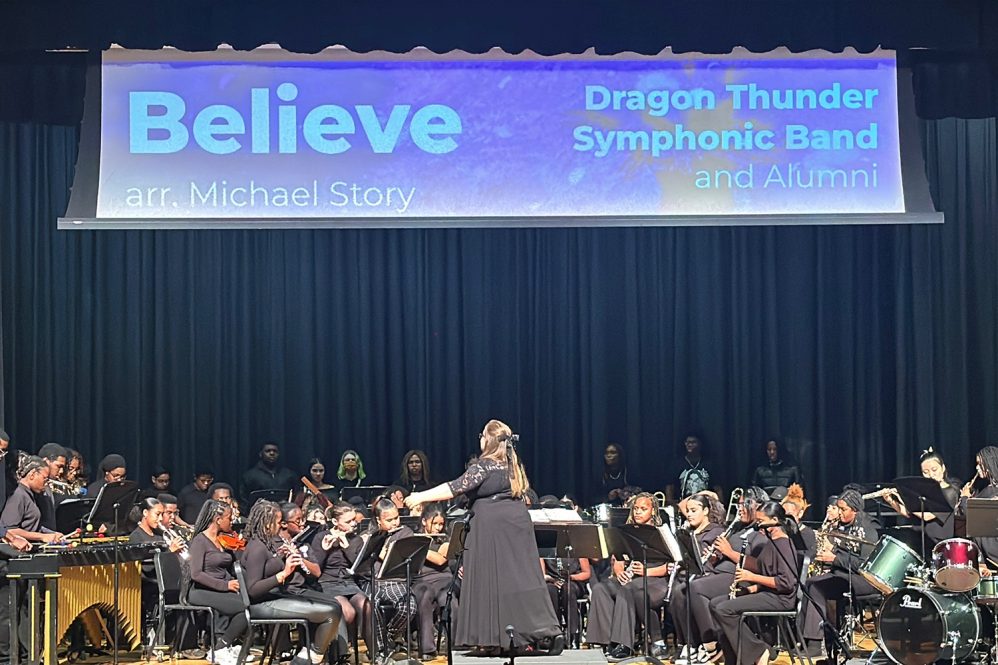
Ellie Campbell believes music and music technology are for everyone. All her students at the Capitol Region Education Council’s Academy of International Studies in Bloomfield deserve the chance to access new technologies that make music creation and recording possible, especially if students in neighboring towns do, too. That unwavering belief in social justice and equitable access has led the director of bands and theater to be named the Neag School of Education’s 2026 Rogers Educational Innovation Fund award winner.
Designated by the late Neag School Professor Emeritus Vincent Rogers and his late wife, Chris, a lifelong teacher, the fund provides $5,000 to support innovative projects by Connecticut elementary or middle school teachers. The gift is intended to support and expand the innovative, collaborative work of Connecticut’s classroom teachers and the Neag School of Education. This is the seventh year that the award has been bestowed.

Campbell’s project is titled “Amplifying Equity: Professional Music Production for Title 1 Students,” and will create a professional-grade recording studio where students can develop their creative expression and transferable STEM/technical skills. While affluent towns often have access to recording studios and creative technology for students, Campbell says her Title 1 students lack the tools to participate in the music industry and learn skills that are applicable to college programs in audio engineering, music production, and digital media.
“Technology is very relegating, based on who has it and who doesn’t,” Campbell says.
“For so many people, it is what allows them to open doors for themselves. While music technology may seem like just one door to some people, there are so many careers that deal with individual recording: audiobooks, podcasts, Foley sound effects. It’s so cool that I can provide my students with high-quality equipment, thanks to the Rogers Award.”
“The committee was impressed by Ms. Campbell’s commitment to expression through music and creation that can come alongside studio production,” says Todd Campbell, professor and head of the Department of Curriculum and Instruction at the Neag School, who chaired the 2026 Rogers Fund selection committee and is not related to Ellie Campbell. “It felt well aligned to the intent of the award to increase access through expression as a transformative experience for students.”
Ellie Campbell started teaching 14 years ago, but says she was in the sixth grade when she first realized she wanted to be a music educator. Originally a French horn player, she now says she plays a little bit of everything and was the Academy of International Studies’ fifth band director in four years when she was hired in 2015.
“We’re a magnet school,” Ellie Campbell says. “Most of my kids come from Hartford, Windsor, Enfield, as far away as Torrington and Clinton. It’s so difficult for their families, and they make these huge commutes for this magnet school program. Eventually, that gets exhausting, so I take it really seriously that I need to build a community, a place where my students feel happy, comfortable, and safe.”
For Ellie Campbell, building that community meant building a music program based on respect for music, but also play: “In your math class, you don’t get to play math, you don’t get to play English, you get to play music. So, I keep that cornerstone of play at the heart of what I do, to build love, legacy, and respect for the program.”
Two years ago, the school’s music program began to move away from traditional teaching methods and began incorporating technology into classrooms. The Mac music lab came out of that effort, and Ellie Campbell started to see students who were struggling in her general music class becoming more engaged with the technology.
“They could do most things, but not record,” she says. “So, I thought, ‘What if I try to get us more music technology?’ I was able to find funding for a podcast set – one nice mic and mic stands – and the students liked it and wanted to do more. I wanted to encourage that, and then I heard about the Rogers Award.”
Ellie Campbell notes that the project also honors Vincent Rogers’ legacy as a jazz musician: “Just as jazz democratized music by making it accessible beyond formal training, digital production democratizes recording, giving students the means of production to create culture, not just consume it.”
The new recording studio will serve more than 100 students annually across music classes, independent projects, after-school programming, and cross-curricular collaborations, allowing them to build professional portfolios and develop project management skills. For example, poetry written for an English class can be recorded as spoken word over beats, a social studies student can produce a podcast about immigration by interviewing family members, and a student who has never touched an instrument can compose their first track using MIDI controllers and virtual instruments.
“Most importantly, students will own their work,” Ellie Campbell says. “They’ll leave our school with portfolios, recordings they can share with friends and family, and skills that translate directly to our high school programs, college majors, and careers. I’m so excited to get quality into my students’ hands and give them something they’re going to be proud of and be able to make.”
She says she’s exceptionally grateful to Vincent and Chris Rogers for understanding how massive $5,000 would be for teachers, schools, and students. She says it’s powerful what the award can do for kids who really need it or would have less without it.
“Thank you doesn’t begin to cover it,” she says. “I promise this award will matter and will keep mattering ten years from now. This project isn’t just about equipment, it’s about agency. It will ensure that ZIP code doesn’t determine which students get to amplify their voices.”
Read more about the Rogers Educational Innovation Fund at rogersfund.uconn.edu.