Many people view the field of scientific research as a daunting industry filled with complex experimental protocols and never-ending data tables. Among this chaos, people can forget the core principles, which are often the concepts we learn in high school.
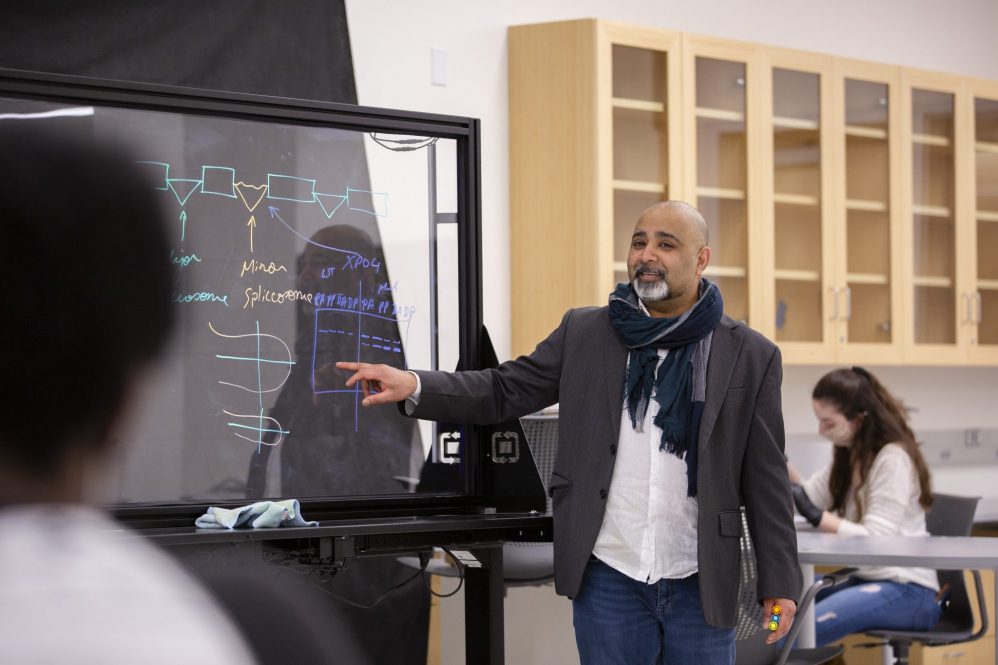
Rahul Kanadia, an associate professor in the Physiology and Neurobiology (PNB) department, demonstrates a prime example of taking a seemingly simple scientific concept and turning it into a research focus, not only for himself, but for his graduate and undergraduate students. His research program for undergraduates, Learning by Experiencing and Applying Principles (LEAP), revolves around this idea.
Taking a LEAP
The LEAP program takes a fundamental concept of genetics and breaks it down for first- and second-year students over the course of three semesters. With a combination of theory, research paper writing, and benchwork, the LEAP program provides a stepping stone for early undergraduate students to experience research in a low-pressure environment.
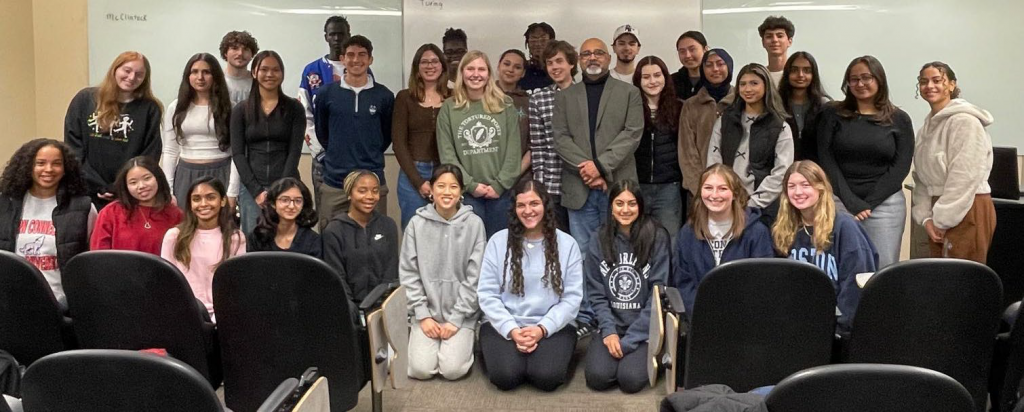
As a former LEAP student myself, I remember coming into my first lecture and being asked the question, “What is a gene?” Naturally, I brushed it off because this was something I learned in middle school – how could we not know this by now? Yet, a simple concept that could take five minutes to explain somehow turned into a two-day lecture and the basis for the entire program. After hours of pulling apart the original definition of a gene that we had been taught, we came up with a completely different answer to the question. As an aspiring scientist, that was the first lesson I learned from Kanadia: always question what’s in front of you.
When Kanadia himself was an undergraduate student at Bethune-Cookman University in Florida, he was faced with a predicament in which he was asked to isolate ribosomal genes from spinach.
“At the beginning of class, my professor dropped off two big boxes and said ‘Here is the kit, figure it out,’ and then he walked away,” says Kanadia. The structure of the class was confusing in the sense that it provided complete freedom and no instruction. Kanadia found this freedom exciting. That is essentially how research works, he says.
Not everyone shared his love for the process: “There were twelve students in the class,” says Kanadia. “Just before midterms, the class was six people.”
After multiple failed attempts, they were finally able to successfully isolate ribosomal genes from spinach from scratch. “The thrill is something you just cannot replicate,” Kanadia says.
The benefit of having no protocol or instruction is that scientists learn to pull apart basic concepts and apply them to real research experiments themselves. This experience is what spurred Kanadia into the field of research and was a deciding factor for his journey into graduate school.
His time in graduate school introduced him to RNA biology.
“One of my professors for the semester core courses gave the most amazing lecture on RNA processing,” says Kanadia.
This realization encouraged him to pursue a position in Maurice S. Swanson’s lab at the University of Florida to study myotonic dystrophy (MD): a class of conditions caused by a genetic mutation that lead to muscle weakness, degeneration, and a lack of proper mRNAs that encode various protein products from the same gene. The genetic mutation occurs at the RNA processing level and causes a gene called Muscleblind to lose function.
Kanadia created a mouse knockout (where a specific gene for that particular mouse is inactivated) for the Muscleblind gene, which caused the mouse to develop symptoms observed in patients diagnosed with myotonic dystrophy. With this finding, he was able to support the role of Muscleblind in the pathology of myotonic dystrophy.
Finding the root cause of the disease gave him the opportunity to also find the solution by overexpressing the Muscleblind gene and reversing its loss of function. This breakthrough positively impacts not only the research field, but also in clinical practice. Eventually, Kanadia was able to patent his research and aid in the therapeutic aspect of this disease.
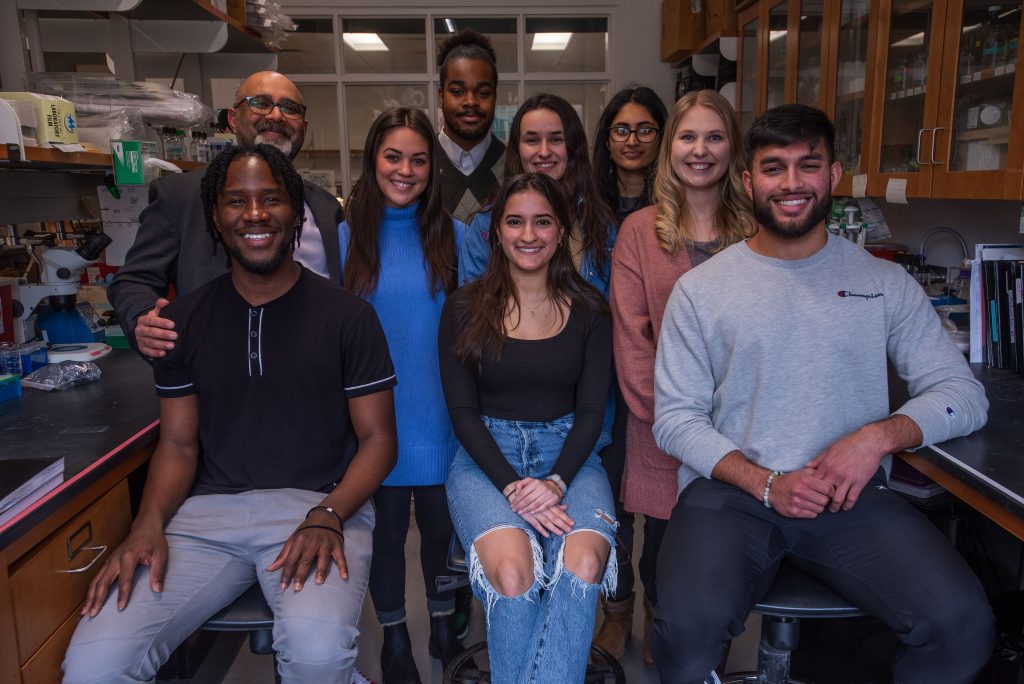
The Kanadia Lab
When it came to running his own lab at UConn, Kanadia recalled one of his favorite lectures on RNA biology and remembered a key concept: minor introns. In order for a gene to be expressed, first, it must be transcribed into an intermediate sequence called messenger RNA (mRNA). This mRNA strand can later be translated into a fully functional unit (e.g. a protein). However, during the process of transcription, where the DNA is transcribed into RNA, the mRNA strand includes sequences of both exons and introns. Exons are the strands of the sequence that are kept even after RNA processing and later translated into the fully functioning unit, while introns are removed during RNA processing in a process called splicing, conducted by a particular machinery within the cell called the spliceosome.
Minor introns are a class of introns that make up less than 0.5% of all the introns in the body and utilize a completely different machinery for splicing called the minor spliceosome. (The rest of the introns are broadly classified as major introns.) Kanadia’s simple question was, “So for 1.8 billion years, we have kept separate machinery for minor introns, but we don’t know why?” This question opened up an entire branch of genetics yet to be uncovered.
Once the foundational purpose of the lab was established, pieces started to fit together.
“It was a very organic process.” Kanadia says. The lab began its 15-year journey by creating its first knockout mouse that stopped the expression of the minor spliceosome. From there, Kanadia’s graduate students were able to independently explore their areas of interest in relevance to the theme and build from there.
Currently, the Kanadia lab explores the function of minor introns in the developing cortex in mice, limb development, cancer, primordial dwarfism and many more. From asking the question, “What is a gene?,” Kanadia was able to introduce his undergraduate students in LEAP to 15 years’ worth of critical research and an entirely new realm of genetics. This same question is also what continues to drive graduate research in Kanadia’s lab to this day.
Minor introns may represent a small part of our genome, but their persistence for 1.8 billion years proves they are anything but insignificant. By observing such a small detail, Kanadia reminds us that science and research do not move forward by memorizing definitions, but by questioning them.