Natalie Tocco ’23 MA (CAHNR) grew up around animals. She had cats as companion pets, and her dad and uncle kept cows, horses, and chickens on a small farm in Rhode Island.
Tocco’s love of animals solidified when she read James Herriot’s “All Creatures Great and Small,” a book series that focuses on the adventures of an English veterinarian.
“That’s where the love of animals developed into wanting to pursue veterinary medicine,” Tocco says.
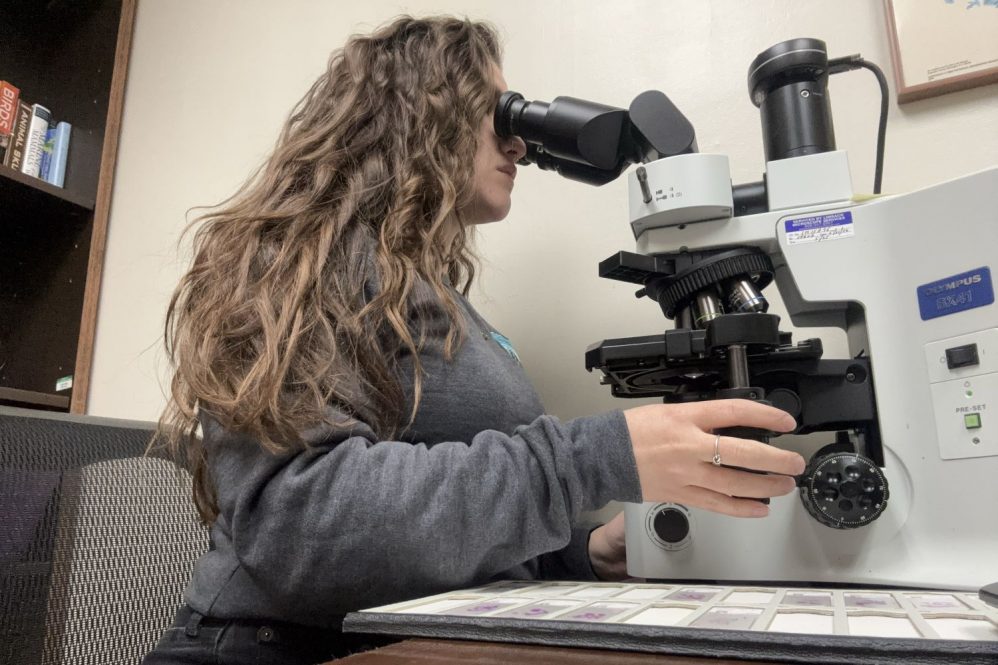
Now, as a veterinary pathologist, Tocco has had the opportunity to study creatures great and small herself – from black bears, to beluga whales, to elephants, and invertebrates.
Tocco received her bachelor of science degree in animal science from the University of Vermont and went to the Atlantic Veterinary College of University of Prince Edward Island for her doctorate of veterinary medicine.
During vet school, Tocco, who had planned to become a farm veterinarian, discovered the field of veterinary pathology.
“The whole reason I wanted to be a farm vet was actually because of population health, global health, and one health,” Tocco says. “I started making a shift into pathology because I found that those core principles that I went to school for were very much aligned with pathology.”
Tocco came to UConn in 2020 after completion of her DVM to complete the veterinary anatomic pathology residency program and master’s degree offered through the Department of Pathobiology and Veterinary Science. While UConn does not have a vet school, it is home to the Connecticut Veterinary Medical Diagnostic Laboratory (CVMDL), which can provide unique training opportunities for undergraduate and graduate students.
One of the main advantages of the CVMDL’s residency program is that the lab sees all kinds of species come through, including pets, wildlife, farm animals, and even animals from Mystic Aquarium.
“UConn’s lab gets so many different things,” Tocco says. “It was a very intense program. But in that intensity, I learned a lot because of how much we saw.”
During her time at CVMDL, Tocco was a self-described “black-bear magnet.” She discovered a group of black bears in the state all suffering from a genetic neurological condition. Tocco has submitted these findings for publication in a peer-reviewed journal and is currently working on a case report in a wild geriatric black bear with an undocumented cancer presentation.
Tocco coauthored two papers alongside her CVMDL colleagues identifying the genetic makeup of strains of West Nile virus detected in an alpaca and a crow and the molecular epidemiology of West Nile virus in raptors. With these cases, she helped reinvigorate West Nile Virus research within the department. She was also involved in the identification of the first case of COVID-19 in a dog in Connecticut.
After completing her residency, Tocco worked as a veterinary epidemiology fellow at the Smithsonian’s National Zoo. There, Tocco worked on cases of wildlife from the surrounding area that made their way into the park. She also worked on necropsies for animals that were actual residents of the zoo including elephants, a cheetah, and red panda while maintaining mortality data from the collection.
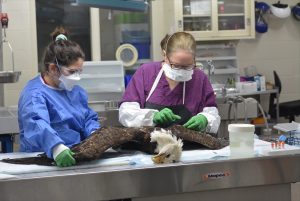
Performing necropsies on zoo animals provides a wealth of scientific information that can help members of the species in captivity and in the wild. Knowing, for example, what kinds of diseases an animal is susceptible to, is extremely valuable, especially for animals that are difficult to study in the wild. She is currently a coauthor on papers that are in progress including species like new world porcupines, Komodo dragons, and their close relatives.
“So much of the data that is acquired on these species is from the pathology of when they pass,” Tocco says. “What we learn from them in a captive setting will better help us take care of the animals within our care as well as seeing if that translates to their wild counterparts.”
Tocco is now working as a wildlife pathology fellow at the U.S. Geological Survey National Wildlife Center in conjunction with University of Wisconsin-Madison School of Veterinary Medicine. She describes the former as “the CDC of wildlife,” referring to the federal Centers for Disease Control and Prevention. The center studies and monitors diseases and mass mortality events in North American wildlife such as avian influenza in birds and mammals, white nose syndrome in bats, plague in prairie dogs, and chronic wasting disease in deer.
Studying diseases in animals is critical for human health as well, given that many diseases can transfer between species.
“If anything’s going to happen to any creature, it’s usually going to happen to wildlife first,” Tocco says. “It’s more so getting ahead of situation before it comes to us, or at least learning how we can better help so that we are not grossly affecting these creatures.”
Tocco says one of the elements she has enjoyed most her positions is the opportunity to contribute to science through collaboration.
“Every day is different, and it’s just the opportunity to just continually learn and be involved with a lot of science,” Tocco says. “Once you get the zoo and wildlife side, it becomes very science-heavy and becomes a lot more of a collaborative effort than, I think, standard clinical practice is.”
Across all of Tocco’s work, her focus on population health has remained steady.
“It all comes down to population health,” Tocco says. “You are thinking a bit about the one individual, especially for longer-lived species. But all in all, that data is still translated to what can help with the population as a whole.”
This work relates to CAHNR’s Strategic Vision area focused on Enhancing Health and Well-Being Locally, Nationally, and Globally.
Follow UConn CAHNR on social media