Associate Professor Gregory Sartor, has been named as the School of Pharmacy and Pharmaceutical Sciences Faculty Research Advising award recipient for 2026.
Sartor received his B.S. and B.A. in Biology and Psychology at the University of Mississippi in 2005 and later earned his Ph.D. in Neuroscience at the Medical University of South Carolina in 2011.
Sartor started teaching at the University of Connecticut as an assistant professor in 2018, following his postdoctoral research with the University of Miami Miller School of Medicine. He was then promoted to associate professor in 2025 with tenure along with taking on the director position for the Center for Addiction Science and Innovation.
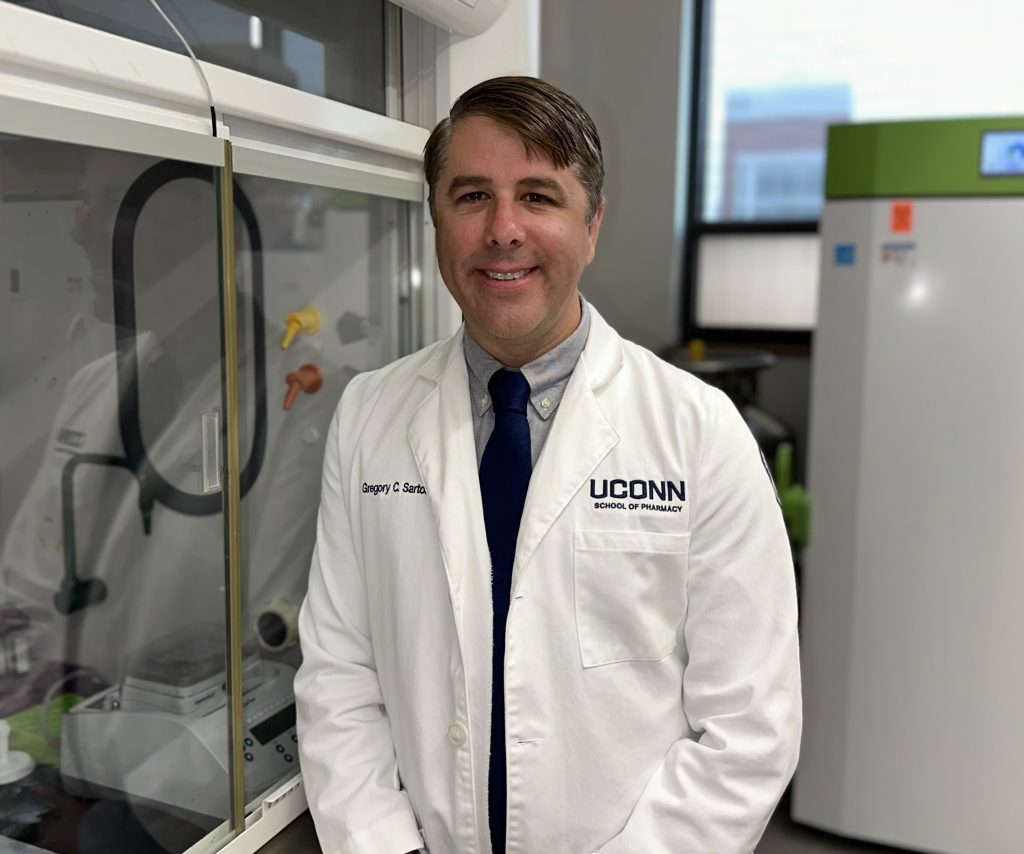
Along with teaching, Sartor has led a research lab and has mentored students as a research advisor for many years at UConn.
Sartor’s advising philosophy trains students to be two things:
“The goal of training students isn’t just to make them productive researchers, it’s also about helping them become thoughtful and independent problem-solvers,” Sartor said.
Sartor also said that when students are in his research labs, they learn a couple of key attributes.
“They receive training in scientific writing, presenting their work and communicating effectively,” Sartor said. “Just as important, they gain experience working with others which is essential both in the lab and in any professional setting.”
Students in the Sartor lab also gain experience in mentoring and training the next generation of researchers that come into the lab.
There have been a few student-led projects over the past couple of years that have captured what the Faculty Research Advising award recognizes.
The first was by a 2022 graduate, Suzannah De Almeida. She was interested in studying opioid addiction, but Sartor’s work was more focused on psychostimulants like cocaine.
Even though her interest did not perfectly align with the lab’s main focus, Sartor decided to give her project idea a chance.
“It was a good example of how students, even at the undergraduate level, can shift the lab’s focus,” Sartor said. “Usually, you think that research ideas come from the advisor, but good ideas also come from students and it is really rewarding to see their project come together.”
Sartor added that through De Almeida’s opioid research, 2023 graduate Caryssa Drinkuth, became interested in testing new treatments for opioid addiction.
“Drinkuth asked me if she could test new therapeutics in these opioid addiction models,” Sartor said. “She identified a new therapeutic that was effective at reducing opioid withdrawal and seeking behaviors in preclinical models.”
Sartor added that both projects resulted in peer-reviewed publications and several related studies are now being conducted by current undergraduate and graduate students.
One thing Sartor does to be an effective research advisor is to get students out of their comfort zone.
“A lot of students don’t realize how much potential they have, so you have to push them to try new things,” Sartor said. “Sometimes it works out and sometimes it doesn’t, but either way it’s a learning experience and they grow from it.”
Many students in the Sartor lab have received awards and scholarships like the American Foundation for Pharmaceutical Education (AFPE) Gateway Award, the National Research Service Award (NRSA), McNair Scholarship, Nieforth Research Award, School of Pharmacy and Pharmaceutical Sciences Honors Research Scholarship, Institute for the Brain and Cognitive Sciences (IBACS) fellowship, Summer Undergraduate Research Fund (SURF) award, American Society for Pharmacology and Experimental Therapeutics (ASPET) poster and travel awards, Maximizing Access to Research Careers (MARC) scholarship and other internal awards.
Sartor has also recently taken up a new position as the Director for the new Center for Addiction Science and Innovation (CASI).
CASI is a new research center that brings together a number of fields on campus like neuroscience, pharmacology, medicinal chemistry, engineering and clinical practice to help develop new therapeutics specifically designed for different symptoms of substance use disorders.
To learn more about CASI, visit the CASI website.
Sartor will receive the 2026 Faculty Research Advising Award during commencement weekend in May.