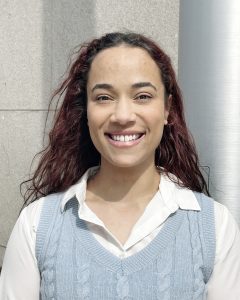
After graduating from Springfield College with a degree in psychology and a minor in biology, Bridget Foley-Johnson spent three years supporting adults with substance use disorders and other mental health challenges at Hartford HealthCare.
“I set out to help individuals,” she said. “But I also got a look at the policy side of medicine and how decisions made behind the scenes affect clinicians, patients, and entire systems.”
This experience, along with a desire to “make a difference at a population level,” led her to explore advanced degrees. UConn, she discovered, provided the perfect blend of courses between the School of Social Work and School of Public Policy.
“[UConn] felt like a strategic place to be if you want to work in public service,” she said. “I could see how intertwined the two fields are and it made sense to study them together, especially with the internship opportunities and the range of career paths it opens up.”
Now, Foley-Johnson is pursuing both a Master of Social Work (MSW) and a Master of Public Administration (MPA) through UConn’s School of Social Work and School of Public Policy.
Separately, each program requires two years of study but pursuing them jointly allows students to complete requirements for both degrees in three years instead of four.
“The public policy program highlights the processes of working in government, public service, and how to impact legal systems to change communities, whereas the social work program deepens my understanding of social constructs, the way systems; institutional and otherwise impact individuals, their lives, and the choices they make,” she says.
Typically, students in this joint degree program start with a majority of public policy classes in their first year, switch to a majority of social work classes in their second year, and then complete a combination of coursework in the third year, explains Catherine Guarino, director of academic affairs and director of undergraduate programs for the School of Public Policy, and Carlton Jones, director of the School of Social Work’s Office of Student and Academic Services.
Foley-Johnson hit the ground running by taking Analysis of Social Welfare Policy for a deeper understanding of the history of social work in the U.S., while Public Finance and Budgeting and Introduction to Public Policy have strengthened her analytical and writing skills. And, through the School of Public Policy’s Internship and Professional Practice Program (IPP), Foley-Johnson is gaining hands-on experience with the Connecticut Department of Developmental Services, where she works on employment and day services, supportive housing, and technology initiatives for adults with intellectual disabilities.
“This internship has really connected both social work and policy for me. I’ve seen the importance of having a ‘seat at the table’ to impact decisions,” Foley-Johnson says.
In her first two semesters at UConn, she’s already found herself in rooms with Connecticut Governor Ned Lamont, state commissioners, agency leaders, and other policymakers shaping Connecticut’s future. She also attended the Campaign School for Social Workers in February, where she met multiple social workers from different states with different political views.
“I found it delightful to be able to pick their minds about their local political environments, how it impacts them as social workers, and how it may impact their choices in career fields,” she recalls.
Next year, Foley-Johnson is hoping to begin a social work practicum placement in a housing agency with the state of federal government.
Any impact we make in that space affects everyone. That’s what motivates me, knowing I can contribute in a way that benefits my community and beyond. —MSW, MPA student Bridget Foley-Johnson
“The skills I’ve learned in my social work program have been easily transferred into my policy practice skills,” she says. “I remember in one of the first public policy classes about the theory of management, a peer of mine questioned how people could practice interview skills. Social Work programs give you that opportunity, to practice having hard uncomfortable conversations; conversations that may be controversial. Hard conversations are the most important part of changing policy.”
Foley-Johnson expects to graduate with both degrees in May of 2027. After, she hopes to build a career in state or local government, focusing on preventative healthcare and harm reduction, particularly for adolescents facing mental health and substance use challenges. She’s also considering a career as a policy analyst, program coordinator, project manager, state representative, nonprofit leader, political advocate, lobbyist, human resource management, legislative aide, government relations specialist, or research analyst.
“With these degrees, these are all possible career paths, with the shared emphasis on service roles,” she says. “Any impact we make in that space affects everyone. That’s what motivates me, knowing I can contribute in a way that benefits my community and beyond.”