Every UConn student has a unique story, but not every student gets a chance to perform that story.
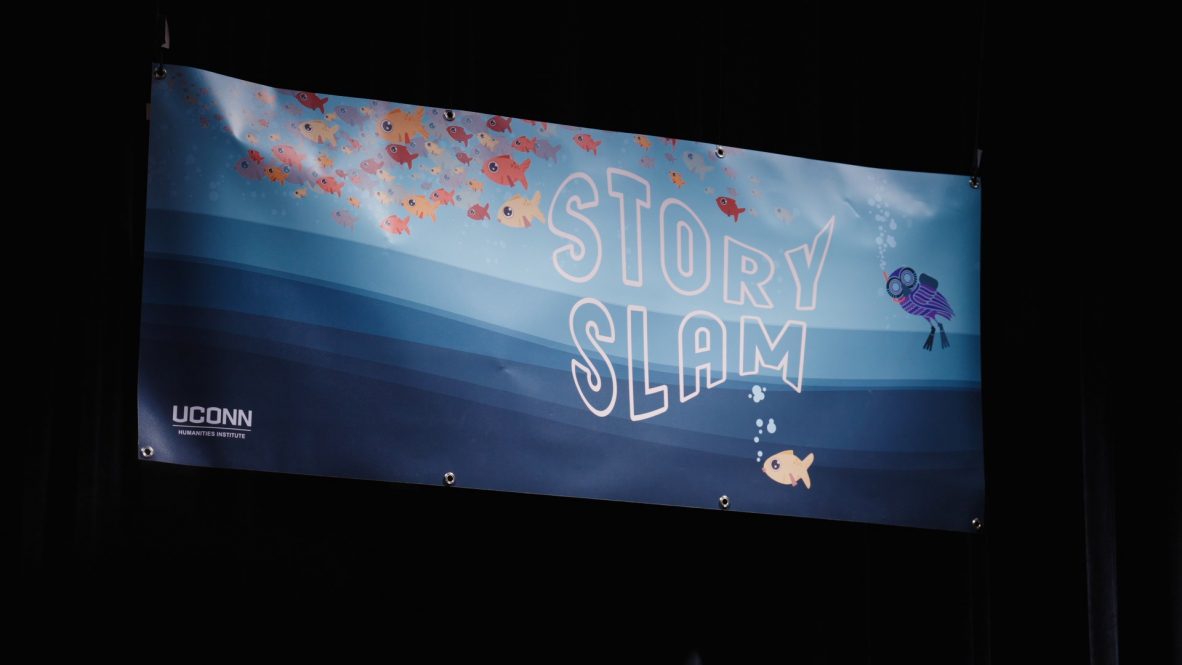
The UConn Story Slam, held on April 14 at the Black Box Theatre in the Ballard Institute and Museum of Puppetry, offered six students to perform nonfiction personal stories in front of an audience.
This event, hosted by the UConn Humanities Institute for the second time, featured performances by their 2026 UCHI Student Ambassadors.
“These narratives crafted by UConn students exemplify how the work of creating, listening to and interpreting stories don’t just help us understand each other better, but help us understand ourselves and how we might navigate the challenges of living in our current moment,” says Anna Mae Duane, the director of the UConn Humanities Institute.
From diaries to condiment statues, these student storytellers weaved the intricacies of their personal lives into captivating and real performances.
Sugita Mahendarkar ’27 (CLAS) opened the performance with her story that took audience members on a journey of her life through her diary.
Starting from an early entry from the first grade, Mahendarkar vulnerably shared snippets from her journal that shaped the young woman she has grown into today.
“As I flip through the literal pages of my life, I can trace the lineage of who I’ve been. Messages and doodles that capture a collection of moments, but whose meanings continue to grow with me,” says Mahendarkar, who opened up about culture, finding herself and growing into her identity through revisiting and reviving her journaling.
Jenna Ulizio ’26 (CLAS) followed with the story, “Shipcake,” right after PJ Bukkali ’27 (CLAS) and the story “Size Me Up.”
Ulizio and Bukkali shared personal familial stories with the audience, each bringing a unique sense of humor and perspective to the stage.
The final three storytellers, Tomas Hinckley ’27 (CLAS), Nicole Young ’26 (CLAS) and Rebecca “Rebe” Wahl ’29 (BUS) took the stage with stories focused on activism, speaking up, and identity.
In Young’s performance of her story “Beyond the Edges,” she led the audience through pivotal moments in her high school career that forced her to reflect on conformity, fitting into the “normal” path and representing identity.
“I’m tired of asking to squeeze into someone else’s frame, their perfectly curated image of me. Not because I didn’t belong, but because I feel most seen just beyond where the frames can’t reach,” says Young, as she closed her story.
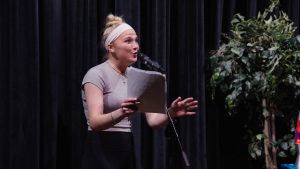
The last performance was Wahl’s story, titled “One Mississippi,” in which she shares her truest, bubbly personality with the audience, while also letting them in on her personal struggles.
“That means I spend so much time thinking, like literally sitting in silence. Yeah, actual silence. I promise I could do that. And just thinking about the things that I want to do, and the projects that I want to make, and the events that I want to go to, and what I wish I had,” says Wahl, who delivered a chatty and energetic performance while touching upon a breadth of emotions. “I’m terrified that so much of this time is gonna be sucked up with the thinking part, and there’s gonna be no none of my life left for the actual doing part. I’m terrified that I won’t be seen.”
Across the six stories told in the theater, the audience was met with thought provoking and reflective stories about identity, growth and the vulnerabilities of life.
The UCHI Student Ambassadors spent their semester working with Jon Adler and Gillian Epstein, who founded The Story Lab at Olin College in Massachusetts, to write nonfiction personal stories and turn them into performances.
“Storytelling is a deeply human, natural thing. Scholars from a huge variety of disciplines, it all sort of converged on the idea that storytelling is this human adaptation. It is embedded in who we are and what we do,” says Epstein, an associate professor of English at Olin College. “Yet, we are born without words, let alone stories. So, this is something we all need to learn to do, and we learn that by hearing and receiving stories of other people.”
The process culminated in the Story Slam, which was attended by an audience of students, faculty, and community members.
“What’s amazing about stories is they take something so internal, and seemingly just sort of contain within an individual. They put it out there in the world, and so weirdly and strangely, no matter what it is and what they’re saying, you’ll find a way in. You’ll find a way to connect,” says Epstein.
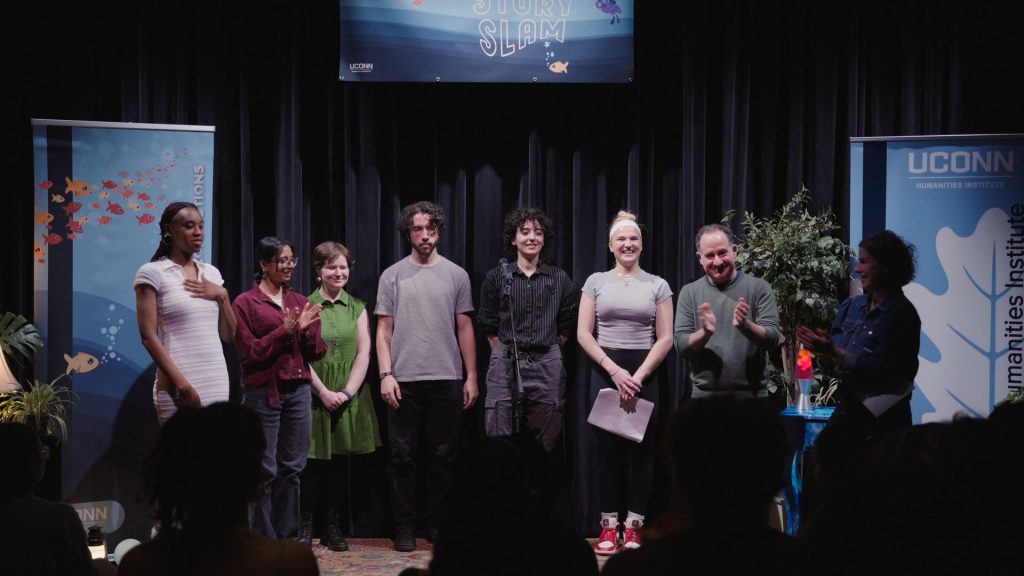
The Story Slam is a key component in the UCHI’s Connections/Disconnections Initiative, which aims to explore and address loneliness, connection and disconnection at UConn and beyond through events and community partnerships. This partnership with The Story Lab fosters the goals of this UCHI initiative by allowing students to share their individual perspectives and experiences on finding connection.
In their introductory marks, Adler and Epstein invited the audience to fully engage with and be moved by these stories.
“Stories help us understand the values that connect us, and they really help us attend the parts of our communities that might otherwise be silent and in the background. And in doing this work, we think quite deeply about the work that it does for our storytellers as individuals. But then the work that it does for the broader community of people who are here to receive these stories and go on to share their experience of hearing them,” says Epstein.