A few years after receiving the National Science Foundation Early CAREER Award, UConn College of Engineering Assistant Professor Hongyi Xu is demonstrating how embracing uncertainty can lead to stronger, smarter engineering systems.
Xu’s research focuses on a simple, but challenging, fact, which is that not everything in engineering is perfectly uniform. Many real-world materials contain a mix of order and randomness, a concept known as stochasticity. Rather than designing around that uncertainty, Xu has developed new computational tools that allow engineers to use it intentionally, and combine it seamlessly with ordered materials.
“Traditional engineering tries to eliminate randomness as much as possible,” says Xu, who is the project’s PI and a professor within the School of Mechanical, Aerospace, and Manufacturing Engineering. “Our work asks a different question: what if we can design with it? What if controlled randomness actually leads to better performance?”
At the core of the project is a novel computational framework that bridges predictable structures with stochastic ones, enabling engineers to create materials and systems with tailored properties. Using advanced generative artificial intelligence techniques, Xu and his team built a unified “design space” that allows them and future researchers to explore putting together both fully ordered and partially random configurations, something that was previously difficult to achieve.
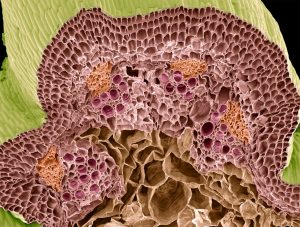
Xu’s research also takes inspiration from natural materials, which often have randomized but sturdy architectures, like the cells of tree leaves, the wings of dragonflies, or the gills of a mushroom.
The implications span a wide range of industries. Xu points to applications in batteries and energy storage, where optimizing material structure can improve battery performance, as well as in automotive design, where lightweight yet durable materials are critical.
“These tools give us a new level of control,” Xu says. “We can design systems that are not only high-performing, but also more robust and reliable under real-world uncertainty.”
That real-world relevance has driven collaborations beyond the lab, including partnerships with leaders such as Ford Motor Company and the U.S. Army. The research also connects to broader systems like power grids and transportation networks, where managing variability is key to long-term resilience.
Xu is currently in the fourth year of this five-year project, and the findings and collaborations have already been lucrative.
Since the 2022 NSF CAREER grant was awarded, the project has generated significant scholarly output, including 16 journal papers, four full-length refereed conference papers, and seven invited seminar/keynote talks.
Xu’s work has been published in journals with high impact factors (IF) like Advanced Energy Materials (IF: 26), Energy & Environmental Science (IF: 31), Journal of Manufacturing Systems (IF: 14.2), Reliability Engineering & System Safety (IF: 11), and Small (IF: 12.1), among others.
But for Xu, the most meaningful outcomes extend beyond publications.
Students involved in the research have earned national recognition, including multiple honors from the American Society of Mechanical Engineers, alongside strong career placements in academia and industry.
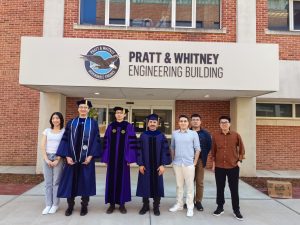
Zihan Wang received the prestigious ASME Design Automation Dissertation Award and first place in the ASME CIE Hackathon, and is now a postdoctoral researcher at Northwestern University. Leidong Xu, also a CIE Hackathon winner and recognized for research presentations and publications, will join Ford. Majid Kheybari earned distinction as an editor’s pick in AIP Advances and has begun his academic career as an assistant professor at Saint Mary’s University of Minnesota.
Current doctoral students continue to build on that momentum: Kiarash Naghavi Khanghah has earned both a best paper award and a hackathon win through ASME, while Zhengkun Feng has received competitive fellowships supporting his research. At the master’s level, Filip Penda is now an engineer at Newport News Shipbuilding, and William Hobson-Rhoades is pursuing a doctorate at University of Michigan.
Together, these outcomes reflect the project’s strong emphasis on student development and its impact in preparing engineering leaders.
Future research might involve more connections to cognitive science.
Xu has also emphasized connecting research to the broader community. Through outreach efforts, the project has introduced K–12 students and teachers to hands-on STEAM learning, while also sharing new design tools with small businesses and manufacturers across Connecticut.
“By working with educators and industry partners, we can help translate these ideas into real economic and societal impact,” Xu says.
As engineering systems grow more complex, Xu believes that embracing (not avoiding) uncertainty will be essential.
“Stochasticity is everywhere,” he says. “The challenge is learning how to work with it in a systematic way. This project shows that when we do, we can unlock entirely new possibilities for materials design.”
The research conducted by Xu and his team was made possible through the NSF Division of Civil, Mechanical, and Manufacturing Innovation, through the Engineering Design and Systems Engineering program.