The “Food Systems” weekend alternative break with Community Outreach under Student Activities took place from April 17 to April 19, where students immersed themselves in the entire food system — from crop production to distribution. Four pre-program meetings were held to educate participants about what food insecurity is as a whole and how it affects community members in New Haven specifically.
A group of UConn students and a staff member spent their weekend during an alternative break experience where they lived together in community in a church. Cooking together, gardening, and distributing food items to New Haven residents were some of the highlights for the UConn volunteers committed to service.
Coming from a community that needed assistance, Isha Gandhi ’26 (CLAS) served as the student program director for the weekend-long service trip, recruiting volunteers, planning the program, and implementing direct service. Gandhi wanted to pay it forward, providing the same support to the communities outside of her own.
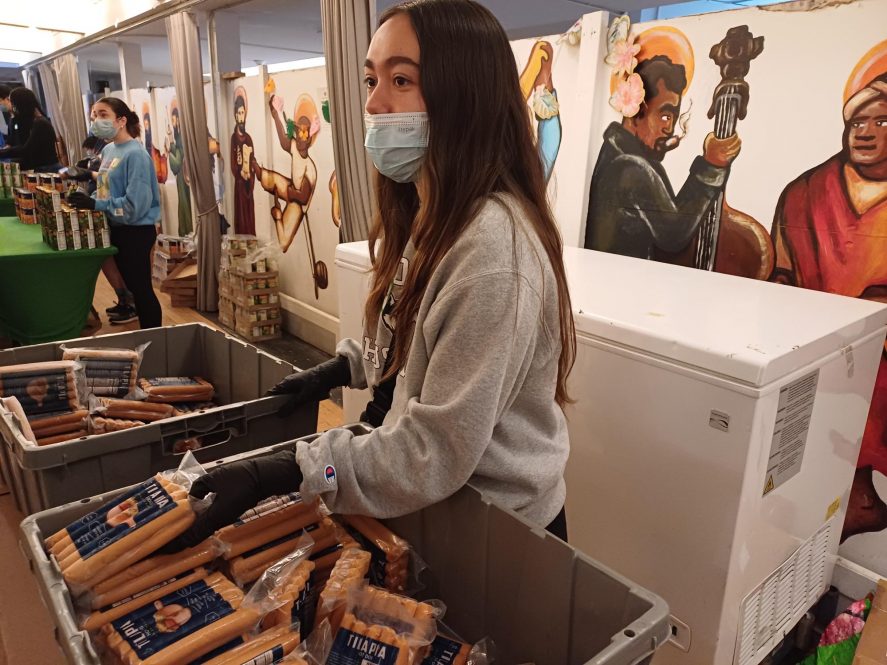
The first full day of service was at Loaves and Fishes, a nonprofit in New Haven that distributes food and clothing to those experiencing financial — such as housing and food— insecurity.
Assigned at different stations, participants began their service-learning experience. Students either helped with clothing distribution, food distribution, or directed traffic. Participants led with intention as they engaged in service to support community members.

Gandhi appreciated seeing additional organizations such as the Yale School of Medicine volunteer with Loaves and Fishes. “We were all there for one purpose, which was to give back to the community and dedicate some time to hopefully promote public health, nutritional access, and clothing access,” she says. “I think that was a really pleasant surprise. I wasn’t expecting to see, but it really meant a lot getting to see different people in different organizations come together for this one volunteering event.”
Mariana Lopez-Quiles’29 (CAHNR) signed up to better understand individuals’ access to nutritious foods, learn what “food deserts” are, and observe how community partners work to address disparities in access to nutritious food. She enjoyed working at Loaves and Fishes and seeing the impact her simple act of service had on New Haven residents.
After reflecting on her experience, Lopez-Quiles says that what shocked her the most was the extent of need New Haven residents have, witnessing the wealth discrepancy between Yale University students and those living in surrounding neighborhoods.
“I definitely want to keep volunteering and keep learning about food insecurity,” Lopez-Quiles says.
After completing service at Loaves and Fishes, the next stop was gardening with Neighborhood Housing Services, a nonprofit with the mission to make affordable housing more accessible. With high lead levels in the soil posing a serious health risk for children and residents, hügelkultur mounds were built as a risk-mitigating strategy. Participants collected fresh soil, wood chips, branches, and leaves, and layered them on top of each other to reduce direct contact with potentially contaminated soil and promote sustainable crop cultivation. While participants were digging, wheelbarrowing, and layering organic material on top of each other, other volunteers worked in the greenhouse to plant seeds.
Students found the experience educational as they learned about food systems. Before concluding their service at each site and returning to the church, students and staff asked both nonprofits questions to learn more about their work and the importance of the tasks they were assigned.
As Gandhi puts it, “The food system begins with planting that seed, preparing the soil beds, and preparing these hügelkultur mounds. Getting to engage in that and see the opposite end where we were distributing food to community members, both played into the overarching theme of what a food system is.”
An important component of the alternative break program is reflection. Daily reflections during alternative breaks help participants unpack their service engagement and think about what lessons they can carry forward into their everyday lives that would make an impact on their local communities as well.
Alternative Breaks are service-learning experiences hosted by Community Outreach under Student Activities. Alternative Breaks are designed to increase participants’ awareness of social issues, grow as individuals, and prepare them to be lifelong community collaborators. The program provides students with the opportunities to meet new people, learn new things, and live simply in a community off campus.
Service trips range from week-long sessions during winter and spring break, and weekend-long volunteering sessions. Alternative Breaks completed 11 trips, and more than 140 students and staff participated during the 2025-2026 academic year.