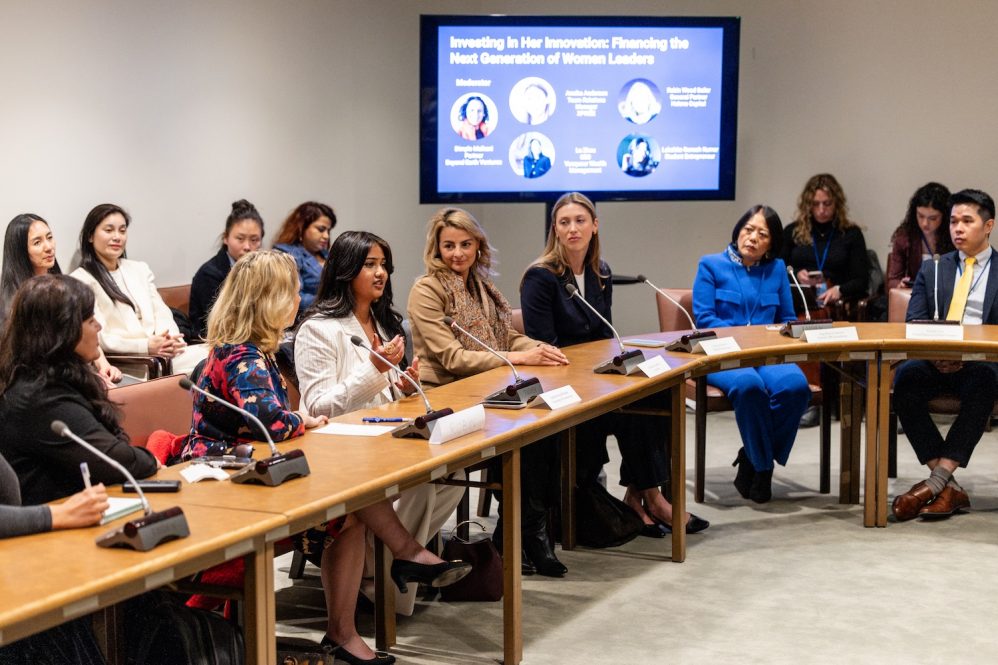
Three years ago, when she came to UConn, Lakshita Ganesh Kumar ‘27 (ENG & CLAS) would never have dreamed she’d be speaking at the United Nations (UN). Now a junior, Lakshita found herself as the youngest panelist during the UN’s Igniting Women’s Innovation event hosted by Principles for Responsible Management Education (PRME) as part of the Commission on the Status of Women.
As a signatory member of PRME, UConn is part of a global UN-supported network committed to preparing students to lead with ethical, sustainable, and socially responsible approaches to management. The relationship, maintained by the School of Business, provides students like Lakshita with the opportunity to engage in conversations on the future of responsible leadership.
Lakshita started her journey at UConn as a Computer Science and Engineering major, but quickly realized she wanted to do more after joining the UConn Werth Institute’s Werth Innovator Program in the first-year female cohort. Her participation in the program led to the addition of a Statistics major and Business Fundamentals minor and a heavy courseload, but it didn’t faze her. This mindset was shaped by her family’s values growing up, rooted in self-confidence.
“My parents always instilled that thought that women can do anything, so for me, I’ve always been a hard worker,” Lakshita says. “I’ve always been somebody who just goes for it and is confident in anything that I do, me being a woman has never been a barrier in my mind.”
This mentality supported her as a participant in the Werth Innovator Program. Designed for undergraduate students who are interested in entrepreneurship and innovation, the program provides opportunities for Werth Innovators to develop ideas and pairs them with expert mentors. Katie Britt, director of leadership development for the program and Lakshita’s cohort leader, supported her throughout the program and the founding of her business, Stylistic. She hadn’t come to UConn expecting to launch a business during her freshman year, but through the support and mentorship of the program, Lakshita felt empowered to take on the challenge.
Lakshita also highlighted the Connecticut Center for Entrepreneurship and Innovation (CCEI), where she participated in various programs that expanded her exposure to business, venture, and entrepreneurship. Through this programming, she was able to focus on execution and expand her knowledge.
Stylistic was founded originally as a mental-health-focused app. At the end of her senior year of high school, Lakshita had the idea to create an app that would help people love themselves and feel more confident. It wasn’t until she became a Werth Innovator that she started turning those thoughts into reality. Stylistic was designed to create a community where individuals authentically share their personal style and find inspiration. The app was the perfect opportunity for Lakshita to apply everything she learned in her courses and independently, blending STEM and business together.
Fast forward to junior year: Lakshita was planning a quiet spring break at home when she got the email from Katie Britt to speak at the UN panel focused on women’s innovation. The panel “Investing in Her Innovation: Financing the Next Generation of Women Leaders,” examined dismantling systemic barriers that limit women’s access to capital and leadership in entrepreneurship, and venture capital. Panelists discussed structural and mental obstacles, repeatedly emphasizing the importance of confidence and persistence.
“She kept repeating ‘Don’t be afraid to ask for money. Don’t be afraid to ask for what you need. Don’t be afraid to persist no matter how many times you get no for an answer,’” Lakshita recalls. “That really resonated with me because it’s not just about structural barriers existing, but it’s about pushing through those barriers and getting what you need.”
In her own discussion statements, Lakshita used herself as an example as a young woman currently pursuing entrepreneurship and business ventures to show that, “You can achieve a lot of different things if you just believe in yourself and you don’t doubt your abilities just because you’re a woman, there’s no need to doubt your abilities because of that.”

Lakshita’s comments during the panel also focused on changing university ecosystems to better bridge the gap between STEM and business students she’s noticed. In her STEM classes, she’s seen firsthand the innovative ideas students have, but many don’t come to fruition due to siloing between disciplines. She brought up the common tunnel-vision that STEM students experience where they’re caught up in the hustle of internship goals or major requirements and don’t seek out opportunities that exist if they don’t see a direct correlation. However, Lakshita emphasized that UConn has vast resources to support students with a desire to create and innovate such as the UConn Library Maker Studio, Innovation Zone Makerspace, and OPIM Innovate which are available to UConn students for cross-disciplinary creation and learning.
The final piece of advice that Lakshita wanted to share with students was to do as much as you can early on. She drew the connection from her freshman year participation in the Werth Innovator Program to the invitation to speak at the UN: “My mentor, Katie Britt, knew about my work ethic, my passions, and what I like to speak about, and she reached out to me… Just go out there and try to do as much as you can now because there’s no point in waiting for the right time because the time is never going to be ‘right’.”
For Lakshita, saying yes to opportunities early in her time at UConn led to a moment few undergraduates every experience: sharing her voice at the United Nations.