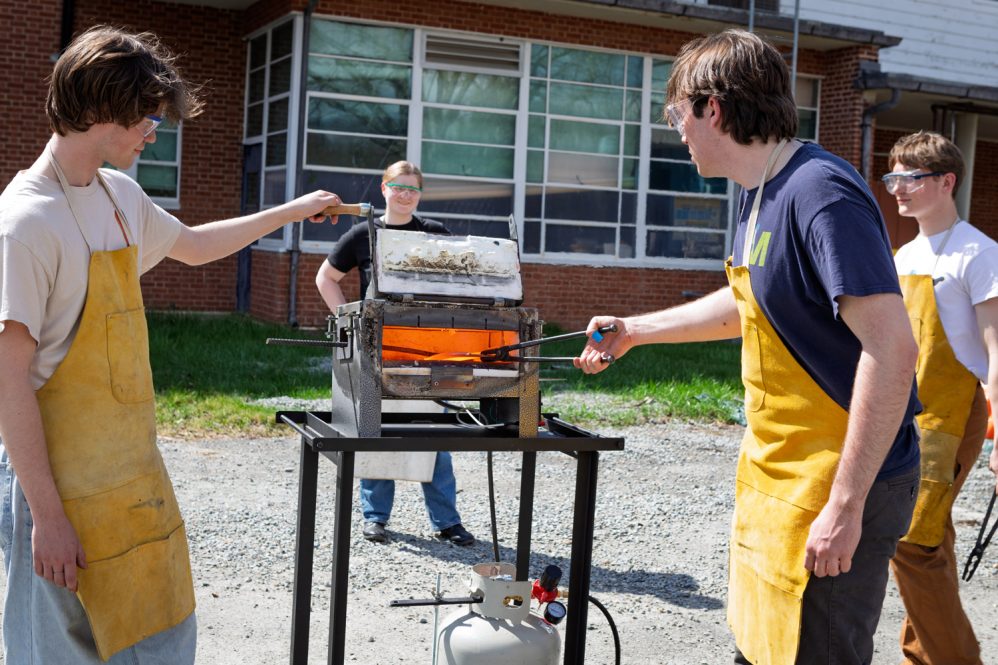
UConn’s Metalworking Club, an extension of the College of Engineering’s (CoE) materials science and engineering department, has been awarded a Forging Industry Educational and Research Foundation (FIERF) Forging Club grant. Funds from the grant will be used to purchase new equipment and to allow students to focus more on the forging aspect of metalworking.
Founded in 1961, FIERF is a national nonprofit that supports the Forging Industry Association, which is dedicated to promoting forging technology and education through working with students on research and development projects.
The Metalworking Club was launched seven years ago, says club president Samuel Crowley. The funds from the grant, he adds, will be used for purchasing protective gear and hardware used in forging, such as anvils, tongs, hammers, and other materials. As a requirement of the grant, the University also must participate in the annual FIERF Axe Challenge forging competition.
“We’re thrilled to have received this grant,” Crowley says. “It will allow us to expand the work we’re doing currently and try and regain momentum lost due to the social restrictions enforced during the COVID-19 pandemic.”
The UConn foundry was available to the Metalworking Club students until spring 2025. It includes an induction furnace, allowing students to create metal castings and a variety of other forge-related tasks. The foundry equipment is in storage as the CoE works on the development of new space, but the club continues to gather each week for forging activities at the designated club space near Longley on the UConn Depot Campus.
“We’ve been working with a small propane-fired forge, a single anvil and a few hammers under the guidance of Lesley Frame, an associate professor in the materials science and engineering department,” Crowley says. “We’re interested in both the practical and artistic opportunities of forging and its role in industries like manufacturing, aerospace, and construction.”
Crowley says he and fellow materials science students focus on material structure, processing, and property relationships. It’s important, he stresses, to understand how metal-forming processes fundamentally work in order to design a product with ideal mechanical properties and performance.
In the Metalworking Club, students are introduced to these core principles of metallurgical processing with a greater focus on the art of hand forging.
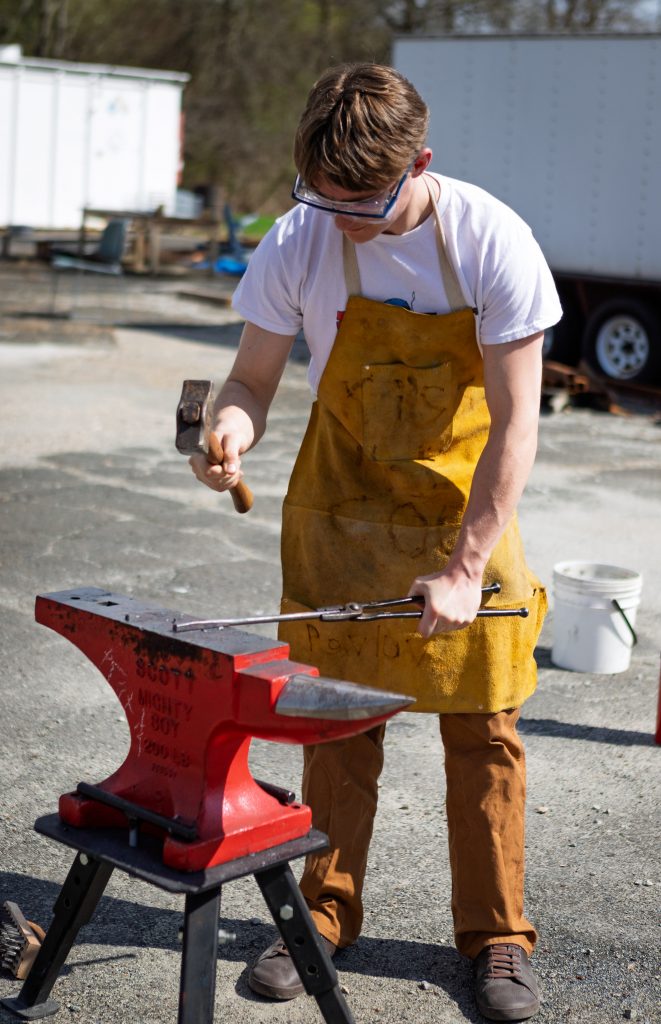
Working directly with materials gives students a much deeper understanding of materials processing.
Club members have visited working forges, including a historical blacksmith operating at Mystic Village in Mystic, Connecticut. The club is open to anyone, including those interested in artistic metalwork, structural design, architecture, and other fields.
“We’ll be eligible to apply for another FIERF grant in two years and hope to bring the foundry equipment back into use,” says Crowley. “This year, we’re designing and forging an American felling axe for the 2026 FIERF forging competition.”
The competition looks at aesthetics, performance, practices, and finished products.
“For us, the Metalworking Club is about leaving a legacy,” Crowley adds. “We want future students to have the opportunity to get hands-on experience in metals processing, and this grant helps us work toward that goal.”
More photos of the Metalworking Club can be viewed online.