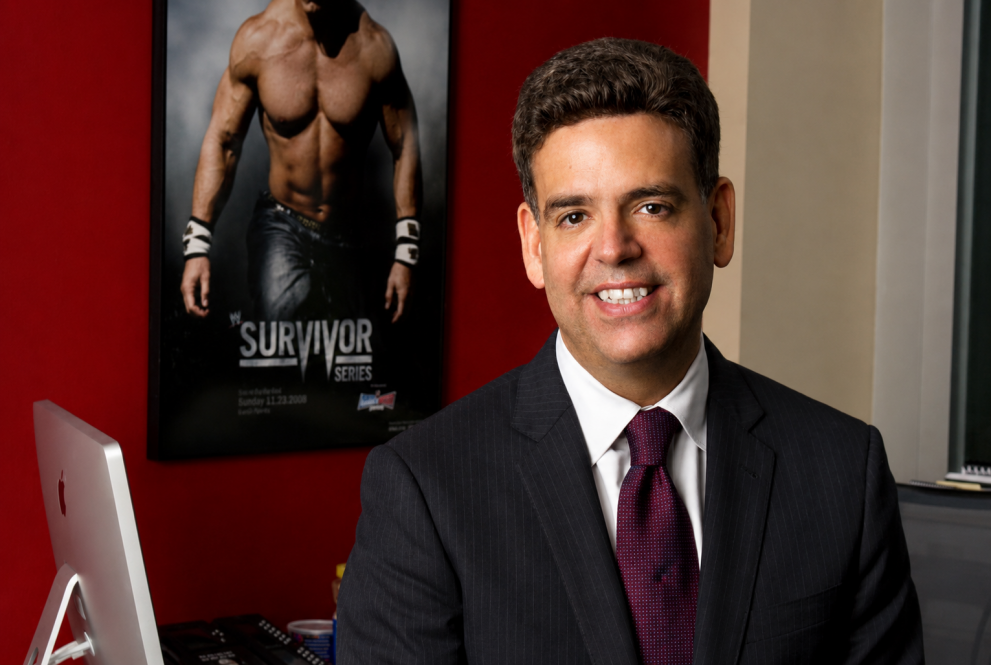
In one of the most harrowing descriptions in his new book, two-time alum George Aldo Barrios ’87 (CLAS) ’89 MBA, a transformative business strategist and former co-President of WWE, recounted a trip to Saudia Arabia to close an important deal to bring wrestling entertainment to the kingdom.
The company was in the home stretch of the deal when journalist Jamal Khashoggi was assassinated at the Saudi consulate in Istanbul, in October 2018. His death was believed to be at the behest of the Saudi Crown Prince. Everyone at WWE was nervous about moving forward.
Sensing that the important deal was going to collapse, Barrios agreed to go to Saudi Arabia. First, he had to sign a disclaimer acknowledging that drinking alcohol, showing public affection, or viewing pornography were infractions that were punishable by death.
“The car drove us straight to a compound that was something out of a movie,’’ he writes. “Roving guards were everywhere. They carried machine guns and wore bandoliers of ammunition …I have never been so uncomfortable before–or since.’’
They met with an official who seemed very angry and, through a translator, told Barrios and a WWE colleague that the wrestling empire was asking for too much in negotiations. The two men were ushered into a room to work out a deal, while guards with machine guns and long, black, tactical knives, kept entering the room.
“I remember thinking, ‘This cannot be happening. What the f*&k was I thinking coming here in the middle of the night?’’’ he writes.
The deal eventually was approved, and the WWE team was invited to a banquet. Afterward, Barrios, still shaken to the core, left the country on the first plane out at 4 a.m.
Barrios’ Advice: Always Believe in Yourself
During the time that Barrios worked at WWE, he helped grow the business from an $800 million wrestling company into a $9.3 billion, multi-platform, international sports and entertainment giant.
But much of what goes on behind closed doors never gets shared, and Barrios wanted to impart some of those lessons.
In his new book, titled “Sometimes Wrong But Never In Doubt: How a Cuban Kid from Queens Transformed WWE,’’ Barrios tells the story of his experiences — from his childhood in Queens, to his life-changing years at the University of Connecticut, to the skills and beliefs that gave him the courage to disrupt multiple industries.
“The book was a labor of love—and hate,’’ Barrios says, laughing. “It was five years in the works and the fact that it’s done is rewarding and a nice relief.’’
The book was originally intended as a how-to guide to business, but morphed into a deeper look into the factors that gave him the courage to excel, even in the most difficult times. He emphasizes the importance of bold but thoughtful decision-making, resilience, and reinvention.
“If you’re going to do hard things, have confidence you can do them. But you also have to do the hard work,’’ Barrios tells UConn Today. “I’ve always been able to bet on myself.’’
But that doesn’t mean it’s easy.
“It’s the loneliest feeling in the world to find yourself standing up when everybody else is sitting down,’’ he writes. “To have everybody look at you and say, ‘What’s the matter with him?’ I know what it feels like.’’
He says a great business leader must be knowledgeable, prepared, insightful, have the right temperament, possess tremendous courage, and believe in him or herself.
“I’m living proof that you can start with nothing in life. You can get punched in the face, ridiculed by the media, fired from a job you love. So what? Life sucks sometimes. That’s a fact,’’ he writes. “But if you’re willing to get back up each time, to punch back…if you’ve got good people around you—people you love and who love you back–if you keep moving forward always, then you are a hero…Bottom line, it’s all up to you.’’
UConn Gave Him All the Tools He Needed to Succeed
Barrios earned two degrees at UConn, a bachelor’s degree, with a major in economics, in 1987 and an MBA in finance two years later. He held several senior financial and general management roles at The New York Times Co., Praxair, and Time-Warner, before joining WWE in 2008.
“My first big job was at Time-Warner and all the other employees were Ivy League MBAs,’’ he says. “About six months in I came to realize that I know everything they know. I had all the tools I needed to succeed.’’
One day Barrios was collaborating with a friendly colleague who was a few years older and had earned an MBA at Wharton. The two had been assigned to run a P&L analysis.
“Let’s divvy up the workload,’’ the colleague said. “Which do you want to do? The P&L or the income statement?’’
Barrios responded: “The P&L is the income statement!’’ Any feelings of inadequacy vanished that day, he says.
Although he didn’t go to Harvard or play lacrosse at boarding school, Barrios says he had something better: “What I had instead were brains and an edge. I was grittier. Tougher. More real,’’ he writes.
UConn is also where Barrios met his wife, Carol ’88 (BUS) ’97 MBA, and many of his closest friends. He describes his wife as his rock. “Everyone should have a Carol in their life, a life partner who always has your back and provides you with beautiful, talented kids, unflinching assessments, the truth and a home!’’ he writes.
Cuban Family Provided ‘Role Models’ for Life
Barrios is the son of Cuban immigrants and grew up in a tiny apartment in “in the steel and concrete jungle of Flushing, Queens,’’ not far from LaGuardia Airport. He almost flunked out of high school, not because he lacked the ability, but because he just wasn’t interested.
His father, a gregarious man with a short temper, passed away from a stroke when George was just 9. His mother was a scholar and professor in Cuba. To support her son, she got a job teaching Spanish in Bridgeport. With no driver’s license, she left Flushing at 4 a.m., traveling first into Manhattan and then Bridgeport by train, and took several buses to get to school. Her commute was six hours a day, Monday to Friday.
In his book dedication, Barrios thanks his parents who “taught me the virtues that matter most: love, an unrelenting spirit, laughter, and the unbreakable bonds of family and friendship.’’
“Sections of the book are hard for me to read without getting emotional,’’ Barrios says. “Once you’re a parent you realize how difficult that job is. My family had nothing. Wouldn’t it be normal to be bitter? I never saw that! I came from a giving, nurturing family that wasn’t going to be deterred. I couldn’t have had better role models to live my life. I only saw joy and happiness. I was very lucky.’’
‘A Price for Pursuing Your Vision’
Despite his successes at WWE, Barrios grew restless. Eleven years in, both he and co-president Michelle Wilson wanted more autonomy. They were both ready to leave, but WWE founder Vince McMahon pleaded with them to stay.
Barrios credits McMahon for making him a better leader, a more creative thinker, and a deeper human being. But, as he promised at the beginning of the book, Barrios doesn’t sugarcoat his experiences.
After 12 years of “pouring blood, sweat and tears” into the company, McMahon fired Barrios and Wilson and had them escorted out of the building.
“After 12 years and all that we’d done,’’ Barrios writes. “Smackdown!’’
Barrios and Wilson went on to form a new company, Isos Capital Management, where they took on new challenges, including the growth of Bowlero, the largest bowling center in the nation with some 300 bowling alleys.
Several years later, McMahon, contacted Barrios and asked if he and Wilson would rejoin the wrestling company. They agreed.
“The vindication I enjoyed was something that doesn’t happen often in business or in life,’’ Barrios writes. “Did I savor it? You’d better f*cking believe I did.’’
Eventually they arranged for the sale of WWE, for $9.3 billion, to the parent company of mixed martial arts company Ultimate Fighting Championship (UFC), which merged the two brands in the new TKO Group Holdings company.
“There’s a price for pursuing your vision,’’ Barrios writes. “Extras get to hide in the wings and pray that people will forget about them. Heroes have to dream big, then go on a quest that turns their dream into a reality. Along the way, they must face the demons of doubt, the monsters called ridicule, foes called failure.
“That will feel awful, but just remember this: Getting knocked down isn’t a sign of failure. Success is always a hard-won battle, but the hardest battle you’ll ever end up fighting is with yourself,’’ he writes. “Be willing to blaze your own path. Bet on yourself when no one else will.’’
What to Do When Life Throws More at You?
Today Barrios is an investor, director, and board member of Global Sports Group, a $14 billion holding company focused on growing iconic sports. He co-chairs the Equine Network.
“My wife, Carol, likes to point out that I’ve gotten on a horse only three times in my life, but now here I am, the chair of the largest equestrian sport company in North America,’’ he says with delight.
Looking back, Barrios says that every job he took during his career prepared him for the next challenge, and that the personal struggles he experienced taught him valuable lessons in resilience and in life.
He ends the book with his trademark optimism: “Life, as I’ve learned, always has more to throw at you. You know what I say? Bring it on.’’