On a weekday morning at the Mark Twain House and Museum in Hartford, the parking lot tells its own story. Cars arrive from Pennsylvania, Virginia, New York, Vermont, and Indiana; the visitors are drawn to the iconic home, and increasingly to the gardens surrounding it. Winding through historic beds, pollinator pathways, urns, and terraces surrounding the home, they encounter living history stewarded by UConn Extension Master Gardener volunteers.
For more than a decade, Master Gardener volunteers have played a vital role in shaping, restoring, and sustaining the historic gardens at the Mark Twain House. Their work blends horticultural expertise with research, interpretation, and care, helping ensure these landscapes reflect the Victorian-era setting of Twain’s time while remaining resilient and relevant today.
A Garden Coordinator Rooted in Service
Dallas Coursey of Wallingford is a UConn Extension Master Gardener who became garden coordinator at the Mark Twain House in 2024. He says the house and its gardens pull volunteers in.
“Once you start volunteering here, you want to come all the time.”
Coursey balances a full-time job at ESPN with his role at the museum, where he works Fridays and Saturdays overseeing all exterior gardens alongside a dedicated group of volunteers.
“I sat on the idea of becoming a Master Gardener for years,” he mentions. “When my work schedule changed, I jumped into it, and it opened a whole new experience.”
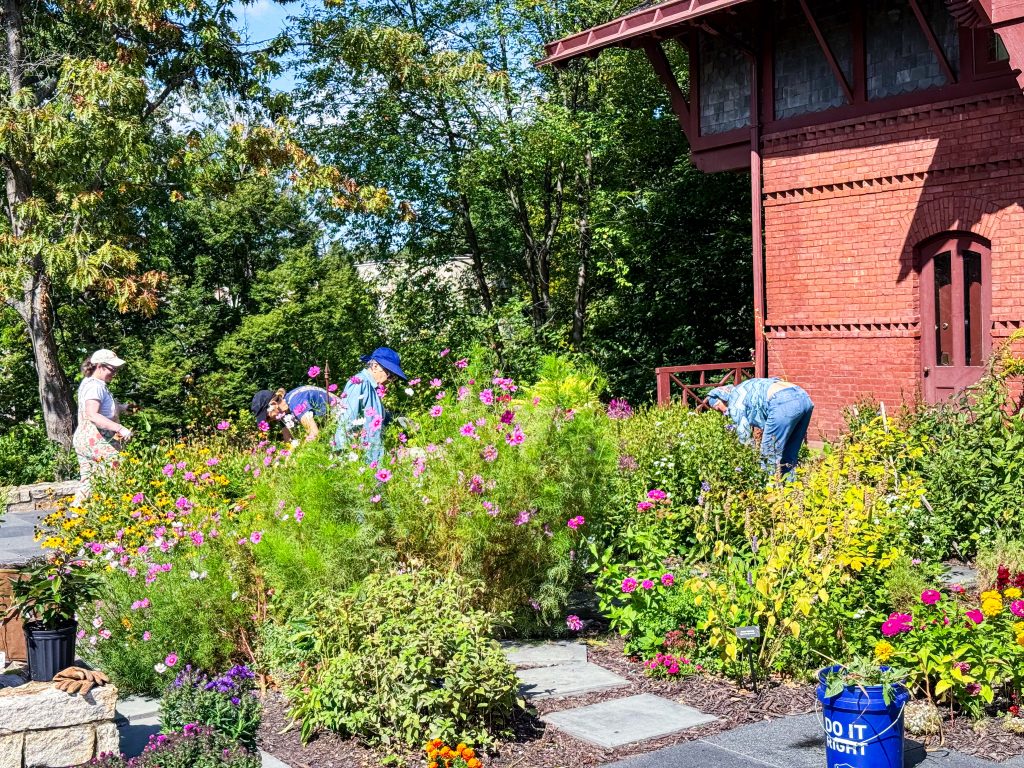
That experience now includes coordinating 12 to 13 consistent volunteers each season, including veteran Master Gardeners, returning interns, and newer participants eager to learn. From March through November, volunteers contribute up to eight hours per week, tackling everything from deadheading and soil restoration to historical research and invasive species management.
“We love it. We want to make it look great,” Coursey says. “We take a lot of pride in it.”
Gardens With Stories to Tell
The Mark Twain House gardens are far more than ornamental. Mark Twain was the pen name for Samuel Clemens, and he and his family lived in Hartford from 1874 to 1891. The family hired a gardener, among other staff, and the first gardener’s notebook still exists.
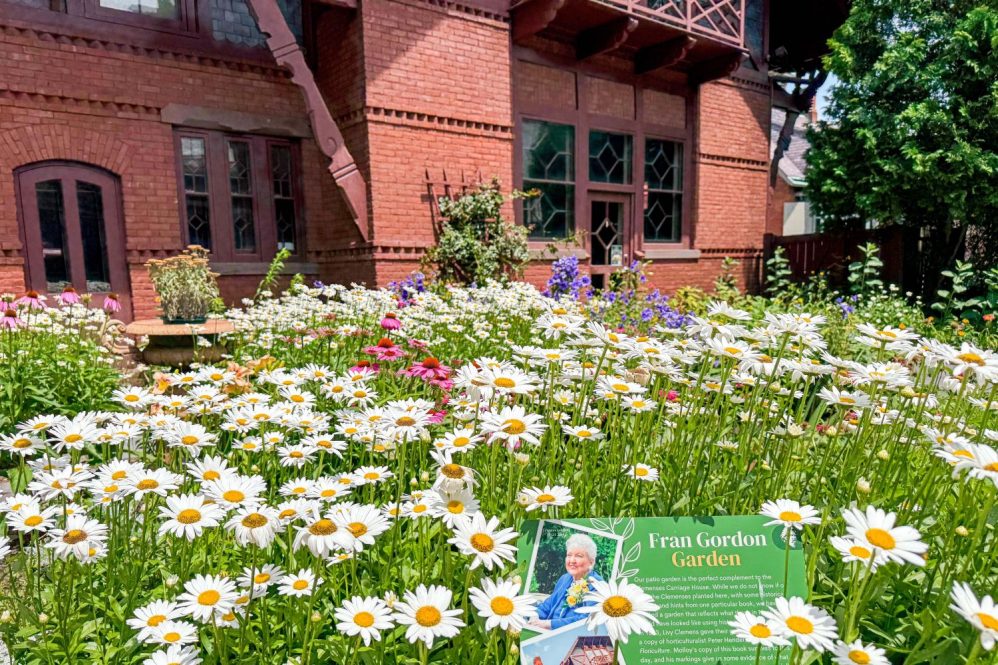
Today, the gardens at the Mark Twain House are named, documented, and increasingly recognized for their historical significance. Among them is the Fran Gordon Garden; the first garden visitors see as they exit the visitor center on the way to the house. Fran Gordon is the woman who famously mobilized community support in the mid‑20th century to save the Twain House from demolition. The garden has become a focal point for volunteer effort and visitor admiration.
“People love having their photos taken in front of it,” says longtime volunteer Cindy Curry, noting how often guests stop and ask about the plants, and about Twain.
Other gardens include Livy’s Garden, named for Olivia, Twain’s wife; the Sundial Garden, part of the Pollinator Pathway and sometimes called the Friendship Garden because so many of its plants were donated from volunteers’ own homes; the Urn Garden, Wall Garden, Carriage House Garden, Stairway Garden, and Horseshoe Garden, each with its own story, challenges, and planting plans.
Perhaps most significant is the Turnway Garden, at the site of a former driveway and now an officially designated historic garden. Gail and Ed Thibodeau are the lead volunteers in the Turnway Garden, and it features hundreds of spring bulbs including daffodils, hyacinths, and tulips. All are purchased, planted, and cared for entirely by volunteers.
This garden helped secure the Mark Twain House a place on the Connecticut Historic Gardens list, making it one of just 16 sites statewide.
“Getting on that list took a lot of work,” Coursey says. “It’s a wonderful honor.”
Where Learning Meets Preservation
Historic accuracy is at the core of the volunteers’ work. Gardens closest to the house are maintained with Victorian-era plantings in mind; boxwoods, period perennials, and historically appropriate varieties selected through extensive research, including photographs and documentation.
Inside the house, the Conservatory, with its original glass still intact, exemplifies that approach. Larry Zarbo leads six Master Gardener volunteers in caring for the space, watering twice weekly, inspecting for pests, and maintaining a curated collection of plants. There are 35 to 40 historically appropriate species on their list of potential plants. A recent Connecticut Master Gardener Association grant helped to resupply the conservatory after harsh winters.
“These gardens are a constantly evolving classroom,” says Heidi Stefanski, a 2026 Master Gardener from Litchfield. “You learn things here, about planting plans, mature landscapes, and historic context, that you don’t get in the program alone.”
That learning flows both ways. Volunteers study compacted clay soils, experiment with mulching and naturalizing plants, monitor jumping worms, and manage invasive species, removing what they can, while preserving elements like the historic Japanese wisteria trellis installed by Eagle Scouts more than a century ago.
“It’s hands-on learning every day,” Coursey says. “Someone spots a stain on a tree, or an unfamiliar insect, and suddenly you’re researching sycamores, cankers, arachnids. When something grabs people’s interest, they go deeper.”
A Community Effort
With limited budgets typical of nonprofit historic sites, the gardens thrive largely through volunteer passion. Urns, the sundial, bark boxes, and plants often come from volunteers’ own yards. Master Gardener grants have supported demonstration gardens, pollinator installations, and educational features like moonflower vines and butterfly spaces. Corporate volunteers and community partners regularly lend a hand.
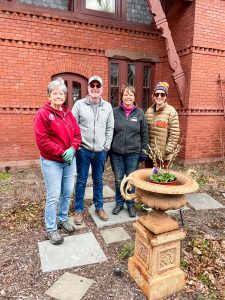
Christie Kuriger, who served as garden coordinator for nearly a decade, calls the work deeply rewarding.
“People come through and say, ‘Wow.’ That makes it all worth it,” she shares, and adds that the presence of gardeners signals the changing season. “When the volunteers are here, employees and docents get excited. It’s a sign of spring.”
For Kuriger, a former English teacher, volunteering has deepened her connection to Twain’s world.
“People ask us questions about the history. You get to know the story so well, and it’s such a happy place to be.”
The Mark Twain House and Museum is in Hartford’s historic Nook Farm neighborhood, named because it was at the nook of the Park River that flowed through before being moved to prevent spring floods. During Twain’s time, the Nook Farm neighborhood included Harriet Beecher Stowe and William Gillette. It remains a place where literature, landscape, and community intersect. The gardens are a destination in their own right now, drawing more than 100 visitors during last year’s Connecticut Historic Garden Day, always the fourth Sunday in June.
For Coursey, that recognition underscores the impact of UConn Extension Master Gardener volunteers statewide.
“Extension Master Gardeners have opportunities at historic gardens across Connecticut,” he says. “The Master Gardener program opens doors, to learning about plants and to meeting people, preserving history, and being part of something bigger.”
His advice for those considering the program is simple: “Absolutely go for it. Most people are already passionate about gardening. Being a UConn Extension Master Gardener just helps you explore it further.”
The grounds at the Mark Twain House and Museum are open dawn to dusk year-round, with advance tickets recommended for house tours. The UConn Extension Master Gardener Program offers horticultural training, and certified Master Gardeners provide insight to community members statewide, in addition to community projects.
UConn Extension is part of the College of Agriculture, Health and Natural Resources and fulfills the land-grant mission of translating the university’s research for the public. UConn Extension’s statewide locations and programs help serve all 169 Connecticut municipalities. Programs include health and wellbeing, agriculture, horticulture, natural resources, and positive youth development. UConn Extension provides answers you can trust on issues ranging from health and wellness to agriculture, horticulture, natural resources, and positive youth development.
Follow UConn CAHNR on social media