Invasive plants are species that spread aggressively because they lack natural predators or controls in their environment. They often outcompete native plants for light, water, and nutrients, and in some cases release chemicals that inhibit other plant growth.
Managing invasive plants can feel daunting, but local efforts across Connecticut show that consistent action, community partnerships, and education make a real difference. A leading example is the Collinsville Pollinator Trail in Canton, where UConn Extension Master Gardeners and community volunteers have spent a decade reducing invasive plant populations and restoring native habitat.
A Community-Driven Approach
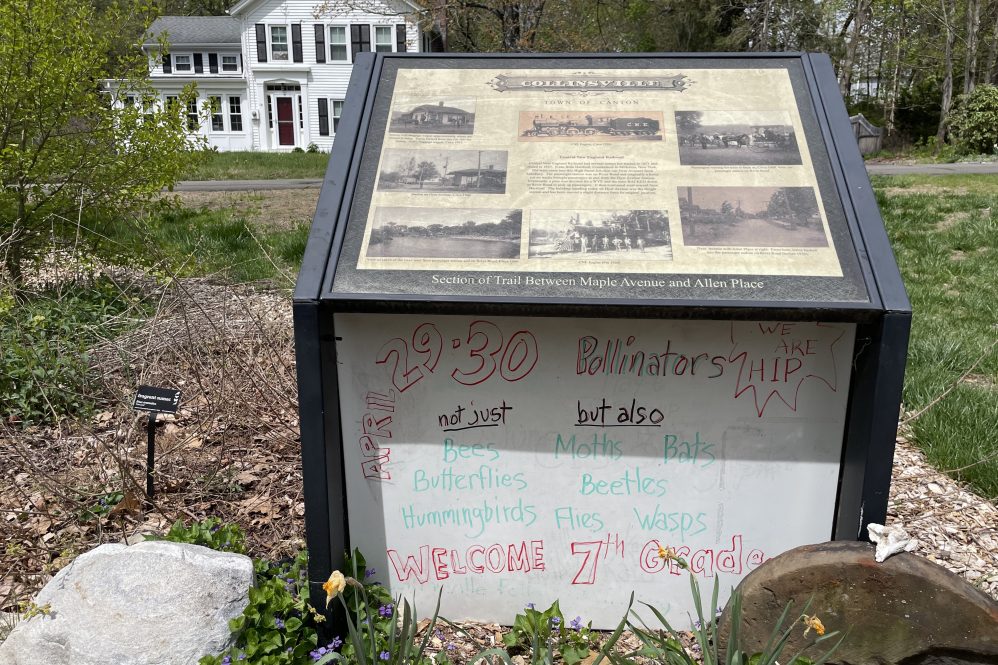
The Collinsville Pollinator Trail is a volunteer-driven effort that began in 2017 as a Master Gardener project grew into a sustained community initiative. Karen Berger and Holly Hambleton, both Extension Master Gardeners from Canton, lead the volunteer effort, with a core team and over 100 volunteers in the past decade. They transformed a dense stand of Japanese knotweed along a 25-by-375-foot corridor, described as a “tunnel,” into a pollinator habitat, and expanded their efforts to stretch along the trail from Dyer Avenue to Maple Avenue.
Japanese knotweed is one of the most difficult species to control in Connecticut; it was originally introduced for ornamental use and erosion control. It spreads through an extensive underground rhizome system, often comprising two-thirds of the plant, and can regrow from small fragments moved by mowing, soil disturbance, or flooding.
The Collinsville team leveraged Master Gardener volunteers, residents, and service organizations to tackle the problem. A key to success has been strong collaboration with local partners, particularly the Canton Department of Public Works (DPW).
Over the past 10 years, hundreds of volunteers have contributed thousands of hours to cutting invasive plants, restoring habitat, watering during droughts, tracking plant data, and engaging with visitors. They’ve also expanded their management area to the hillside and stream, and planted islands of native plants, including a rescue garden of salvaged plants.
Berger and Hambleton’s leadership, and their ability to mentor and welcome new participants, are critical to their success. Recent Master Gardener program graduates now help coordinate volunteers, manage schedules, and expand outreach.
“There’s nothing like having an active trail go through the center of your project,” Berger says. “We want to plant natives to showcase what it would look like in your yard. We have wonderful volunteers year after year and try to make their experience match their interest.”
Practical Strategies for Managing Invasives
The Collinsville project highlights several practical strategies that can be adapted for home landscapes or community spaces. At the core of their approach is persistence.
In the case of UConn Extension’s Master Gardener volunteers, the work began by breaking the site into manageable sections, using the distance between telephone poles as a guide, and committing to repeated action over time. Japanese knotweed was cut multiple times each growing season for several years, with volunteers continuously monitoring regrowth. While there is no single solution to invasive plant management, this steady, consistent effort has proven effective in reducing plant vigor over time.
Equally important is preventing the spread of invasive plants during removal. Japanese knotweed is particularly challenging because even small fragments can regrow. To limit accidental spread, the team adapted their practices over time. Live invasive plant material cannot be transported off-site. Instead, volunteers dry the cut stems before disposal in a brush pile. These adjustments, informed by experience, helped reduce the risk of unintentionally expanding infestations.
Restoration plays a critical role alongside removal. Native plants provide essential food and habitat for pollinators and wildlife, support the insects that form the base of the food web, and typically require less maintenance once established. The Collinsville team prioritized planting and encouraging native species suited to the site, recognizing that long-term success depends on what replaces the invasives. As invasive pressure decreased, native plants, including trillium, wild geranium, jack-in-the-pulpit, and winterberry, were more prevalent.
Rather than attempting to address every invasive species at once, the group focused on priority species that posed the greatest threat. Japanese knotweed remained the primary target, along with other common invasives such as mugwort, garlic mustard, and woody species like bittersweet and honeysuckle. This targeted approach allowed volunteers to use their time and energy effectively while making noticeable progress.
Partnerships and policy have helped scale the impact of their work beyond the trail itself. The group’s efforts contributed to the town adopting a Native Plant Policy in 2022, with ongoing work to strengthen these standards through local regulations. Collaboration with partners, including municipal departments and utility companies, has further supported improved vegetation management practices and reduced reliance on pesticides. Together, these efforts demonstrate how a local, volunteer-driven project can influence broader community practices over time.
Education as a Core Strategy
A defining feature of the Collinsville Pollinator Trail is its role as an outdoor classroom, where education is integrated into everyday stewardship. Volunteers regularly lead school field trips that introduce students to pollinators and plant science, creating hands-on learning experiences just steps from the classroom. Invasive and native plant identification walks are paired with workdays, giving community members the opportunity to learn while actively contributing to land management.
“It’s a public park and has involved the community. People like this section because there is so much variety of plants,” Hambleton says.
Lisa Franklin lives around the corner from the trail and is a member of the core team. She adds, “People are genuinely interested in the work being done on the trail to restore habitat, beauty, and natives. I really enjoy when someone walking or riding on the trail stops to ask a question or interact with us while we’re working. Our team is deeply engaged in bringing as many native plants as possible to the trail and showcasing how beautiful they can be in the landscape. This is where the ‘Homegrown National Park’ takes form.”
Martha Lojzim from Bristol is a fellow 2024 graduate of the Master Gardener program with Franklin and has been instrumental in helping the team with plant data management, gathering insights and information to support various activities and decisions, and sharing her knowledge of native and invasive plants with new Master Gardener interns. The site also supports volunteer service and youth engagement efforts, including scout projects. By connecting people directly with the environment, these educational efforts build awareness and foster long-term stewardship within the community.
Michele Jenks of Simsbury has been the sole caretaker of Shultz Park in downtown Simsbury for 20 years. She did her intern hours in 2020 keeping the Collinsville plants alive by watering from a rain barrel on the back of her truck three times a day twice a week and became the third leg of the team. She designed the native beds that pull people off the trail to get a closer look.
What You Can Do at Home
Meaningful impacts also happen in residential yards. Managing invasive plants at home starts with awareness and small, consistent actions. Begin by identifying invasive species and removing small infestations early, before they have the chance to spread. Take care to avoid moving soil or plant material that may contain roots or seeds, as this can unintentionally introduce invasives to new areas.
Replacing invasive plants with native species suited to the site supports long-term ecological health while reducing maintenance needs. Ongoing monitoring is essential, as many invasive plants require repeated attention to fully control, but control efforts positively benefit the landscape.
Now approaching its 10-year milestone, the Collinsville Pollinator Trail continues to evolve through its dedicated volunteers. The group is planning to expand restoration areas, refine management techniques, and deepen connections with the community.
“Our purpose is showing people that removing invasive plants is possible, and that replacing them with native plants is beneficial,” says Berger.
Have a Question? UConn Extension is here to help with answers you can trust. Whether you’re managing a backyard, farm, or community space, we can provide research-based guidance tailored to Connecticut landscapes.
This work relates to CAHNR’s Strategic Vision area focused on Fostering Sustainable Landscapes at the Urban-Rural Interface.
Follow UConn CAHNR on social media