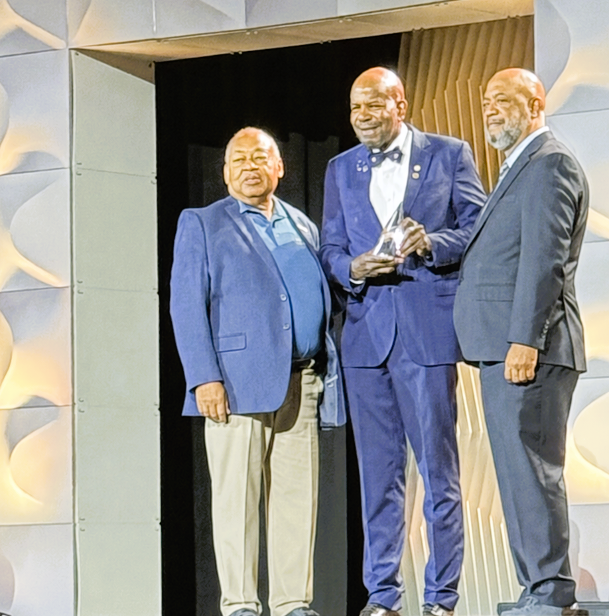
Professor Sir Cato T. Laurencin received the 2026 Dr. William Montague Cobb Award in the National category from the National Association for the Advancement of Colored People (NAACP). The award was presented during the Opening Plenary Session of the 117th NAACP National Convention in Chicago in July 2026 where he addressed the organization.
Founded in 1909, the NAACP is one of the nation’s oldest and most prominent civil rights organizations. It works to advance equality and eliminate racial discrimination across areas including health, education, justice, and economic opportunity. The Dr. William Montague Cobb Award honors individuals and organizations that have made a significant impact in health while advancing the social justice legacy of Cobb, a physician, anthropologist, educator, and civil rights leader who served as president of the NAACP from 1976 to 1982.
The National category is presented annually to an outstanding individual for special achievement in health and social justice advocacy, health education and promotion, and research. Laurencin previously received the NAACP’s Spingarn Medal, the organization’s highest honor, “given to the man or woman of African descent and American citizenship who shall have made the highest achievement during the preceding year or years,” for his pioneering of the field of Regenerative Engineering.
Laurencin has dedicated much effort to improving human health and addressing racial and ethnic health disparities. He received the Herbert W. Nickens Award from the American Association of Medical Colleges for his work in promoting social justice and fairness.
At UConn, Laurencin is a core faculty member in Africana Studies. A scholar in the area of Racial Justice and Health Equity, he was rated the number one scientist in America in Health Equity by Scholar GPS over the past 5 years (https://scholargps.com/top-scholars?year=2025&ranking_duration=LAST_5_YEARS&specialty=Health+equity).
Regionally he is the president of the Connecticut National Medical Association Society, a large society affiliate of the National Medical Association. Nationally he is the founding editor-in-chief of the Journal of Racial and Ethnic Health Disparities, which publishes research examining health inequities affecting racial and ethnic populations in the United States and around the world. Laurencin also co-founded the W. Montague Cobb/National Medical Association Health Institute and served as the founding chair of its board. The Institute and the National Medical Association established the Cato T. Laurencin Lifetime Research Achievement Award presented at the opening ceremonies of the National Medical Association meeting in his honor to recognize sustained research contributions that improve human health. In addition, he is the chair of the annual World Congress on Racial and Ethnic Health Disparities, sponsored in part by Springer Nature.
At the University of Connecticut, Laurencin serves as the University Professor and Albert and Wilda Van Dusen Distinguished Endowed Professor of Orthopedic Surgery at UConn School of Medicine. He is professor of Chemical and Biomolecular Engineering, professor of Materials Science and Engineering, and professor of Biomedical Engineering. He is the chief executive officer of The Cato T. Laurencin Institute for Regenerative Engineering, an Institute created and named in his honor.
Laurencin is the first surgeon in history elected to all four major U.S. national academies. He is an elected member of the National Academy of Sciences, the National Academy of Engineering, and the National Academy of Medicine, and an elected fellow of the National Academy of Inventors. He is also an elected fellow of the American Academy of Arts and Sciences and of the American Association for the Advancement of Science.