When the National Area Health Education Center Organization (NAO) issued a call to its more than 300 Area Health Education Center (AHEC) offices across the country to converge on Capitol Hill for the NAO Leadership Forum to advocate for continued funding of health workforce pathway programs, the Connecticut Area Health Education Center (CT AHEC), based at UConn Health, answered in full force.
Its 11-member leadership delegation, representing the program office and three of the state’s four regional AHEC offices, joined teams from 106 other AHECs to meet with their legislators and staff. Together, they highlighted AHEC’s impact on strengthening the healthcare workforce, shared the organization’s many accomplishments, and emphasized the critical need for continued federal support to sustain their programs.

The AHEC program was developed by Congress in 1971. The goal of this federally funded program is to improve healthcare access through training, recruitment, and retention of healthcare professionals. Nationally, AHECs receive a total of $47 million annually from the Health Resources and Services Administration (HRSA), with 75% of funds going to the regional centers that serve as a conduit/pulse for local need. AHECs are asking for increased funding of $67 million annually to meet the statutory funding of $250,000 per center.
“We were happy to have this opportunity to collaborate with other AHECs at the NAO Leadership Forum held in Washington, DC. In addition to learning valuable advocacy and leadership skills, the forum provided an invaluable opportunity to educate our representatives about the important work of AHECs,” says Petra Clark-Dufner, director, CT AHEC, who has been educating legislators/staffers for multiple decades.
“AHECs are trusted partners and respected messengers within the communities they serve,” said Clark-Dufner. “Policymakers often turn to us for insight on healthcare issues because they recognize our deep understanding of local needs, challenges, and opportunities. We are frequently asked to provide information on healthcare workforce issues and to help gauge the pulse of our communities,” she said.
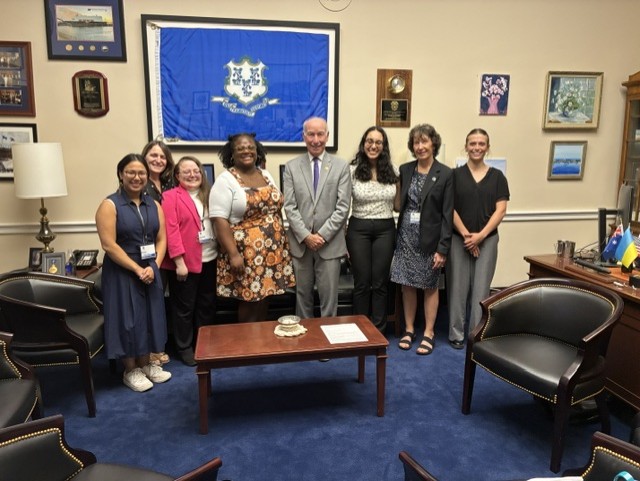
Cecil Tengatenga, CT AHEC’s associate director, echoed how Connecticut legislative offices value CT AHEC as a trusted resource and welcome opportunities to learn about how CT AHEC is addressing current and future healthcare workforce shortages through targeted education, training, and workforce development initiatives. “By connecting community voices with policymakers, CT AHEC helps ensure that healthcare solutions are informed by the real needs of the populations we serve,” says Tengatenga.
CT AHEC also coordinated its advocacy efforts on Capitol Hill with AHEC leaders from across New England, reinforcing a shared regional message on healthcare workforce shortages, educational pathways, and the importance of sustained federal investment in workforce development programs. “Together, our New England AHECs emphasized the critical role these programs play in addressing provider shortages, strengthening regional workforce pipelines, and improving access to care across urban, rural, and underserved communities,” says Tengatenga.“Continued federal investment in workforce training, educational pathways, and community based-experiential learning programs are needed to prepare healthcare professionals to serve in underserved communities,” he adds.
Tengatenga also noted that Connecticut’s Congressional delegation has been a consistent supporter of federal investments in healthcare workforce development, including HRSA training programs that expand primary care, nursing, behavioral health, and rural workforce capacity.
During the meetings on Capitol Hill, he and the other AHEC leaders emphasized the importance of ongoing congressional support to reauthorize and strengthen the AHEC program, along with other HRSA Title VII Health Workforce and Title VIII Nursing programs that were up for reauthorization. Their reauthorization expired last year. (Note, since AHECs day on Capitol Hill, the Senate HELP Committee was able to advance S.4110, the EMPOWER for Health Act, which includes AHEC and all HRSA Title VII reauthorization.)
Alyssa McClain, president of the CT AHEC Network’s Health Education Center in Norwich, was clear that these legislative relationships are a priority. “Knowing our legislators and making sure they know us is so important for the work we do and the lives we affect. Sustainable funding isn’t just a budget goal; it’s the backbone of accessible resources, education, and long-term impact that keeps our communities thriving.”
HRSA has determined there are 177 Health Professional Shortage Areas in Connecticut, with 65 in primary care, 59 in dental services, and 65 in mental health. The 2024 Mercer report, titled The Future of the U.S. Healthcare Industry, states that Connecticut will require 5,700 additional providers by 2028 and indicated there will be a critical shortage of registered nurses, nurse practitioners, and home health aides/personal care assistants.
These projected healthcare workforce shortages are not unique to Connecticut and that is why AHEC program offices and regional centers across the country are working to strengthen the healthcare workforce and improve access to care. Nationally, these AHECs support 3,412 training sites in medically underserved communities, including more than 2,000 sites in rural areas and primary care settings. They also collaborate with 120 medical schools, more than 600 nursing and allied health schools, community health centers, behavioral health providers, and other community-based organizations to build a stronger, more sustainable healthcare system.
Fernando Morales, executive director, Southwestern AHEC in Shelton, said he appreciated the opportunity to hear from AHEC leaders across the country at this forum. “Learning about their successes, challenges, and innovative approaches reinforced that we are part of a national effort to build a stronger healthcare workforce,” he said. His AHEC hosts Youth Health Service Corps, Public Health Ambassadors, Collegiate Health Service Corps, community-based experiential training opportunities for health professions students, and community health worker (CHW) core competencies trainings.
The teams spent the day before the Capitol Hill visits being updated on AHEC’s efforts and preparing to make an effective pitch in the brief time allotted with each legislative office. Clark-Dufner had a seat on a leadership panel where she shared advice on how to be a strong leader. Clark-Dufner is a 2026 recipient of the UConn Provost’s Outstanding Service Award. “To be a leader you must have enthusiasm for what you are doing and ‘find your joy’” which she noted includes working with CT AHEC’s Urban Health/AHEC Scholars, two of whom participated in the forum and Hill visit.
One of those students, Margaret Waweru, a master’s degree student in the UConn School of Social Work, said participating in the pre-visit workshops with AHEC professionals from all over the country was a great honor. “The leadership demonstrated fortitude and foresight: drawing lessons from the past, staying attentive to the present, and preparing thoughtfully for the unseen future,” she said.
The other Urban Health/AHEC Scholar, Shreya Nagri, UConn School of Medicine Class of 2029, said she accepted CT AHEC’s offer to travel to Washington as a student advocate because she wanted legislators to know about the impact the Urban Service Track/AHEC Scholars Program (UST/AS) has had on her and her medical school experience. “Having the opportunity to apply the skills I learn in the classroom in the community and learning about the issues that the communities around me face has been extremely valuable,” said Nagri. “Getting an education grounded in understanding the communities we will ultimately serve is extremely important and at the center of the work that Urban Service Track does.”
UST/AS is a two-year “add on” program focused on underserved urban and rural communities that is available to students in the UConn Schools of Medicine, Dental Medicine, Pharmacy, Nursing, and Social Work, and Quinnipiac University’s Physician Assistant Program. University of Saint Joseph will be joining the program’s new rural track in the fall semester. Eight to twenty students per school/program are selected each year from among qualified applicants who have demonstrated a commitment to community engagement.
Dariene DuBois-Plante, CT AHEC’s administrative officer, emphasized the value of the legislative staff hearing directly from students involved in CT AHEC programming, which reached 18,000 participants overall last year. “This experience reinforced the power of storytelling in advocacy,” she said. “Our data demonstrates outcomes but hearing firsthand from students about how AHEC programs shape their understanding of patient care and community health brought those outcomes to life. It reminded me that the most effective advocacy connects policy priorities with real people and real experiences.”
Tengatenga summarized the impact of the trip when he said: “The NAO Leadership Forum demonstrated the strength of a national network working toward a common goal: ensuring every community has access to a well-prepared healthcare workforce. Our conversations on Capitol Hill highlighted Connecticut’s contributions to that effort and underscored the value of coordinating with colleagues across the nation to advance workforce solutions that are locally responsive, regionally aligned, and informed by the realities facing communities across the country.”
For more information visit the National AHEC Organization.