Materials are everywhere. They are in the batteries powering our devices, the engines moving us from place to place, the implants used in modern medicine, and nearly every piece of technology people interact with each day.
Yet Alexander Dupuy, an assistant professor in the Department of Materials Science and Engineering at UConn, thinks they rarely get the attention they deserve.
That idea is at the heart of Dupuy’s research, which explores not only what materials are made of, but how the way they are manufactured can fundamentally change what they are capable of doing.
“Materials science is critical to solving the world’s technological challenges,” says Dupuy. “Materials science is the bottleneck for almost all technological innovation right now. Solving those problems and enabling those new technologies is what motivates me.”
Much of materials science focuses on manipulating a material’s chemistry to achieve a desired set of properties. Dupuy’s group approaches the problem from a different direction: processing.
The lab studies materials processing, synthesis, and manufacturing with several goals in mind, like finding new ways to make materials, creating materials that have never existed before, and using processing techniques to make existing materials behave in unexpected ways.
“How you process a material matters a lot,” Dupuy says. “My group studies how different processing techniques and conditions will influence the behavior of a material.”
This processing-focused approach allows the group to work across a broad range of applications. Dupuy’s research interests include the synthesis and processing of ceramics, high-entropy ceramics, materials for energy generation and storage, functional materials, and materials capable of operating in high-temperature and other extreme environments.
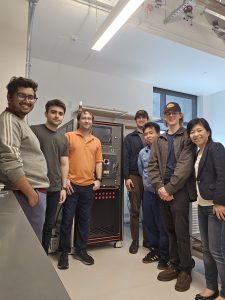
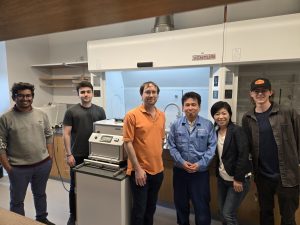
One of the lab’s most important tools is Spark Plasma Sintering, or SPS, a manufacturing technique that uses pressure and electrical current to consolidate powdered materials. Dupuy has two decades of experience working with this technique, and his lab is currently home to the only SPS system in Connecticut.
SPS can process materials at lower temperatures and in much less time than many conventional techniques. It can also enable researchers to produce materials that may be difficult or impossible to create through other methods.
Because Dupuy’s research focuses on how materials are processed rather than on one particular application, his group can move between research challenges in fields ranging from energy to medicine.
One of the lab’s current projects could have implications for the future of battery technology. They recently discovered a material whose properties can be controlled by how it is heated. Depending on the heat treatment applied, the same material can behave as an electrode, and electrolyte, or somewhere in between.
That tunability could allow engineers to customize battery components without having to continually develop different material chemistries for each desired function.
“Its properties are very highly tunable through a simple heat treatment process,” says Dupuy. “This is exciting because it will allow for highly bespoke battery designs without changing the battery chemistry.”
The battery project is one example of a much broader question driving the lab: What becomes possible when researchers rethink the way a material is made?
The research group is also studying materials for dental implants with the goal of improving surgical recovery time and developing ceramics that could allow engines to operate more efficiently by withstanding conditions that existing materials cannot.
“Engineers may know how to design a more advanced engine, battery, or computer,” Dupuy says. “The challenge is often finding a materials capable of making that design a reality.”
Dupuy’s fascination with those possibilities can be traced back to his own experience as a graduate student.
While pursuing his Ph.D. in mechanical engineering at the University of California, Riverside, Dupuy worked on materials for fiber-optic communications. One project required him to fabricate an especially challenging material that had never been successfully produced.
Then, one night, he figured it out.
“I was able to make a viable sample for the first time,” says Dupuy. “I was the first person to do this, and I realized in that moment that I was literally the only person on Earth who knew that. It was an amazing feeling. I have been chasing that rush ever since.”
After earning his Ph.D. in 2016, Dupuy continued his research at the University of California, Irvine, first as a postdoctoral scholar and later as an assistant project scientist. He joined UConn’s Department of Materials Science and Engineering in 2023.
“It was a no-brainer for me to accept the job at UConn,” Dupuy says. “UConn is a mecca for materials science.”
Dupuy points to the combination of the Materials Science and Engineering department, Institute of Materials Science, research infrastructure, and faculty expertise as particularly important to his work.
“At UConn, I have access to incredible facilities, world-renowned colleagues, and an incredible support network,” he says. “For the research that I want to do, there is probably no better place than UConn.”
Industry has also become an important part of his research. Dupuy says he did not initially realize the extent of UConn’s industry connections, but partnerships with companies now provide much of his research funding.
Looking towards the future, Dupuy is excited to see his group grow.
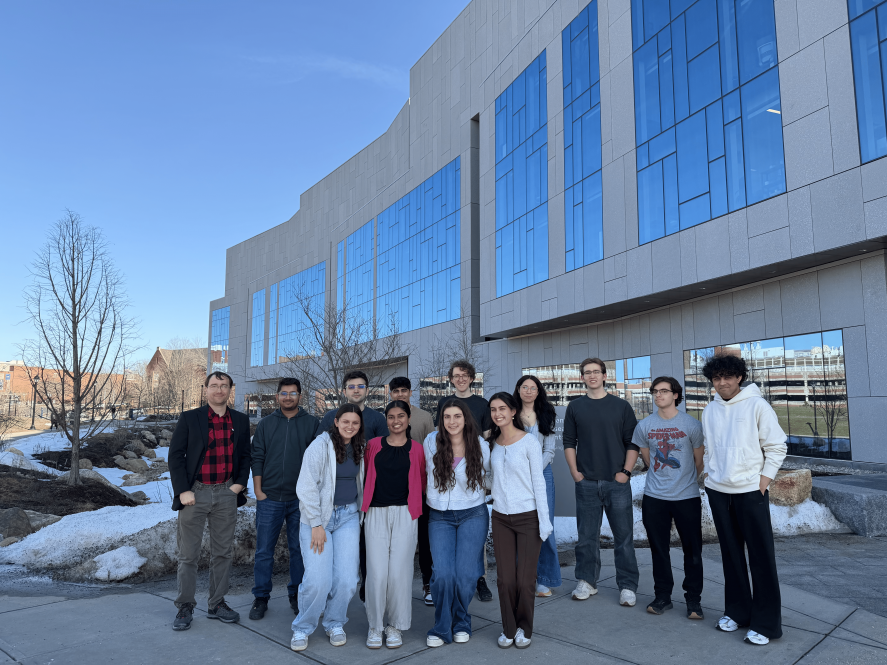
His research group will welcome two new graduate students this fall, joining an already established group of seven undergraduate researchers and two graduate students.
Dupuy is also pursuing funding for a new slate of projects centered on pioneering processing and synthesis techniques, including new approaches to powder coating and low-temperature manufacturing.
While the applications may differ, the goal remains the same. Demonstrating that a change in how materials are processed can open possibilities that chemistry alone cannot.
For Dupuy, that means continuing to shine a light on the materials quietly enabling technological progress and finding new ways to make them do things they have never done before.