When Evan Piotrowski first stood inside the Millstone Nuclear Power Station and saw the reactor vessel that had powered his home for years, he gained more than a behind-the-scenes look at one of the nation’s largest clean energy sources. He found a career path.
Now a rising senior in the UConn Chemical and Biomolecular Engineering department, Piotrowski has been awarded the NASA CT Space Grant Scholarship. The scholarship recognizes his academic excellence, undergraduate research, and commitment to developing engineering solutions for some of society’s most pressing energy and sustainability challenges.
A member of the UConn Honors Program, Piotrowski is pursuing minors in both materials science and mathematics while conducting research in assistant professor Burcu Beykal’s laboratory. His long-term goal is to work at the intersection of nuclear energy and process systems engineering, developing advanced reactor technologies that could one day power missions beyond Earth.
“The work I am currently doing and the work I desire in the future have strong applications in the advancement of space technology,” says Piotrowski. “My goal is to become an engineer who advances both the nuclear power and space technology frontiers.”
That vision extends well beyond the classroom.
In assistant professor Burcu Beykal’s research group, Piotrowski has explored sustainable energy technologies through projects focused on atmospheric water harvesting and geothermal power systems. Last spring, he received UConn’s Environmental & Social Sustainability Grant for his work investigating how atmospheric water harvesting can be integrated with geothermal energy to create more sustainable water production systems.
As part of the project, Piotrowski used Aspen Plus process simulation software to model and analyze the systems and developed a Python-based automation tool to streamline complex simulations. The tool is designed to make simulation automation easier and more accessible to other researchers and students.
“Evan is an exceptionally bright and motivated student, and it has been a pleasure to have him, as part of my research group,” says Beykal. “His accomplishments reflect not only his strong technical skills, but also his curiosity and drive to take on meaningful engineering challenges. I look forward to seeing Evan continue to be an ambassador for the Department of Chemical and Biomolecular Engineering and UConn Engineering for years to come.”
With support from the NASA CT Space Grant Scholarship, Piotrowski plans to devote even more time to research in Beykal’s lab during his senior year. He hopes to build on his current work by pursuing new projects centered on power and energy systems, an area of research that Beykal is also interested in.
“The broader goal is to produce research that supports communities facing limited access to clean drinking water while promoting carbon-free energy solutions,” Piotrowski says.
Piotrowski’s previous engineering experience includes internships at Millstone Nuclear Power Station and Rand-Whitney Containerboard, where he gained firsthand experience applying engineering principles in industrial settings. Together with his research experience, those opportunities have helped shape his interest in tackling technically demanding engineering challenges with real-world impact.
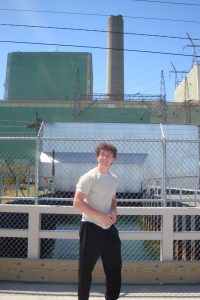
He is currently an intern at MPR Associates Inc., an engineering consulting firm that focuses on the nuclear and power sectors. There, he has worked on a variety of engineering projects supporting operating nuclear power plants, helping navigate the technical and regulatory challenges involved in plant modifications and long-term system improvements.
Piotrowski has also had the opportunity to work on some small modular reactor (SMR) projects while at MPR Associates Inc. These projects connect directly with Nasa’s lunar surface power initiatives.
Outside the lab, Piotrowski is co-founder and vice president of UConn’s Human-Powered Submarine Club. In that role, he oversees the technical progress of approximately 15 students across four engineering teams as they design and build a human-powered submarine for the International Submarine Race in 2027. He credits the experience with strengthening both his leadership skills and his appreciation for collaborative engineering.
Receiving the NASA CT Space Grant will allow Piotrowski to devote more time to undergraduate research during his senior year, expanding on the work he has already done in in Beykal’s lab, while exploring new projects in advanced power systems. Coupled with his research experience and recent internship in the nuclear power industry, the scholarship positions him to pursue a career developing the next generation of energy technologies for applications on Earth, and possibly beyond.