Jie Zhao keeps coming back to one question: does technology actually change people’s health, or does it just look like progress?
“We keep working hard to make this technology more advanced and sophisticated, but for most people’s health management, it still feels like there’s a layer in between,” says Zhao, a second-year Ph.D. student in the UConn School of Social Work. “What actually changes health outcomes isn’t some cutting-edge technology. For most people, it’s more likely to be a simple improvement, a modest technical update.”
That belief drives her dissertation research, and it traces back to a project she worked on before coming to UConn, an evaluation of a healthcare integration reform in Shenzhen, China.
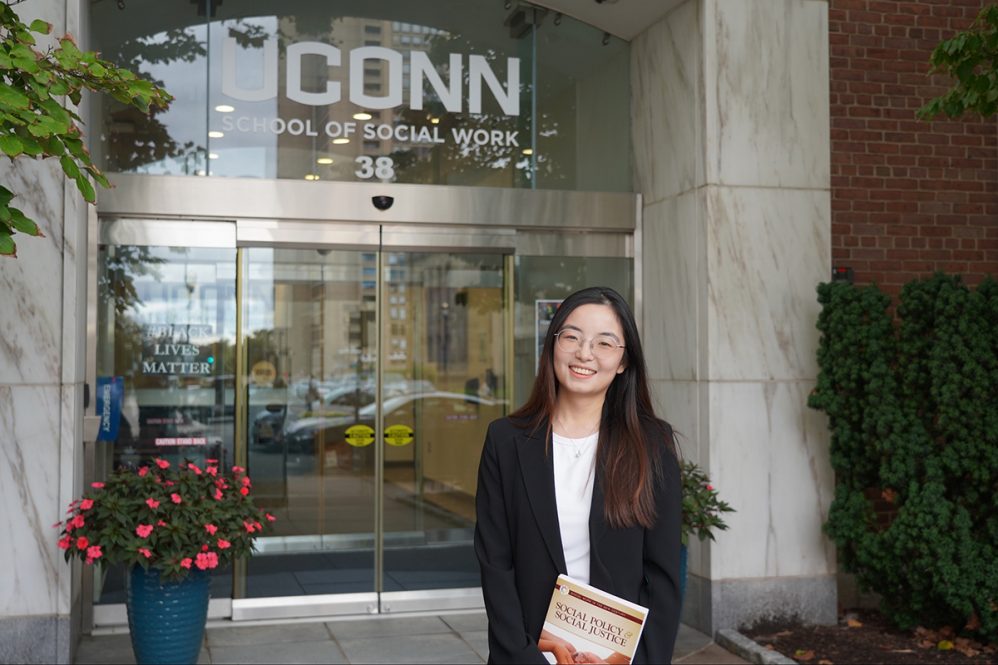
Jie Zhao is a second-year Ph.D. student in the UConn School of Social Work.
From Shenzhen to the UConn School of Social Work
After earning a bachelor’s degree from Harbin Medical University in Harbin, China, and a master’s degree from Huazhong University of Science and Technology in Wuhan, China, she became a research assistant at the Southern University of Science and Technology in Shenzhen. There, Zhao helped evaluate a district-level reform that used a digital platform to connect primary care doctors with specialists. The system automatically flagged patients with poorly controlled chronic conditions, like high blood pressure, and routed their data to specialists at higher-level hospitals for review.
“Through this project, I came to really understand the power of policy,” Zhao says. “When you change a policy, you’re not just changing the policy itself, but everything downstream: how resources get allocated, how services get delivered, and ultimately, patient health outcomes.”
She also saw the limits of technology on its own.
“Technology alone, no matter how advanced, isn’t enough to solve a problem,” she says. “It usually needs to be paired with policy changes.”
That two-way relationship between technology and policy is the thread running through her work today.
A Dissertation Rooted in Rural Health Access
Zhao’s dissertation asks how telehealth-related health policy affects substance use care in rural areas, with a focus on federally qualified health centers. These serve low-income and rural populations and are directly shaped by federal policy.
“That makes them a good setting to examine whether policy design leads to differences in telehealth service delivery, and how that, in turn, affects substance use outcomes,” she says.
The question grew out of what she observed after the pandemic. Many states loosened telehealth reimbursement policies, driving rapid growth in virtual care. But Zhao noticed the change didn’t help everyone equally.
“Even under the same policy and the same services, there are always some people who don’t get high-quality, or expected, care,” she says. “Is it possible that certain people’s needs were overlooked in the policy design itself, in ways that limit their ability to access these resources?”
Chenglin Hong, whom Zhao credits as her GA supervisor, says her background sets her apart. “Jie entered UConn’s Ph.D. program with extensive quantitative research experience, but what particularly distinguishes her is her ability to develop innovative research questions that connect individual level health outcomes with broader health systems and policy contexts,” he says.
Zhao is currently doing a policy document analysis of federal telehealth coverage rules for a Qualitative Research Methods course, with a final presentation at the School this December. “As an international student, I don’t have much lived background in this country,” she says. “This isn’t just an important step for my research, it’s also an important step in deepening my own understanding of this issue.”
Three Papers, One National Stage
This November, Zhao will give her first oral conference presentations, three of them at once, at the American Public Health Association Annual Meeting in San Antonio, Texas.
As lead author, she’ll present a study using a dataset from Malaysia examining sex work, substance use, and depressive symptoms among 374 cisgender and transgender women who reported recent sex work. The team found that women with a longer duration of sex work and a greater number of substances used had significantly higher depressive symptom scores. Notably, the number of days spent in sex work in the past month was linked to depression among cisgender women, but not transgender women, a difference Zhao says matters for how interventions get designed.
Jie is rigorous, curious, and really careful with her data. But what I appreciate most is that she never loses sight of the people behind the numbers. — Cristina Mogro-Wilson, director of the UConn SSW Ph.D. program
She’s also a co-author on two studies led by Hong: one finding that discrimination and violence victimization were linked to greater psychological distress among Asian American sexual and gender minority emerging adults, while family support was linked to significantly less; and another finding a significant association between alcohol use risk and intimate partner violence among sexual and gender diverse emerging adults.
“Having a student involved in three APHA presentations, and leading one of them, is exactly what we hope for in our Ph.D. program,” says Cristina Mogro-Wilson, Henry M. and Judith M. Zachs Chair in Social Work, professor, and director of the School’s Ph.D. program. “Jie is working alongside faculty, other universities, and international partners, and she’s already contributing to the national conversation on public health.”
Though the papers’ topics differ from her dissertation, Zhao sees them as connected. “They’re all connected to the same larger question I keep coming back to: health inequities,” she says. “Working on these studies keeps reshaping how I understand that concept.”
Mogro-Wilson points to that same quality. “Jie is rigorous, curious, and really careful with her data,” she says. “But what I appreciate most is that she never loses sight of the people behind the numbers.”
Additionally, Zhou received a UConn School of Social Work Doctoral Fellowship Award in June 2026 to study “Understanding Cigarette and E-cigarette Dependence and Cessation Among Sexual and Gender Minority Emerging Adults: A Minority Stress Perspective.”
Finding Her Way to UConn
Zhao’s path to a social work Ph.D. wasn’t a straight line. Her bachelor’s and master’s degrees, earned in China, were in public affairs administration, social medicine, and health management — not social work. When she applied to doctoral programs, she looked past discipline labels toward research fit.
“When I learned more about UConn’s School of Social Work, and about the research directions of several faculty members there, I felt like it reflected the kind of work I wanted to do,” she says.
What stood out was the School’s breadth: older adults, people with disabilities, sexual and gender minorities, children. “That made me feel like this was a place where I’d have more possibilities to look at the structural factors underlying why health inequities happen across these different groups.”
Post Ph.D. Plans
Zhao doesn’t have a fixed plan yet, but she’s leaning toward a research career grounded in practice, not just theory, a preference shaped by her time in Shenzhen, watching data collide with what was actually happening on the ground.
“When my work actually puts me in contact with frontline workers or the populations I’m studying, I feel like I learn so much, and it broadens my perspective,” she says. “That feeling of being able to help someone, or make even a small difference, matters a lot to me.”