Bystander CPR (cardiopulmonary resuscitation) can be a lifesaving technique administered before paramedics arrive to respond to a cardiac arrest.
A month-long installation of an interactive CPR kiosk in the Student Union at UConn Storrs is providing students with the opportunity to quickly learn hands-only CPR. The kiosk is provided by the American Heart Association (AHA), with the support of Hartford HealthCare.
There are more than 350,000 cardiac arrests outside of hospitals each year in the United States. On average, it takes emergency services seven to 11 minutes to arrive. In rural areas, the wait can be much longer. While CPR can double or even triple a person’s chance of survival, bystanders only perform CPR 46% of the time.
“The people that survive cardiac arrest have somebody who has done something for them before EMS gets there,” says Michael Zacchera, adjunct allied health sciences faculty and a licensed paramedic.
The installation, which lasts for the month of September, is the result of a collaboration between the AHA, Hartford HealthCare, the Department of Allied Health Sciences (AHS) in the College of Agriculture, Health and Natural Resources (CAHNR), and UConn Rescue, a student organization that provides emergency medical services training and education.
“In my role I really want to bring as many training opportunities to our students [as possible], especially trainings that are on-site,” says Jill Skowrenski, Allied Health Science’s administrative lead for student placement and engagement. “The kiosk seemed like a great opportunity to quickly and centrally teach students the proper way to do CPR.”
The kiosk provides game-like training in which users first learn about the difference between cardiac arrest and a heart attack. Then, they watch a demonstration of how to perform CPR. Finally, users practice themselves to the tune of the Bee Gees’ “Stayin Alive.” They receive feedback from the system on their hand location, compression, compression rate, and recoil. The program is available in both English and Spanish and with subtitles.
“These CPR kiosks are one of the many ways the American Heart Association wants to make sure we close the gap in bystander CPR,” Lynette Coleman, AHA vice president for community impact for Connecticut, says. “The impetus was to bring it to Connecticut so we can help close that gap and the disparity of people understanding and having access to bystander CPR. We are thankful to Hartford HealthCare for supporting this important initiative.”
The kiosk had previously been installed at Quinnipiac University, the University of St. Joseph, UConn Avery Point, and UConn Waterbury. There are plans to bring the kiosk to UConn Hartford and Stamford next year.
So far, the kiosk has provided training to over 10,000 people in Connecticut.
Coleman says university campuses have proven especially receptive to the kiosk and provide access to a diverse group of people.
While UConn Rescue does offer full CPR classes, these can be expensive for students. The kiosk provides a free, easily accessible alternative.
“We saw the opportunity to bring CPR for free to college students who typically can’t afford the classes we offer,” UConn Rescue president Grace Gewirtz ’27 (CLAS) says. “For people who have never taken a [CPR] class, having the CPR kiosk, it breaks the ice a little bit and makes people more comfortable and more confident if there is an emergency.”
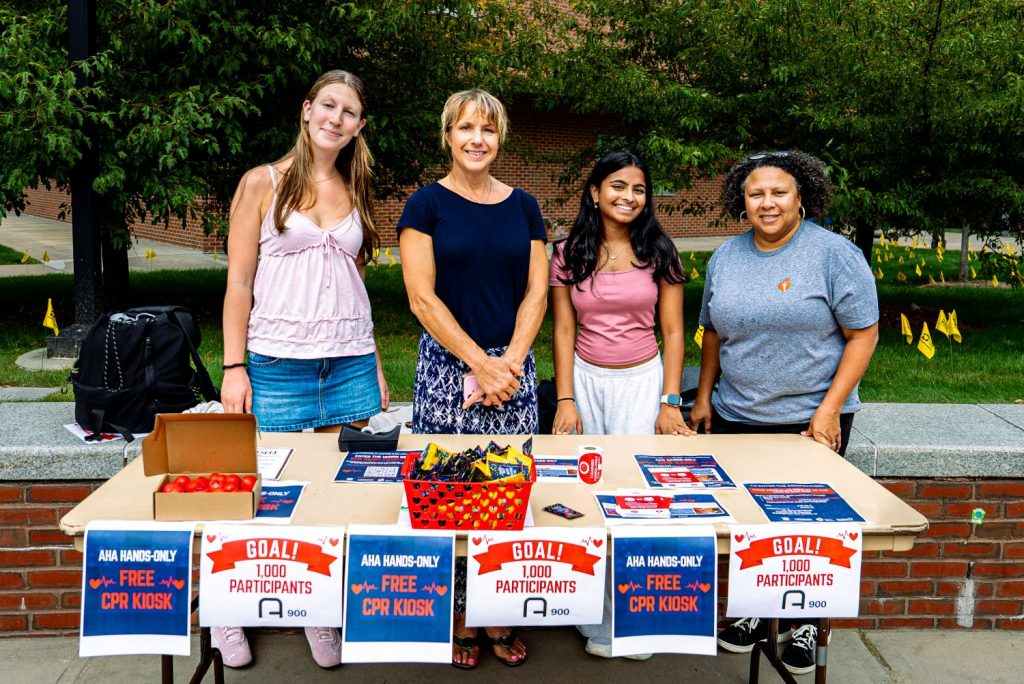
The kiosk will be in the Student Union through mid-October. On Wednesday, Sept. 30 from 12 to 3 p.m., there will be an event at the kiosk with representatives from UConn Rescue, AHA, and Allied Health Sciences.
Student clubs are also eligible to participate in a contest hosted by UConn Rescue. The club with the highest rate of participation will receive discounts for members to take CPR classes.
“[The kiosk] is to encourage people to move forward with the full certification when they can,” Coleman says. “Full certification is not just about CPR, but placing the value of CPR in the context of life-saving skills and first aid for adults, infants, and children.”
The kiosk may also serve as an introduction for students to realize they want to pursue a career in emergency medical services.
“The kiosk is the hook,” Zacchera says. “It sparks that interest. This is [students’] time to explore opportunities.”
This work relates to CAHNR’s Strategic Vision area focused on Enhancing Health and Well-Being Locally, Nationally, and Globally.
Follow UConn CAHNR on social media