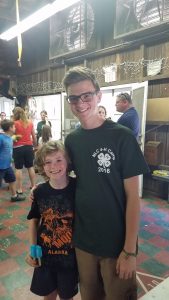
The camper refused to get out of bed. He missed his parents, didn’t want to participate in activities, and was ready to go home. As a junior staff member at the New London County 4-H Camp in Franklin, Oliver Gatti ’29 (ENGR) had a request: give camp one more day. Gatti empathized because he had once felt that way during his first summer at camp, before he discovered the camp magic. Throughout the day, he joined the camper in activities, offered encouragement, and helped him feel more comfortable. By the end of the week, the camper was thanking Gatti and making plans to return to camp.
“That moment really solidified for me what leadership and camp were all about,” says Gatti, a sophomore at UConn. “I realized I was helping create the same positive experience for younger campers that older leaders once created for me.”
UConn 4-H and the New London County 4-H Camp emphasize leadership, community, and personal growth, helping young people become Beyond Ready. Gatti grew up in Lebanon, Connecticut and attended camp, before progressing to teen leader, and then was promoted to junior staff. Each role came with increased responsibilities, leadership training, and opportunities to mentor younger youth.
“I wanted to give other kids that kind of camp magic,” he says. “Knowing that I helped create those memories was really special.”
Spending time away from home is one of the most valuable aspects of the camp experience. For many young people, camp is their first opportunity to be away from their parents for an extended period and it helps them develop independence, build confidence, and discover more about themselves. It’s part of why Gatti thought it was important for the camper to give camp one more day. Campers meet people from different schools and backgrounds, learn how to make friends, solve problems on their own, and navigate challenges without relying on their parents. These experiences become valuable life lessons.
Learning to Lead
Through UConn 4-H and the camp experience, Gatti learned that leadership is ultimately about helping others succeed. Each week, hundreds of youth arrive at camp, and teen leaders and junior staff are responsible for learning names, supporting campers, and ensuring that everyone feels included and welcomed.
“I realized that camp magic doesn’t just come from the activities. It comes from the people,” Gatti reflects. “It’s about making everyone feel included, welcomed, and valued. Seeing how much of an impact those experiences had on me, I wanted to give that back to other campers.”
4-H also helped Gatti become more adaptable and confident. Many situations at camp require teen leaders and junior staff to think on their feet and solve problems in real time. Whether supporting a homesick camper or addressing an unexpected challenge, he learned how to stay calm, assess a situation, and respond effectively. Those experiences have translated well to college, job interviews, and other situations where preparation is limited, and quick thinking is essential.
In 2024, Gatti attended Citizenship Washington Focus with UConn 4-H, a weeklong national leadership program in Washington, D.C., where he met youth from across the country. The program combines community service, public speaking, and youth-led discussions on complex issues. What made those conversations especially meaningful was the emphasis on listening to and understanding different perspectives. Participants came from a wide range of backgrounds, but everyone was encouraged to share their experiences while respecting the viewpoints of others. Gatti describes the program as one of the most eye-opening experiences of his life.
Extending the Impact
As a management and engineering for manufacturing majoring at UConn, Gatti found a field that combines his interests in business and engineering. The communication, teamwork, and facilitation skills he developed through 4-H continue to contribute to his success in the classroom and beyond. He also credits 4-H with helping him feel comfortable meeting new people and building meaningful connections.
“One thing 4-H taught me was how to help people feel comfortable sharing their ideas. In many situations, someone may think their idea isn’t important, but it could be exactly what’s needed to solve a problem,” Gatti says. “I’ve found those skills particularly valuable in engineering projects, where success depends on collaboration. Five people working together can often come up with better solutions than one person working alone. Helping create an environment where everyone feels heard and respected is one of the most valuable lessons I’ve taken from 4-H.”
The ability to give and receive feedback is another skill Gatti developed through 4-H. Respectful discussions, constructive feedback, and a willingness to consider different perspectives are essential to personal growth and effective teamwork. Looking ahead, he hopes to pursue a career that combines leadership, teamwork, and problem-solving. His major provides opportunities to develop all three while creating positive change within organizations.
“I can help teams tackle challenges, improve processes, and develop new ideas,” he says. “I’ve always enjoyed working with groups and collaborating with others, so I’d like a career that allows me to continue doing that.”
The lessons Gatti learned through 4-H extend far beyond the camp experience. They have shaped how he leads, collaborates, and approaches new opportunities at UConn and beyond. “Over time, I developed skills that don’t come naturally to me, particularly building relationships and connecting with new people,” he says. “Those skills helped ease my transition from middle school to high school and from high school to college.”
The same confidence that once encouraged a shy camper to return each summer eventually inspired him to step into leadership roles and mentor younger youth through their own camp experiences. Today, as a UConn student preparing for his future, Gatti continues building on the foundation that 4-H helped create, and reflects, “Overall, 4-H helped me become a better person and gave me the confidence to reach out, make connections, and continue growing.”
Visit 4-H.uconn.edu to learn more about volunteering or enrolling a child in the program.
UConn Extension is part of the College of Agriculture, Health and Natural Resources and fulfills the land-grant mission of translating the university’s research for the public. UConn Extension’s statewide locations and programs help serve all 169 Connecticut municipalities. Programs include health and wellbeing, agriculture, horticulture, natural resources, and positive youth development. UConn Extension provides answers you can trust on issues ranging from health and wellness to agriculture, horticulture, natural resources, and positive youth development.
Follow UConn CAHNR on social media