Congratulations to the recipients of the Neag School of Education Alumni Board Scholarship for 2026:
- Yasmin Elgoharry, a doctoral student in learning, leadership, and education policy
- Marcus Harris, a doctoral student in research methods, measurement, and evaluation
- Jeongeun Lee, a doctoral student in curriculum and instruction, mathematics education
The scholarship provides a $1,500 annual award to students enrolled in a master’s, doctorate, or sixth-year program at the Neag School who have proven academic excellence or demonstrated financial need. Recipients are chosen by the Neag School Alumni Board, comprised of Neag School graduates interested in outreach in the alumni community and benefiting current and future students.
Support Reaffirms Importance of Highlighting Underrepresented Perspectives
For Elgoharry, the Alumni Board Scholarship not only provides financial support, but it also validates the importance of her work in education and the realities of those she seeks to uplift through it. Elgoharry’s dissertation focuses on the lives of student activists in higher education.
“It affirms that my work matters, that my experiences have value, and that the voices and stories of immigrant, first-generation, and mother-scholars have a place in the academy,” she says.
Elgoharry arrived in the United States from Egypt at 11 years old. She held education in high regard as her parents deeply valued it and believed that hard work and sacrifice would carve paths to new opportunities. As she grew up, Elgoharry also witnessed the impacts of workplace discrimination, limited access to healthcare, and other social and economic barriers that low-income and immigrant families often face. She found her academic calling investigating this intersection.
“These experiences grounded my scholarly interests in access, policy, equity, and the lived experiences of students whose voices and experiences have too often been marginalized,” Elgoharry says.
In addition to these early-life experiences, Elgoharry’s identity as a person and scholar has been shaped by raising children of her own.
“Motherhood and my doctoral journey unfolded alongside one another,” she says. “These experiences have taught me that knowledge is not simply intellectual; it is also embodied, relational, and rooted in hope and community. I believe deeply in the transformative power of education, and I hope to become a faculty member who pays forward the opportunities, mentorship, and support that have helped me reach this point.”
Receiving the Alumni Board Scholarship this year is a full-circle moment for Elgoharry, as she was also named a recipient at the beginning of her doctoral program. She says she is grateful for the Alumni Board’s continued belief and investment in her, especially at a time when funding in academia feels uncertain.
“I carry with me the sacrifices and hopes of my family, the lessons I have learned through motherhood and scholarship, and a deep commitment to making higher education more equitable for those who come after me,” Elgoharry says. “I am honored to carry the support of the Neag Alumni Board with me as I take this next step in that journey.”
Scholarship Furthers Research Opportunities for Statistician
Harris is a statistical researcher focusing on computational reproducibility, but his work has far-reaching benefits across social science and educational disciplines. He is researching how to make data easier to check and reproduce, a process necessary for ensuring that information is reliable.
Harris says his field overlaps with evaluation research, which is used to determine the efficacy of a policy, program, or service. While the work he does is not specifically tied to education, he explains, his work supplies “the tools that educational researchers often use.”
In his home state of Arizona, Harris completed a bachelor’s degree in psychology, and two master’s degrees in public policy and educational policy. Through quantitative statistics classes, he discovered a passion for statistics.
“I started taking a lot of quantitative statistical classes, which made me really interested and passionate about learning about statistics, and then now, advancing them,” he says.
Beyond education, Harris has found many other areas to share his expertise at UConn. He is the Reproducibilibuddies Coordinator at Applied Cognition and peRsonalized Neuroscience (ACORN) lab, which focuses on attention-based neuroscience research.
“That’s been really rewarding as well — being able to do reproducibility work on the ground and affect change that gets implemented rather than just talk about it,” Harris says.
He is also heavily involved in UConn’s graduate employee union, where he contributed to codifying a contract article regarding artificial intelligence. The article established an artificial intelligence council and guarantees the graduate employee union a seat, in which Harris now serves.
“That’s something I’m really excited for — to think about how this integrates with university policy at large,” Harris says.
A significant portion of Harris’ research is understanding the efficacy and safety of using AI for computational reproducibility. Because of the Alumni Board Scholarship, he is able to purchase an additional, dedicated computer to continue exploring this while prioritizing data security.
“Having an option where participant data doesn’t have to leave your computer or leave a secure environment is really, really useful,” Harris says. “I truly believe that without the Alumni Board Scholarship, I wouldn’t be able to purchase a computer. So, it opens up more research opportunities for me.”
Math Educator’s Research Creates More Inclusive Math Environments
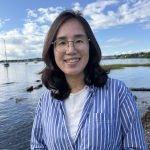
As a mathematics teacher and tutor in both South Korea and the United States, Lee became very familiar with hearing students express that they felt incapable of succeeding in and enjoying math class.
“I’ve heard many K–16 students share their struggles with mathematics and observed them lose the joy of learning and come to believe that mathematics is only for certain people,” Lee says.
Now in the second year of her doctoral program, Lee is intent on challenging this narrative through her research.
“I hope to support preservice teachers in designing inclusive classrooms where all students’ ideas are valued, where they see themselves as capable learners, and where all learners have opportunities to develop confidence and agency in mathematics,” she says.
Lee moved to the United States from South Korea with her husband in 2015. Now a mother of two returning to academia, Lee looks to expand her connections and community, both in Connecticut and in her field. In March, she attended the Associated Teachers of Mathematics in Connecticut Annual Conference — one of her first experiences connecting with educators outside of UConn since beginning her doctoral program.
“When I presented my work and interacted with other mathematics educators at a local conference, it was an inspiring experience that motivated me to participate in national conferences to broaden and deepen my understanding of mathematics education,” Lee says.
Lee is well on her way to accomplishing this goal. In October, she will travel to Denver to present at the National Council of Teachers of Mathematics Annual Meeting, where she intends to bring what she learns back to campus and integrate it into her program.
“I’m pleased to present my work there and to engage with other researchers to broaden and refine my research interests,” she says.
Lee is deeply grateful to the Alumni Board and supporters of this scholarship.
“This support means a lot to me, as it will enable me to participate in national conferences and engage with other scholars in mathematics education,” Lee says. “I truly appreciate your generosity and support for my educational journey as a researcher and future mathematics educator.”