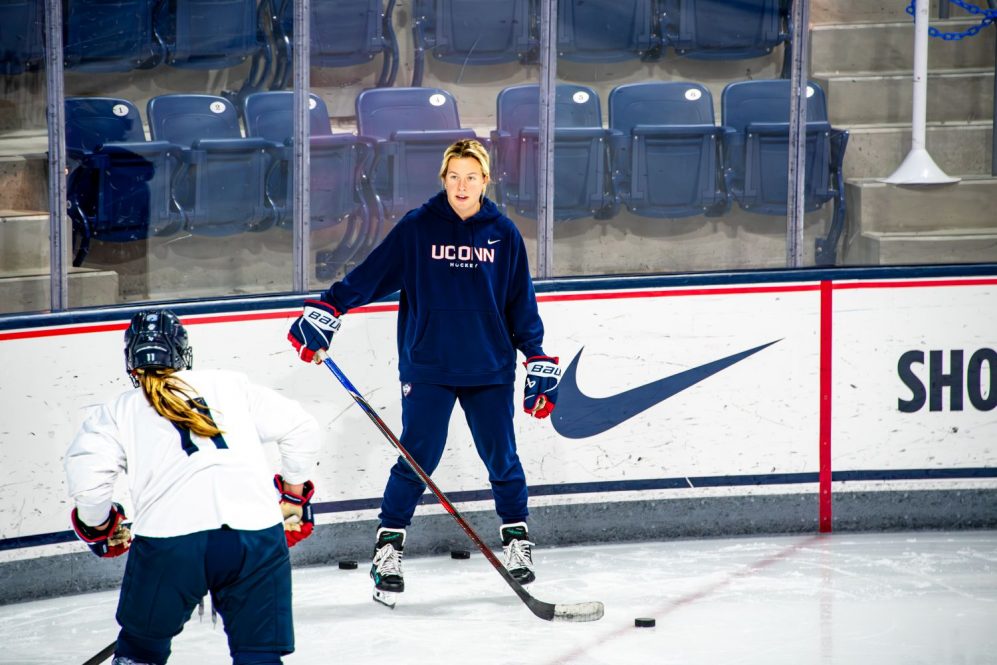
Ainsley Svetek ’23 ’24 (ENGR) ’27 (CAHNR) knows from personal experience what it takes to get an ice hockey player back in the game after an injury.
Before she joined UConn’s women’s ice hockey team, where she played for five years, Svetek broke her femur playing youth hockey.
This experience has inspired Svetek’s current work for her Ph.D. in kinesiology, which focuses on the biomechanics and movement patterns of ice hockey players. She is also an assistant coach for the UConn women’s ice hockey program.
“I think what motivates research and what is most impactful in my research is when you’re passionate about something, it pushes you to want to uncover the things that other people maybe haven’t thought of,” Svetek says.
Svetek studied biomechanics as both an undergraduate and master’s student at UConn. It was through this work, in conjunction with her own experience as an athlete that led Svetek to decide to pursue a Ph.D. in kinesiology in the College of Agriculture, Health and Natural Resources (CAHNR).
“Engineering taught me a lot of the coding and back end of data processing and data analysis,” Svetek says. “But with kinesiology, it allowed me to be more person-based.”
Svetek is studying women’s and men’s ice hockey players’ movements on the ice, which has historically been a challenge for research.
“In kinesiology we do a lot of movement screening for injury risk, and we’ve seen how that can be implemented across different sports,” Svetek says. “But what’s difficult with ice hockey is that the movements they [perform] on the ice cannot be captured.”
Previous work has focused on strength and mobility measures for ice hockey players off the ice. While these measures are useful, they don’t provide a full picture of how players are moving during practice and games.
“Skating is a movement unlike anything we can do off the ice,” Svetek says. “We’re not really understanding how our ice hockey players are moving until we see what they’re doing on the ice during games and practices.”
Using wearable sensors that go under the insoles of players’ skates, Svetek has been able to capture real-time data about how hard an athlete is working, their speed, and left and right force patterns.
This last measure indicates limb asymmetry: a measure of how much you use one leg over the other. Limb asymmetry of greater than 10% puts an athlete at a heightened risk of injury.
Having this information can help identify players’ strengths and weaknesses. This can be translated into personalized recommendations for training to return athletes to play after an injury, or prevent injuries before they occur.
“What we’ve seen in other sports is that if we come back to play too quickly or are not looking at these compensations, it can lead to further injury,” Svetek says. “That’s what we’re hoping to prevent by being able to analyze this data while they are on the ice.”
This connects with a broader push to provide individualized training for athletes.
“No two people move the same,” Svetek says. “If we can individualize data and look at someone and say, ‘you have a problem with this movement. We can correct it and reduce your injury risk,’ looking at each person individually instead of looking at the whole team, it’s going to allow us to hopefully reduce the risk of injury across the board in this sport and also improve performance.”
In order to return to play after her own injury, Svetek underwent a thorough strength-testing process to ensure she was healthy enough to return to play. If she had had additional information about her movements on the ice like the ones she is collecting now, Svetek says she would have felt even more comfortable going back into the game. Now, she can provide that measure to other athletes.
“I had prepared, putting the work in off-ice,” Svetek says. “But I never knew what I looked like and how I moved on the ice. I always felt that was something that I wanted to know for myself to be able to trust that when I get on the ice, I was just as ready as I am off of it.”
This work relates to CAHNR’s Strategic Vision area focused on Enhancing Health and Well-Being Locally, Nationally, and Globally.
Follow UConn CAHNR on social media