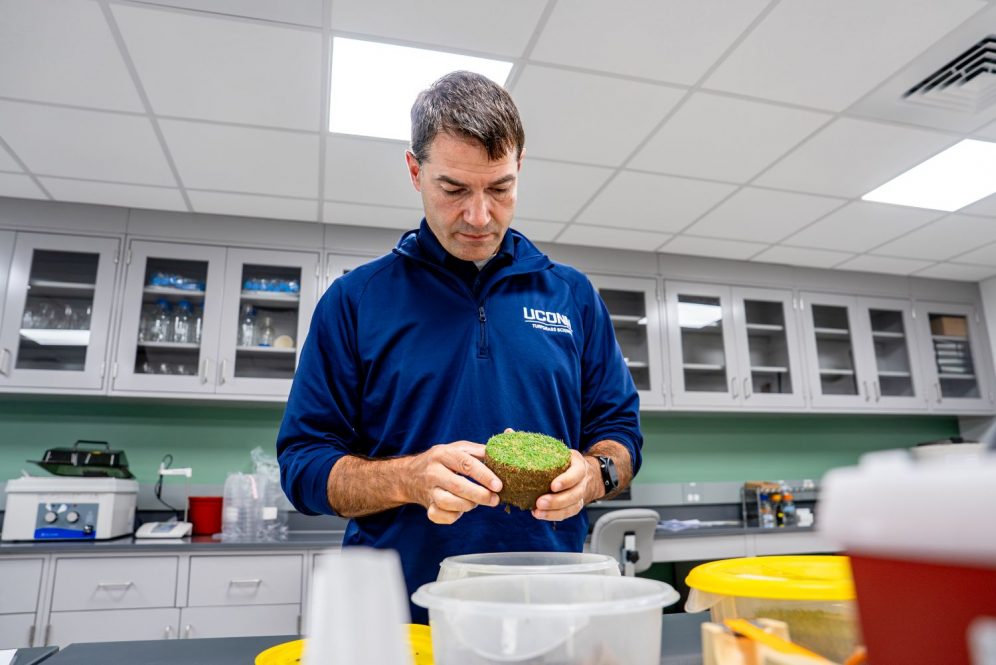
The Turfgrass Disease Diagnostic Lab in the College of Agriculture, Health and Natural Resources (CAHNR) offers valuable services to turfgrass professionals in the state and beyond.
The lab provides rapid diagnosis of and recommendations for addressing turfgrass pathogens and other problems.
The lab serves professional turfgrass managers, including golf courses, athletic fields, and lawn care operators.
“They are observing unexpected performance of their turf,” says John Inguagiato, associate professor of turfgrass pathology. “It could be areas dying out or just not performing as expected. They are looking to address and remedy the situation as fast as possible, so, our lab strives to provide a diagnosis and recommendations to address those problems within 24 hours.”
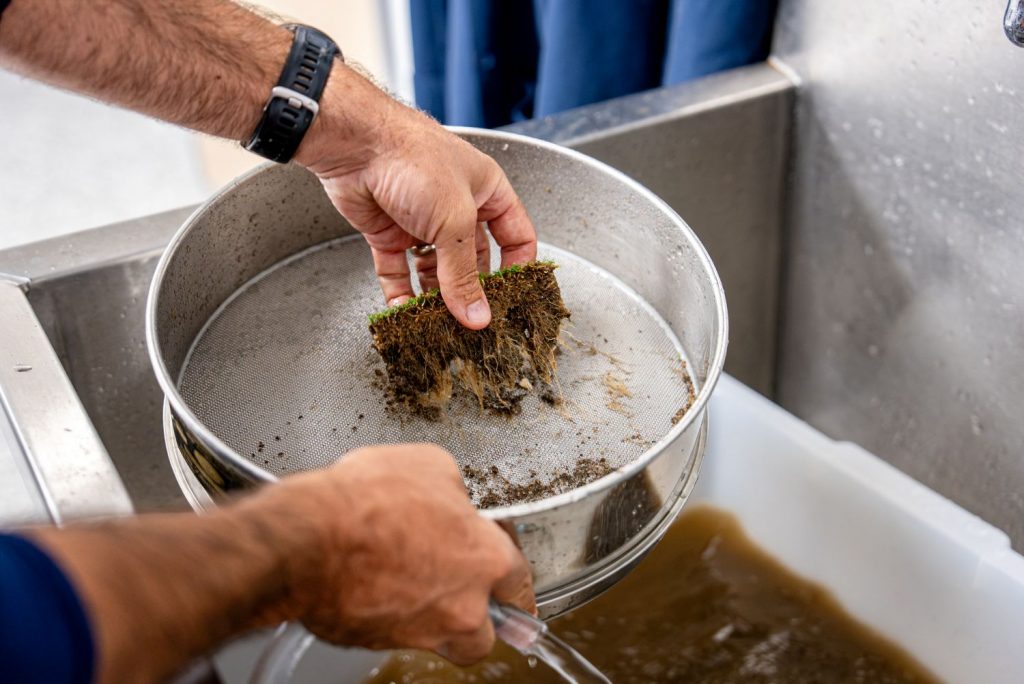
The lab and the experts who staff it can help managers identify if the problem is environmental (like heat or excess water), mechanical injury (from traffic or aggressive cultural practices), or disease caused by a pathogen.
Knowing the root cause of a problem can help managers understand how to prevent it from occurring in the future. Proper diagnosis of a problem can also help avoid unnecessary application of fungicides – saving money, time, and minimizing environmental exposure.
“Some of these problems can be very challenging to diagnose just simply looking at the symptoms in the field,” Inguagiato says. “It really takes sending in a sample and having somebody carefully clean and observe roots under a microscope to be able to observe whether or not a pathogen is present or if there is some other cause.”
With the lab’s recent move into the George Leigh Minor Plant and Soil Health Center, in addition to a space upgrade, the Turfgrass Disease Diagnostic Lab is hoping to offer a nematode quantification service. The UConn Minor Center will host an Open House for the public on October 17, 2026 from 11am-3pm.
“Not every golf course struggles with [nematodes],” Inguagiato says. “But it’s important for them to keep track of their nematode populations and whether they have damaging threshold populations.”
Given that the diagnostic center is staffed by professional turfgrass researchers, occasionally these two streams converge. Recently, Inguagiato and his graduate student Matthew Antunes ’25 ’26 (CAHNR) discovered a new pathogen.
The lab received a sample from a putting green on a Connecticut golf course. At first glance, the sample shared symptoms with a known disease called Brown Ring Patch. But Brown Ring Patch shouldn’t have been occurring at the time of year when they received the sample.
Subsequently, similar symptoms began showing up elsewhere in New England. The lab staff isolated the pathogen, sequenced its DNA, and confirmed that it was a new fungus. They named the disease it causes “Yellow Ring Patch,” and Antunes is preparing to publish his research on the identity of this new fungal species.
“It all came from a sample that came in through our diagnostic lab and our ability to recognize that,” Inguagiato says. “In addition to this characterization, we’re working on management strategies to develop recommendations for golf course superintendents to manage this disease.”
This work relates to CAHNR’s Strategic Vision area focused on Fostering Sustainable Landscapes at the Urban-Rural Interface.
Follow UConn CAHNR on social media