
Growing up in Agartala, India, Bodhi Chaudhuri moved to the United States after receiving his Bachelor of Chemical Engineering from Jadavpur University, Kolkata, and his masters in the same field from the Indian Institute of Science, Bangalore. After his move, Chaudhuri completed his Ph.D. program in Mechanical Engineering from the New Jersey Institute of Technology in 2000.
After completing his education, Chaudhuri worked in the industry for more than three years as a software engineer in telecommunications, computer graphics, and AI/ML technology sectors. With a desire to keep learning, Chaudhuri went to Rutgers for his postdoctoral training. It was at Rutgers where he was first exposed to pharmaceutical engineering. After his time at Rutgers, Chaudhuri secured a faculty program specializing in pharmaceutical engineering at the Department of Pharmaceutical Sciences at UConn School of Pharmacy.
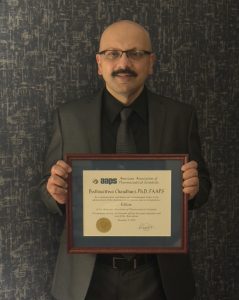
At the School, Chaudhuri’s research focuses on advanced pharmaceutical manufacturing by exploring new ways to make drugs through 3D printing tablets, continuous manufacturing of injectables or inhalable products, and more. Through experimentally valid, multiscale computer models, Chaudhuri’s lab examines materials and processes from the subatomic level to full equipment (meso) scale to design, prototype, and the optimization of cost-effective drug product manufacturing technologies.
Aside from his professor and researcher roles at the School, Chaudhuri is an entrepreneur. Following his passions for modeling, Chaudhuri and chair of computer science at UConn Sanguthevar Rajasekaran created QuaSim, a startup for developing novel quantum algorithms to significantly reduce the computer processing time needed for traditional process modeling of powder handling processes. The applicability of these algorithms in solving real world problems will be demonstrated using simulators and existing quantum machines. Quantum computing leverages the principles of quantum mechanics to perform computations that are infeasible for classical computers.
More recently, Chaudhuri is investigating trends in the pharmaceutical industry as best he can by focusing on continuous manufacturing and machine learning in his lab.
Teaching two professional courses and two graduate courses at the School, Chaudhuri has mentored more than 150 undergraduate, graduate, and postdoctoral students over the past 18 years. In supporting students’ professional endeavors and preparation, Chaudhuri brings 7-8 industry speakers to the School each year and organizes industrial tours of local pharmaceutical companies for students through his role as the faculty chair of UConn’s International Society of Pharmaceutical Engineers (ISPE).
Leila Sharifi and Saeed Najafian are two Ph.D. students under Chaudhuri’s mentorship. Both credit Chaudhuri for his hands-on approach and openness to learning from mistakes. These strategies have helped Najafian and Sharifi stay motivated throughout their research and embrace challenges. Chaudhuri has also encouraged the two to grow their professional skills through seminars, attending conferences, and presenting their research.
Under Chaudhuri’s guidance, Sharifi was honored with the Pharmaceutical Discovery, Development and Manufacturing (PD2M) Award at AIChE’s 2025 Annual Meeting and Najafian received the First Place Academic Award for his research on multiphase mixing.
“Chaudhuri gives his students the opportunity to explore and gives us the space to think and do research.” – Saeed Najafian
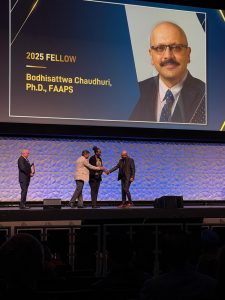
Following last year, when he became an AIChE Fellow, Chaudhuri was inducted as an AAPS Fellow at the PharmSci 360 Meeting. After a highly selective process to honor pharmacists involved in the discovery, development, and manufacturing of drugs and therapies, Chaudhuri was only one of eight fellows selected worldwide. He is recognized for his global leadership in pharmaceutical powder technology and multiscale modeling, along with his pioneering research in electrostatics, 3D printing, heat transfer in granular media, and continuous manufacturing platforms.
Involved in multiple sections within AAPS, including the Manufacturing Science and Engineering section (MSE) and the Northeastern Regional Discussion Group (NERDG), Chaudhuri is strongly involved with the association. Through giving talks, organizing sessions, participating in panels, and supporting committees, Chaudhuri is thankful for this recognition from researchers across the pharmaceutical industry.
“Being named an AAPS Fellow is a tremendous honor.” – Bodhi Chaudhuri
Recognizing UConn as a leader in the shift from batch to continuous manufacturing in drug formulation, Chaudhuri hopes to remain a pioneer in this transition. With an NSF Regional Innovation Engine Proposal at Yale and a recent allocation of millions of dollars for quantum computing, big brands like Pfizer, Merck, and AstraZeneca are funding institutes like UConn, committed to making a positive change.
Collaborating with these big companies, Chaudhuri aims to develop a more efficient and automated manufacturing process that can reduce drug costs and improve patient access.
With his induction as an AAPS Fellow and his 18-year legacy at UConn Pharmacy, Chaudhuri has used a combination of engineering and pharmaceutical modeling to help those in his classrooms, lab, and communities.