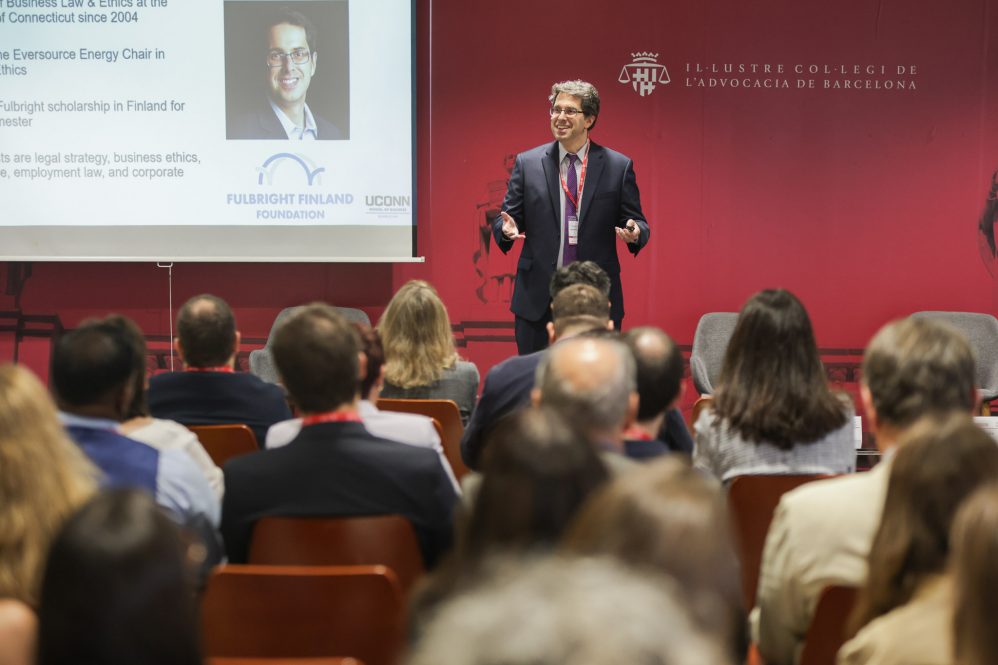
Robert Bird, Eversource Energy Chair in Business Ethics and professor of business law in the School of Business, spent four months as a Fulbright U.S. Scholar at the University of Vaasa in Finland last semester, where he helped create the world’s first Ph.D. program in strategic legal design.
“I really enjoyed the Fulbright experience, and also serving as an ambassador for UConn and the United States,’’ he says. “Finland has a rich academic environment that encourages innovation and interdisciplinary collaboration. My expertise in legal strategy was well received by both business law academics and legal professionals.”
In addition to his academic responsibilities at the University of Vaasa, Bird also delivered 19 lectures to lawyers, compliance professionals, and students across Europe, and built lasting friendships that hold promise for future international collaboration.
“I immersed myself in another country, traveled widely, and befriended warm and welcoming Finnish colleagues,” he said. “My Fulbright surpassed even my own high expectations. It is an experience that I will never forget.”
UConn Today asked Bird about his experience.
How are Finnish business students different from American business students? Are their career aspirations similar?
Finnish undergraduates studying business have similar aspirations as their American counterparts. They want to work in business and experience career success. The Finnish university experience, however, appears to be less stressful compared to its American counterpart. Finnish undergraduates are also more likely to attend graduate school. While students in Finland have high ambitions and work hard like American students do, Finnish students are less grade- and achievement- focused, and I believe less competitive with one another.
Much of this stems from the underlying structure of higher education in Finland. In Finland, university education is essentially free. Finnish students are not burdened with student loans after they graduate, although like American students they struggle to find desirable employment.
What did the students want to know about their American counterparts?
Students were curious about whether the America they saw on television and through social media accurately represented real life. I told them that most of the U.S. does not look like what they would see on social media. Social media usually focuses on highlights, but much of America is more rural and less fast-paced than Finnish students might expect. Not every city in America is Las Vegas or New York.

Students were also interested in American government and politics. I was pleasantly surprised to learn that Finnish students, and Finnish adults generally, are aware of major policy initiatives, political parties, and economic changes in the United States. Finnish students were open to travel a variety of places, including the United States, to learn more about other cultures and bring that experience back home.
What did you enjoy most beyond the academic experience?
I had the pleasure of experiencing a unique Nordic culture. I enjoyed saunas, swam in a pond, and cooked sausage over an open fire with colleagues.
One of the highlights of my trip was picking lingonberries, a Finnish tradition. My colleague escorted me through the woods to a hidden clearing where lingonberry bushes thrived. This was his secret location, and I was honored that he would share it with me. A strong connection with nature is important in Finland, and I found embracing that connection to be one of the most powerful experiences of the Fulbright.
My family visited Finland too, and my wife Laura and I created a traditional Thanksgiving feast. We brought over some genuine American ingredients. Together we made homemade cranberry sauce, and my host and his family delighted in both the food and the idea of setting aside a day for friends, family, and gratitude.
I found the Finnish people to be extraordinarily welcoming. There is a very strong sense of community in Finland. Faculty communicated more on a personal level, spent a great deal of time together, and seemed to enjoy one another’s company. During my four months in Finland, I never ate at my desk, I always took lunch with my colleagues. I felt quite welcome very quickly, and that hospitality is something that I will remember for a long time.
How did you help with the design of the Ph.D. program?
I helped develop a new Ph.D. in Strategic Legal Design. The program is designed for doctoral students who want to understand how legal tools can be redesigned to be clearer, more humane, and more accessible. The program also explores how design methods can be a strategic tool for organizations, and will be the first of its kind in the world.
I was invited to collaborate because of my expertise in legal strategy – the idea that legal knowledge can be a source of value creation for organizations. My book, “Legal Knowledge in Organizations: A Source of Strategic and Competitive Advantage,” explores how legal knowledge can create a competitive advantage for organizations in ways that most companies do not fully appreciate. This knowledge was ideally suited for the doctoral program, a goal of which was to deliver cutting edge instruction to experts in the legal field.
I assisted in developing the curriculum of the doctoral program, helped interview instructors for the program, and agreed to serve as an advisor for the program when needed. Strategic Legal Design brings together two important ideas – a user-centered approach to legal tools with the idea that legal knowledge has strategic potential – under one degree program. Graduates will bring value to organizations with a unique skillset not provided almost anywhere else.
As a university known for its sustainability practices, were you impressed by Vaasa’s energy goals and community commitment?
Like the University of Connecticut, the University of Vaasa has a strong commitment to sustainable practices. They are located in the heart of the largest energy technology center in Northern Europe. Their goal is to achieve carbon neutrality by 2030. The university explicitly ties its sustainability practices to U.N. Sustainable Development goals.
The university also wants to cut its travel-related emissions by 30 to 50% by 2030. From waste management, to catering, and university operations, sustainability remains an important commitment. In that way, it reminds me of UConn’s commitments to sustainability, and how such commitments can be shared with universities around the world.

What was the hardest adjustment to living in Finland?
The hardest adjustment was the different weather conditions. The colder temperatures come faster than we experience in Connecticut. During the winter months, Finland has shorter periods of daylight than we do. Where I was living, the sun rose around 9:30 a.m. in December and it was dark at 4:30 p.m. or earlier. Skies were often cloudy, and you quickly learn to appreciate a bright sunny day as a blessing.
I coped by listening to a Finnish saying: There is no such thing as bad weather, only bad clothing. I also made sure that, when sunlight was available, that I went outside. Frequent cold weather makes you appreciate it more when a day is warmer than expected.
Are there other noteworthy differences between the cultures?
Finns seemed less stressed than Americans. They have a different system of government – education is free and everyone is eligible to receive health care. The cost for Finns is higher taxes, but they are not burdened with the potentially high costs of education and health care that Americans experience. I also sensed lower levels of inequality than what we experience in America.
There is a popular survey reporting that Finland is the happiest country in the world. “Happiness,” however, is not really the right word. There is a strong sense of contentment and life satisfaction that pervades Finnish culture. Finns have their struggles, for sure, but life is lived with a determination under adversity that other countries can learn from. There is a Finnish word, “sisu,” which represents determination, grit, and courage under pressure, which I think captures one of the many things that makes Finland a uniquely “happy” place to live, work, and raise a family.
What is the takeaway that you’ll share with your UConn colleagues?
Spending four months in Finland gave me appreciation for living abroad and a new perspective, but also a greater appreciation for UConn and the impact and reputation of our faculty. When you travel, you recognize that not only do we at UConn have real strengths but that it is recognized around the world. What we teach and research has tremendous value with professionals internationally. Travelling on a Fulbright is something I would recommend to anyone, faculty or student. It is an experience that will reshape how you work and live your life long after you return to UConn.