In the weeks leading up to the start of the General Assembly’s 2026 legislative session on February 4, Connecticut lawmakers were working to determine their legislative priorities.
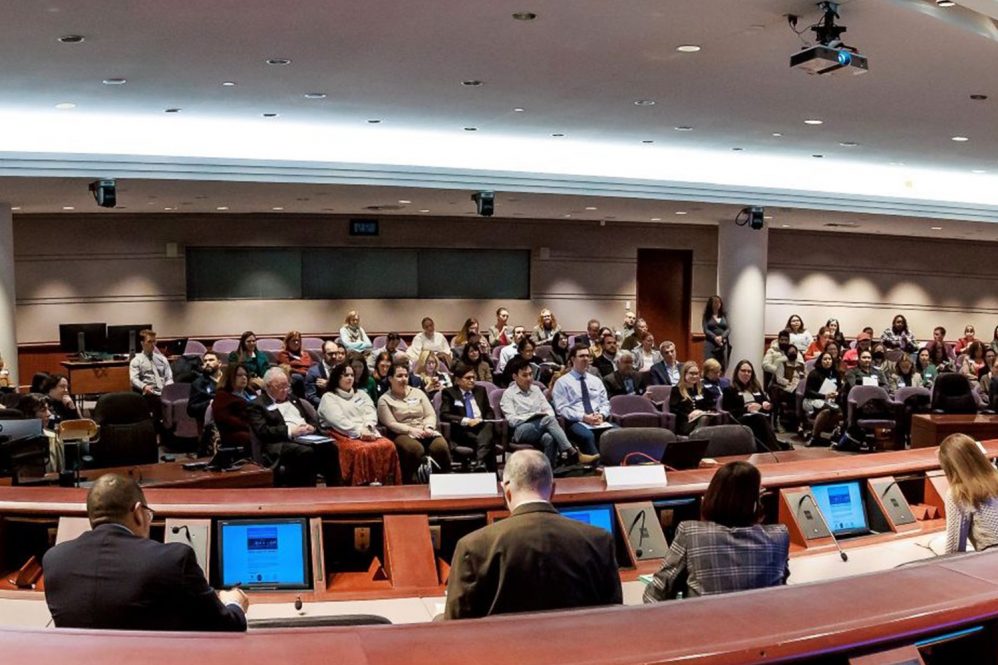
On Thursday, January 15, researchers from across Connecticut, and even neighboring states, gathered at the Legislative Office Building in Hartford to connect with state legislators, policymakers, and state officials to inform the development of evidence-based policy during the upcoming legislative session.
The Moving Beyond Implications: Research into Policy Conference, now in its third year, is a joint initiative spearheaded by state Rep. Jaime Foster ’12 (CAHNR) ’14 MS ’17 Ph.D.; Kerri Raissian, senior researcher at the Yale School of Public Health and co-leader of the Connecticut chapter of the Scholars Strategy Network (CT SSN); and UConn’s Institute for Collaboration on Health, Intervention, and Policy (InCHIP).
The conference is intended to connect researchers, lawmakers, and state officials so they can discuss policy-relevant research and address the state’s need for research pertaining to policy. It is also an opportunity for researchers, academics, and policymakers to build relationships before the session begins.
“All too often, academics don’t know how to reach legislators, and it can be difficult, and it can be intimidating. I can’t think of any other state that’s in its third year of opening its legislative session with an entire day dedicated to evidence, conversation, and keeping the conversation going. This event brings people to the people’s house, and it connects researchers, policymakers and citizens who want to do better,” said Raissian.
The conference has grown significantly since it was first held in January 2024. Attendance at the first conference was strong with more than 150 registrants. However, this year boasted more than 250, with additional attendees registering on-site the day of the conference.
This year’s conference also featured a bipartisan and bicameral host committee, made up of both Democratic and Republican lawmakers. In addition to Foster, the conference was hosted by state representatives Dominique Johnson; Laurie Sweet; Bill Pizzuto; and state senators Jeff Gordon; Saud Anwar; and Sujata Gadkar-Wilcox.
It also featured presenters from beyond Connecticut, including Massachusetts and Rhode Island.
“We’ve come a long way in a very short period of time,” said Foster, a Democrat whose 57th District encompasses East Windsor, Ellington, and part of Vernon. “What if Connecticut became known as a hub for truly evidence-based policymaking? We are now three Moving Beyond conferences later and we are more than triple the size of our first conference. There is more rigor and volume in the academic applications that have come in, and we are now bipartisan and bicameral.”
This year, UConn faculty gave 10 presentations to committees of the General Assembly. Presentations spanned the topics of energy grid resilience, electric vehicle charging infrastructure, hydrogen refueling stations on Connecticut highways, emotion regulation for children, access to birth control and contraceptives, data systems for waste-to-energy policy, disaster vulnerability, climate resilience, genomic newborn screening, and the cost of disinvestment in public health.
In total, 22 presentations were selected through a competitive review process to be given to 10 standing committees of the General Assembly. Researchers could also submit standalone policy briefs to the conference.
“This conference only works if both groups find value. What we’re doing here is helping people identify the correct policy lever to pull in the exact right moment to make the exact right change that will make people’s lives in Connecticut better. My hope is that this room today is filled with hundreds of conversations that will do exactly that. Conversations that will lead to thoughtful evidence-based policy and improve the lives of people across the state of Connecticut,” said Foster.
Attendees also acknowledged the growing erosion of public trust in institutions like science, higher education, government, and national media.
“Let’s not underappreciate the moment that we’re in, when so many of our institutions across the country are losing the trust of people, and higher education is one of them,” said House Majority Leader Jason Rojas. “I think we need to push back on that. I think events like this are helping to counter that narrative about what it is higher education means to all of us as individuals but perhaps, more importantly, what it means to us as a society and individual communities, and certainly as a state.”
Despite challenges at the national level, Lt. Gov. Susan Bysiewicz praised the state’s leadership in supporting scientific research and the advancement of evidence-based policy.

“Connecticut continues to be a model for the rest of the country, and I think a model for Washington D.C.,” she said. “We have in our state capitol legislators from both sides of the aisle and this huge group of thought leaders and academic researchers who’ve come to share their knowledge with us, and you’ve come armed with data and facts and policy ideas. There is no better time to share your knowledge and expertise because right now, each of these legislators is writing bills and putting their committee agendas together for this coming session.”