Social work, says UConn alumna Ilene Garcia, is a lot like a game of telephone.
Somewhere along the way—between systems, agencies, schools, courts, and community providers—the original message can get lost. Resources don’t reach families. Needs go unmet. Communication breaks down.
“And then there’s a loss of connection,” Garcia says. “So we have to be the ones who say, ‘Let me go back and see what’s missing here so that my client gets whatever they need to be successful.’”
Garcia ’24, MSW ’25, a bilingual Licensed Master Social Worker (LMSW) and former UConn School of Social Work Connecticut ¡Adelante! Scholar, now serves as a full-time social worker trainee with the Connecticut Department of Children and Families (DCF). There, she manages multiple active cases each week, connecting families with preventive resources and supports.
“Success is not only being financially stable or providing things for your family,” she says. “It’s well-being — physically, mentally, within the family. As a social worker, I connect parents with the resources they need so the family can be successful.”
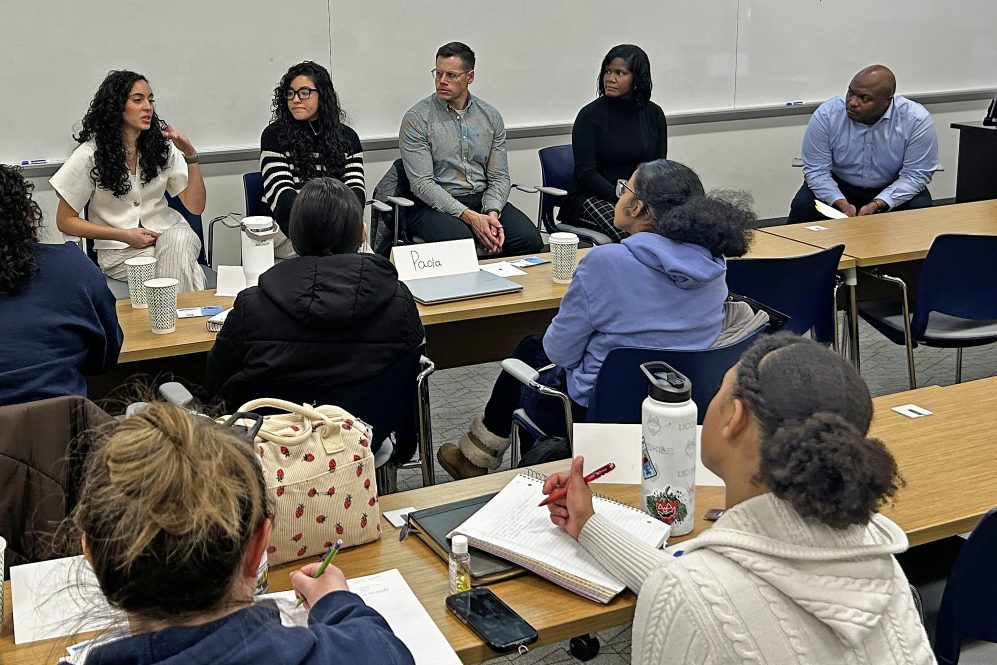
Garcia was one of four speakers who participated in a “Careers for Change: Pathways through Social Work” panel Feb. 10 in the Travelers Collaborative Lounge on the UConn Hartford campus. Presented by the UConn Center for Career Readiness and Life Skills, the panel offered perspectives and advice to students enrolled in SOWK 2000: Social Justice for the Social Work Profession. Wiley Dawson, assistant director of the Center for Career Readiness, moderated the panel and welcomed questions from BSW students.
“It’s important for our undergraduates to learn from social workers who are working directly in the field and to understand the various pathways you can pursue with a degree in social work,” says course instructor Milagros Marrero-Johnson, adjunct instructor and senior director of strategic initiatives and community engagement at the School of Social Work. “Through the panel, our speakers were able to offer students insight into what the experience of being a social worker truly entails.”
Each panelist highlighted a different professional path.
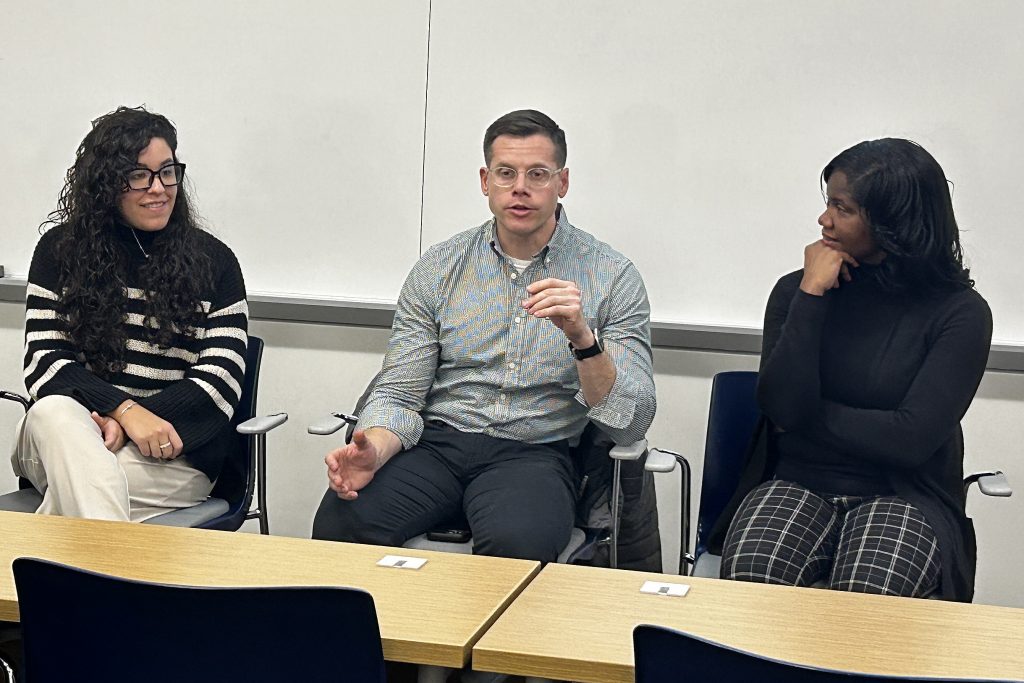
Gus Marks-Hamilton ’03, ’17 MSW, LMSW, an adjunct instructor at the School of Social Work, spoke about his role as a campaign manager at the American Civil Liberties Union Foundation of Connecticut (ACLU-CT). Based in Hartford, he leads advocacy efforts focused on ending the harms of mass incarceration, eliminating racial disparities in the state’s criminal legal system, expanding equitable access to voting rights, and protecting civil rights.
At the state Capitol, Marks-Hamilton works closely with individuals directly impacted by incarceration, many of whom testify before lawmakers.
“These are people who feel dehumanized and are living with a lot of trauma,” he says. “At the Capitol, I make sure that during the four or five hours they spend with me, they feel safe and valued.”
Tynisha Tyson ’05 MSW, also an adjunct instructor, shared her experience as a school social worker with Hartford Public Schools. There, she provides individual and group counseling to students in grades 6–8 who may be experiencing abuse, neglect, food insecurity, poverty, or have an incarcerated parent.
As a school social worker, “you can expect any and everything” to happen on a daily basis, she says. “Our job is to help individuals find a way to deal with what society brought them. We enhance the lives of children and families and look at ways we can improve their lives by empowering them.”
Prior to working in schools, Tyson provided direct therapeutic services—including counseling, group therapy, and family therapy—to children ages 6–18 and families navigating mental health and substance use challenges.
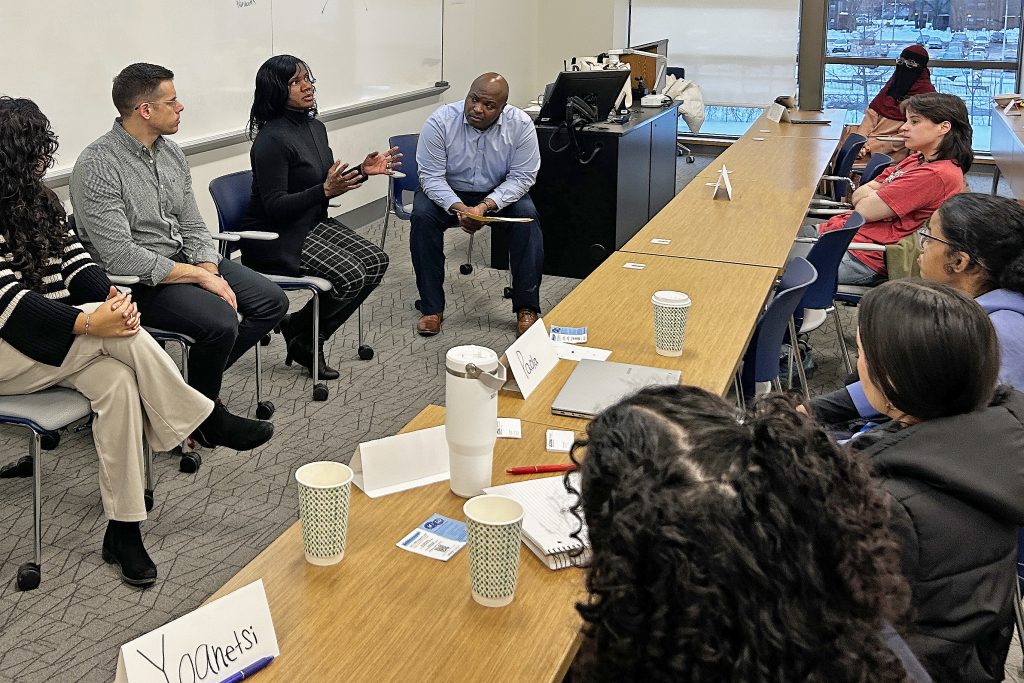
Panelist Michelle Rivera, BSW, works as a program assistant for the School of Social Work’s strategic initiatives and community engagement office, where she helps connect students with scholarships and workforce opportunities aligned with their academic programs and practicum placements.
“In your social work classes, you’re going to have a lot of self-reflection and understand where you are in the world,” Rivera says. “Being culturally aware is very important in this field.”
Rivera, who is also a graduate student at the UConn School of Business, stressed the importance of advocacy.
“You’re not the expert of someone’s life,” she says. “You need to hear from them and, sometimes, hold their hands as you help them navigate. It’s also important to challenge the systems that keep them feeling oppressed.”
The panelists also spoke about maintaining composure in emotionally difficult situations.
“There have been moments where I’m sitting with a client and she’s crying,” Garcia says. “And I feel it. I really feel what they’re going through.”
In those moments, she shifts into problem-solving mode.
“You know how people talk about fight or flight?” she says. “I have to be the one who fights — who says, ‘OK, let’s come up with a plan.’ Even if we can’t control everything, we can at least create direction. Emotionally, it can be very straining. But I always remind myself: there has to be an end goal.”
Garcia credits part of that mindset to her own lived experience as the eldest child and a first-generation college student.
“I think I pull from that part of myself—stepping into action when something needs to get done.”
Tyson says self-care is essential for social workers.
“You have to be intentional,” she says. “You have to set time aside for yourself to do the things that you love, the things that are rewarding to you, the things that are going to give you joy.”