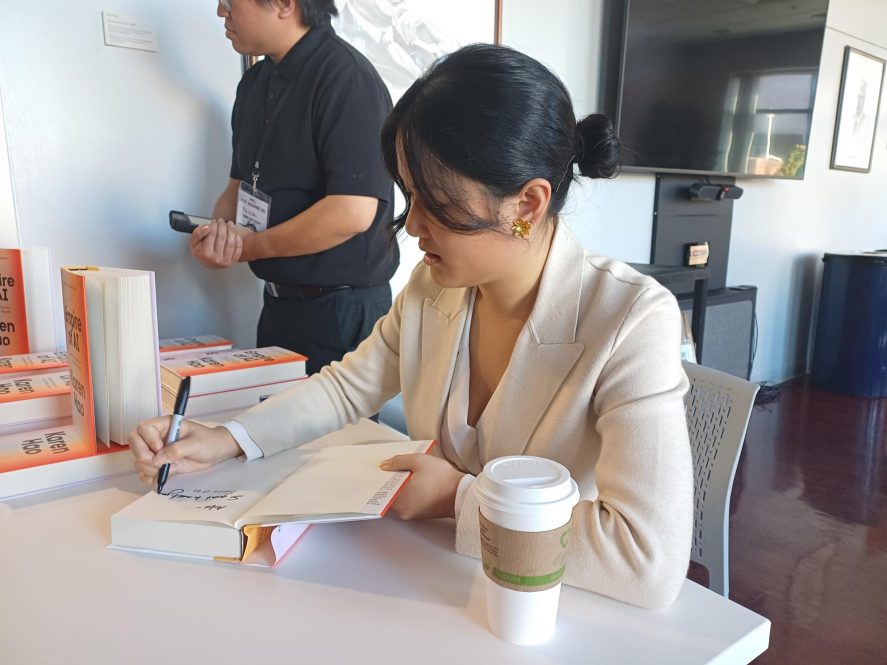
“We need to separate AI from empire,” Karen Hao, author of the New York Times bestselling book, “Empire of AI,” and former foreign correspondent for The Wall Street Journal, said during her talk and Q&A on March 9 at the Dodd Center for Human Rights.
Her presentation, “Empire of AI: How Silicon Valley is Reshaping the World,” got audience members to think critically about what types of artificial intelligence benefit society, and which types don’t. Hao currently leads the Pulitzer Center’s AI Spotlight Series, training journalists globally on AI coverage.
She began by discussing the moral implications of what she called Silicon Valley’s “scale-at-all-costs approach.” Hao shared her interview with Alex Kairu from Nairobi, Kenya, who reviewed and filtered out violent content on websites to ensure people accessed safe AI. He worked for an outsourcing company called Sama. OpenAI wanted a system created where, if someone asked ChatGPT to write something like a method for suicide, the system would refuse. The goal was for AI to filter out harmful responses. However, human workers are essential to teach AI to recognize harmful content such as child abuse or suicide. Kairu’s job was to read descriptions of extreme violence and to then categorize those texts.
Hao said that Kairu’s job exploited his labor by paying him and his team $1.50 to $3.75 per hour. She also said the work caused serious negative effects on their mental health.

Besides the moral consequences of severe underpayment, intellectual property can also be compromised, she said. Hao described how OpenAI collected text for its AI models by transcribing YouTube videos and utilizing content from textbooks and other written materials, raising potential copyright concerns.
Hao also highlighted some environmental concerns stemming from the construction and operation of large data centers — a by-product of the AI industry — such as carbon emissions and air pollution.
Her suggestion was to focus on “small, task-specific AI systems” — either choosing to use or create predictive AI models such as AlphaFold, which forecasts a protein’s 3D structure from its amino acid sequence. Another example is Te Hiku Media, an Indigenous Māori organization in New Zealand that created a speech recognition AI tool to aid in the revitalization of the Te Reo Māori language.
“Every single person can shape technology development,” Hao said, either resisting the AI empire or contributing to the creation of small and task-specific AI systems.
She pointed to a Chilean activist group, “Mosacat,” which challenged the creation of a second data center in their region. Through their continuous pushback, Google agreed to use an air-cooling system rather than water to build an “energy-efficient computing infrastructure.”
Hao stressed the importance of collective action, closing the talk with the words “When people rise, empires fall.”
Students in attendance at the talk found much to discuss afterward.
Millenia Polanco is a first-year Ph.D. student studying engineering education, and came to the talk excited to learn more after reading Hao’s book. She is developing a small and task-specific AI system called “Organize Your Thoughts,” a time management app gathering user data on how individuals currently manage their time based on their preferences. The system will then use that data to predict the best possible schedule users can employ.
Polanco said Hao “encouraged me to keep creating, and there’s no doubt I will.”
Didier Polgar’26 (SFA/CLAS) refuses to use generative AI. Polgar said that when students use large language models to perform tasks, they are inhibiting their critical thinking capacities.
“Prolonged cognitive offloading reduces your ability to think creatively, make decisions, and communicate effectively. This makes you more reliant on tools such as generative AI to fill in these gaps, creating a vicious cycle of dependency,” Polgar said.
Besides their concern for AI overreliance, Polgar referred to the issue of copyright, where artists’ creations were used to train an AI art generator. “Authors, animators, painters, composers, songwriters, and all sorts of other artists have had to watch as massive companies steal their work and use it to train algorithms to produce soulless mockeries of their art,” Polgar said. “I am tired of reading blatantly AI-generated text or seeing AI-generated images when I try to look things up online. I want to learn, think for myself, and continue to make art.”
Alexander Herrera’26 (CLAS) is also strongly against using AI, and said that when individuals use it, their critical thinking skills are suppressed. “Billions of years of evolution have gone into making your brain capable of what it is, and to not use it is the highest form of laziness, in my opinion.”
He also expressed his concern over the amount of water data centers use, often plugging into local, freshwater resources, affecting local residents.
“Generative AI does not have a place in my life, and I continually go out of my way to avoid it. I have never once used AI on any assignment except for one that I asked for an excusal from but was denied,” Herrera said.
“Empire of AI: How Silicon Valley is Reshaping the World” was sponsored by American Studies and the Department of Social and Critical Inquiry alongside cosponsors including the Asian and Asian American Studies Institute, the Office of the Provost, and the Office of Sustainability.