Dear Colleagues,
This week President Radenka Maric and I, along with the UConn and UConn Health CFOs, the UConn vice president for student life and enrollment, and the government relations team, presented at the General Bonding Subcommittee of the state legislature. Just for background you often hear me talk about the “block grant,” funding UConn Health receives from the state, now about 8% of our budget (If you recall it was approximately $200M in FY 25, $143M in FY 26 and will be $138M in FY 27). These block grant funds represent operating dollars or funds we apply to operations such as paying salaries. What I refer to less often are the capital dollars we receive from a state bonding process that we use for deferred maintenance, construction, Information technology, some equipment, and so on.
The bonding process has various steps but the bonding subcommittee’s role is to prepare recommendations for what projects should receive bond authorization, how much bonding authority should be granted and any adjustments to prior authorizations. These recommendations are forwarded to the full Finance, Revenue and Bonding Committee for a vote.
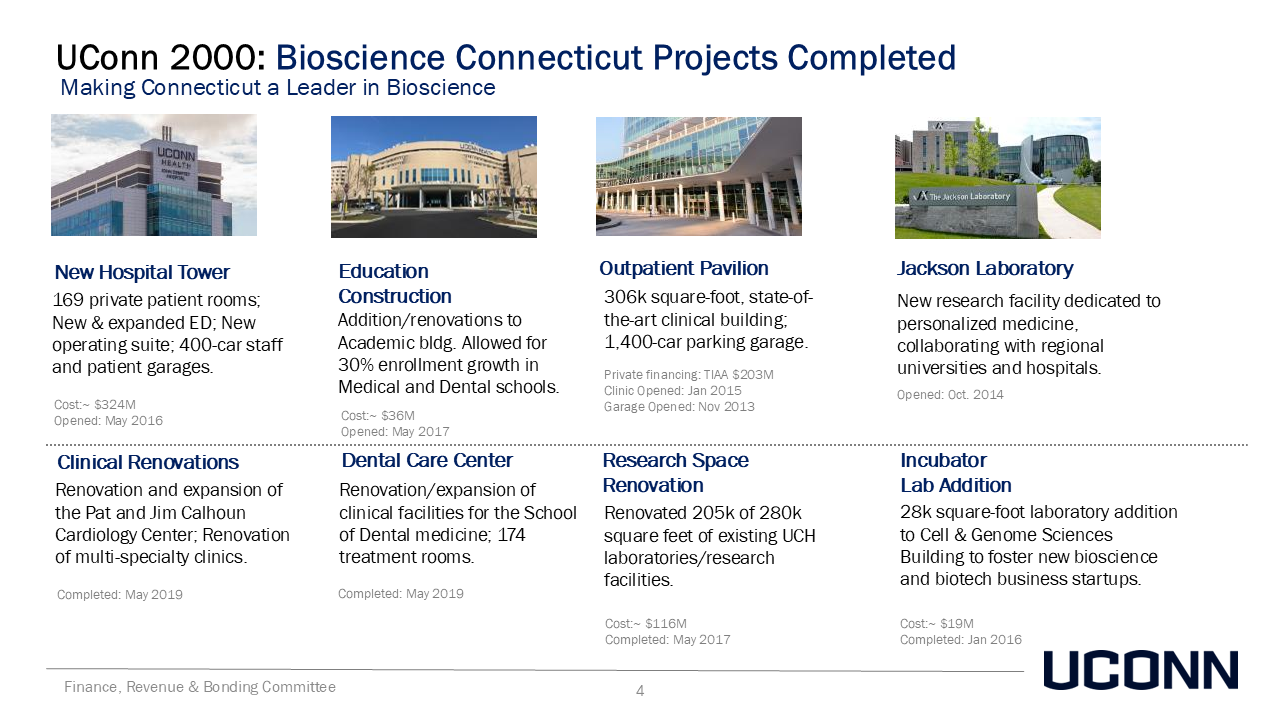
In my testimony I informed the subcommittee that over the past 30 years, the UConn 2000 capital program (i.e. state bonding) has enabled major investments at UConn Health, including:
- A new hospital tower
- Renovations to John Dempsey Hospital and the clinic building
- Expansion of the Cell and Genome Sciences Building to support bioscience startups
- An addition to the academic building to accommodate larger medical and dental school classes
I thanked them and requested that the FY27 authorization (previously approved but not yet disbursed) be maintained.
Specifically we are requesting a total of $43 million comprising:
- $30 million for deferred maintenance to ensure our facilities remain safe, modern, and compliant with codes and accessibility standards.
- $13 million for clinical equipment and IT security, which supports:
- replacement of aging equipment
- protection of patient data
- strengthening cybersecurity infrastructure and monitoring.
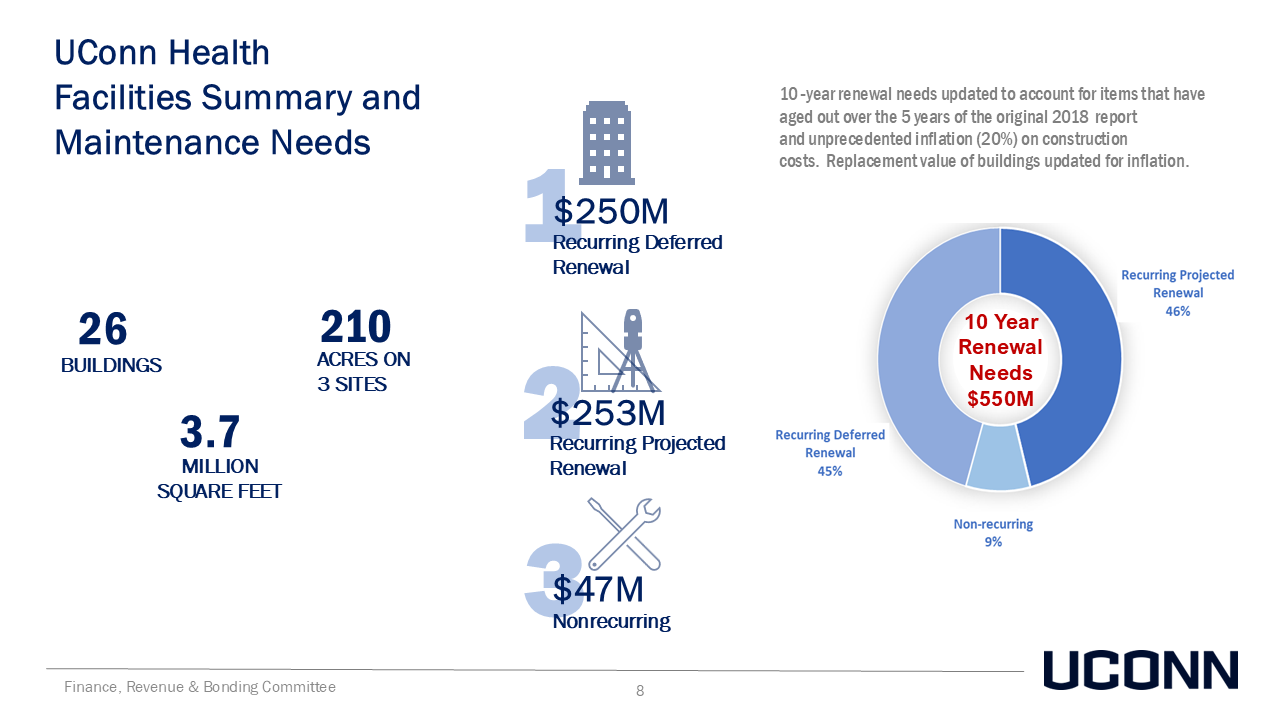
In case you are wondering, as you can see from the graphic below, we have approximately $500M in capital needs. From a definition standpoint, “Recurring Deferred Renewal” represents items at or past the end of normal useful life that have not been addressed, whereas “Recurring Projected Renewal” represents the items that are projected to be at the end of normal useful life within the next 10-year period. Finally “Nonrecurring Renewal” consists of modifications or repairs necessary to comply with fire/life safety etc. These are considered one-time projects. Sample projects are Stair Railing Replacements and elevator upgrades to meet accessibility requirements.
I also thanked the subcommittee for their support in authorizing the bonding for the UConn Health Waterbury partnership.

By the way, this week we also held the first regular UConn Health Community Network Board meeting to approve capital expenditures, and review growth plans.
Switching gears, this week I and the UConn Foundation also met with donors to discuss UConn Health’s exciting strategic initiative called the UConn Health AI Institute. The blueprint is still in the development stage, but we anticipate the AI Institute will include the following components:
- Centralized health care clinical, and operational Innovation
The Institute will act as a strategic hub coordinating AI development, and commercial collaboration for rapid local and nationwide impact. - Clinical and operational validation at UConn Health
With appropriate governance and safeguards, UConn Health will validate suitable AI solutions for clinical, research, and operational application. - Commercialization partnerships
The AI institute will partner for the commercialization expertise necessary to prepare AI innovations for market and sustainability. - AI venture activity
If funding is available, the AI institute will likely have an AI Venture aspect which could be student-led, AI institute guided.
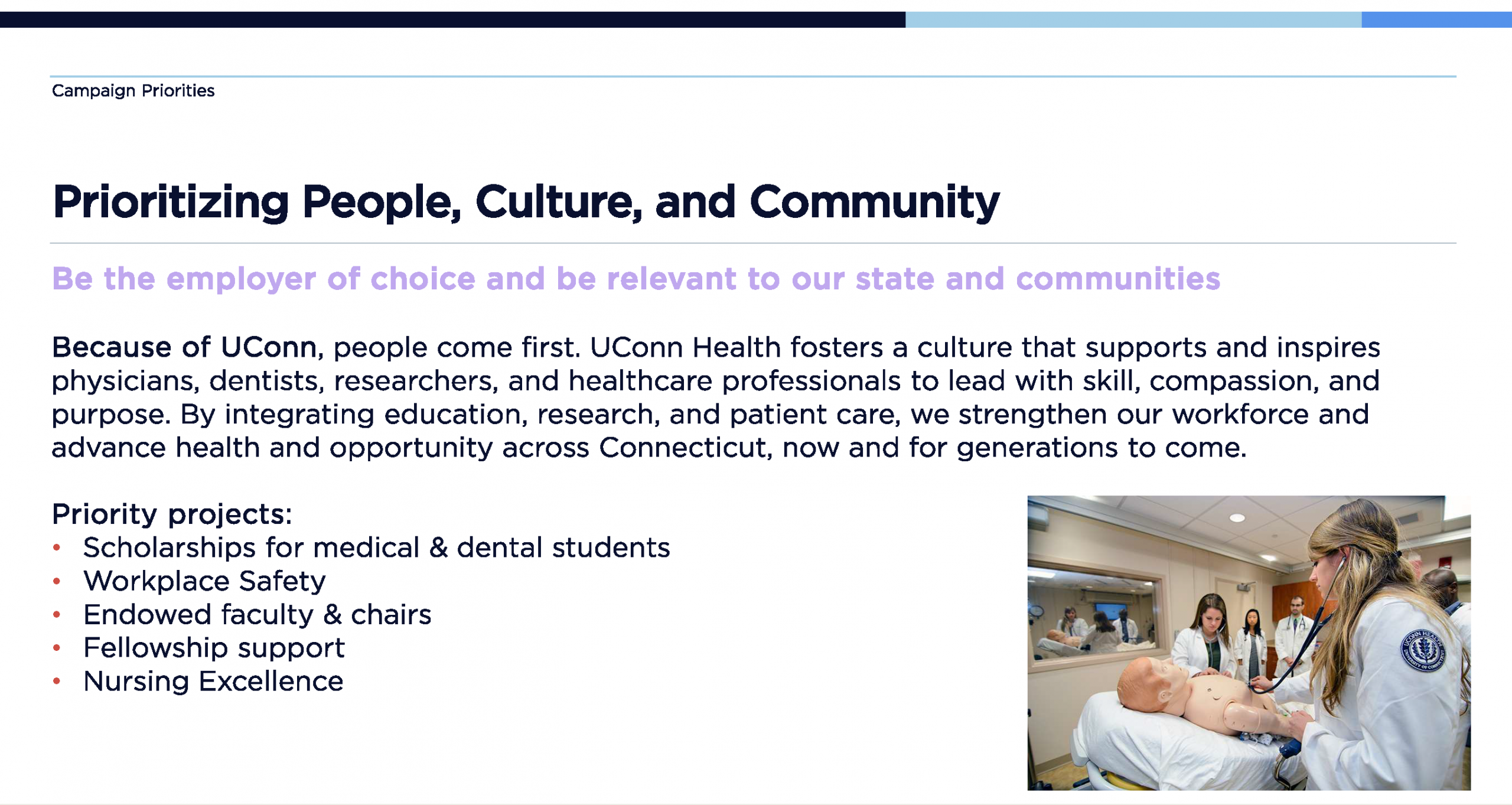
Talking about philanthropy, this week I also presented to the UConn Foundation at their Campaign Leadership Committee Meeting and highlighted the need for funding for a new Labor and Delivery facility.
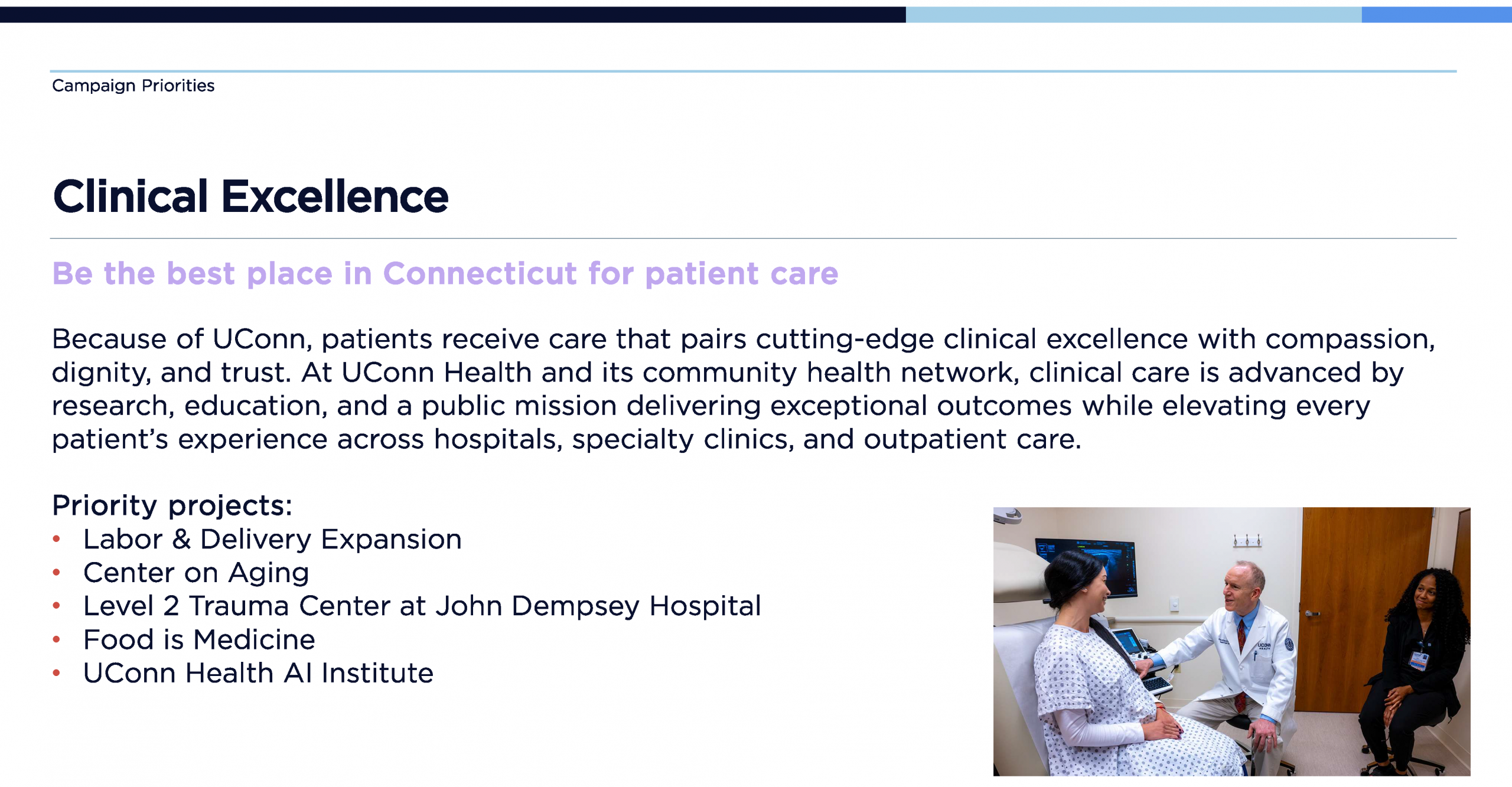
Other priorities that we discussed are noted below:

There have been some significant achievements this week. First, I would like to congratulate Kevin Chamberlin, AVP and chief pharmacy officer, and his team for securing approval by the CT Commission of Pharmacy for the retail pharmacy that will open later this year within the walls of John Dempsey Hospital.
Thanks to those who submitted ideas, we’re calling it the Blue Oak Pharmacy. As Kevin tells us, “We look forward to provide retail pharmacy services to our staff and patients that will enhance our Meds to Beds service and allow for after-hours pickup via medication lockers. Stay tuned for more information on Blue Oak Pharmacy as we approach the anticipated opening in late fall 2026!”
I would also like to congratulate Dr Enrique Ballesteros, chair of our Department of Pathology and Laboratory Medicine, and his team for securing ACGME accreditation for a pathology residency program. Congratulations as well to Dr Gahie Nam, pathology residency director, and Liz Barrientos, program coordinator, for all their efforts to get the new residency approved. I’d also like to acknowledge Dr. Steven Angus, assistant dean for graduate medical education, GME Director Martha Wilkie, Dean Bruce Liang, Dr. Kiki Nissen, senior associate dean for faculty affairs, and CFO Jeff Geoghegan for all their support for this new program.
As Dr. Ballesteros tells us, “This is an exciting new chapter for pathology at UConn Health that will support continued growth in diagnostic services, education, and scholarly activities. It will be a great privilege to educate the next generation of pathologists!”
Finally, speaking of accreditation, I am proud to learn this week that the Accreditation Council for Continuing Medical Education (ACCME) has bestowed upon our medical school’s Office of Community and Continuing Medical Education its highest level of recognition. With the ACCME’s Accreditation with Commendation comes the longest accreditation term possible, six years. Please read more about this on UConn Today, and join me in congratulating Dr. Christine Thatcher, associate dean for medical education and assessment, and Dean Liang for their success in continuing to elevate the UConn School of Medicine.
Although we have made good progress we are not quite finished seeking fair rates from health insurance companies. I wanted to give you an update on our ongoing negotiations with Cigna. We have been working to secure a new agreement that reflects the real cost of delivering high-quality care to our patients. While we continue to negotiate in good faith, Cigna’s current proposal does not represent fair or sustainable terms.
If we are unable to reach an agreement by April 30, 2026, both UConn John Dempsey Hospital and the UConn Medical Group providers and facilities will become out-of-network for patients covered by Cigna. Behavioral health services, and all providers and facilities that are part of UConn Health Waterbury Hospital, UConn Health Waterbury Health at Home and UConn Health Community Network Medical Group are not affected and will remain in network. Fair and sustainable agreements with insurers are essential to ensuring we can continue providing high-quality care to our patients and communities.
We remain committed to the negotiation process and hopeful that we will reach an agreement before the deadline. Additional information is available at uconnhealth.org/cigna
As we grow our UConn Health Community Network, beginning with our Waterbury partnership, our IT team has a critical — and largely unseen — role in enabling seamless, connected care across our community partners, both present and future.
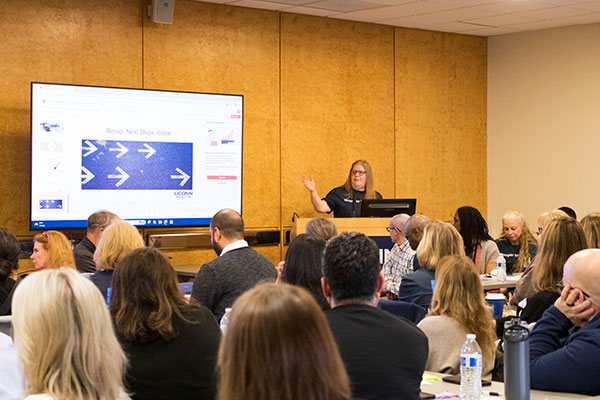
Monday IT held a leadership summit to reflect on our implementation of our electronic health record system Epic in 2018 and define where we are heading next, based on a forward-looking approach to scaling Epic and supporting future growth. We are building on our strong foundation of experience as we prepare to implement the UConn Health Community Connect program, a strategic extension of Epic that enhances EHR compatibility throughout our network. The vision is to share our Epic system with partner organizations and provide the IT services needed to build, run, and support Epic for them under a shared governance model.
I’d like to acknowledge Ingrid Napoletano, AVP for IT clinical systems, and our entire IT staff, under the leadership of CIO Rick McCarthy, for their work to ensure these transitions happen securely and effectively.
Here’s a letter from a patient in praise of Justin Krajcik, one of our phlebotomists:, I’d like to share:
Justin was the only employee in the lab the morning of a snowstorm. He drew everyone’s labs and was so pleasant when he came out to the waiting room. He also offered to take my type and screen to the main lab himself if the couriers were not available.
Thank you, Justin, for your excellent service and willingness to go above and beyond!
I’d like to close this week with a reminder that Monday, March 30, is Doctors’ Day — a day we take a moment to acknowledge and appreciate the dedication of our physicians, dentists, and researchers. My leadership team and I are grateful for your commitment to your patients, your students, and your science, not just today, but every day.
I invite you to watch this short Doctors’ Day video, which shows our impact on our state’s health care workforce, and join me in saying thank you to our physicians, dentists, and researchers:
And thank you — to everyone reading this — for all the work you do.

Andrew C. Agwunobi, MD, MBA
Chief Executive Officer
EVP for Health Affairs
UConn Health
Dear Dr. Andy
While I understand this has been a heavy winter and our grounds team is working hard, the parking garages (especially Garage 1) often do not get cleared out and it is unsafe. The snow drifts inside the garage, in addition to the untreated ice is not only unsafe for staff who are walking in, but for patients being seen. I have personally slipped multiple times and have watched others slip as well. Is this something that is being looked at during the storms? It seems that it is often not being treated until days later, if at all. In addition to the unsafe walking conditions, cars are often going the wrong way down one-way areas and speeding past pedestrians who are walking in the building. Is this an area that our officers are monitoring or could be monitoring? Thank you for your attention to this safety matter.
Thank you for raising these concerns, which I’ve shared with our leaders in parking, grounds, and University Safety. Our grounds crew does remove snow drifts from garages; the volume of snow and prolonged below-freezing temperatures this winter presented extraordinary circumstances, causing this to take longer than normal.
As J.J. Odom, our building and grounds director, explains, the majority of our focus during and immediately after the storms was clearing the surface lots to ensure there was adequate space for parking. Additionally, the timing of the back-to-back storms created further challenges with keeping up with all areas simultaneously. It’s important to understand that the work continues long after last snowflake falls.
Our grounds crew takes a number of steps as a matter of routine to mitigate winter-related issues, and does an excellent job overcoming conditions to ensure parking areas are cleared, walkways are treated, potholes are patched, etc. It can be easy to take this for granted, and I’m glad for this question because it gives us an opportunity to reflect on the outstanding work this team does every day — even around the clock when needed. So I would like to take a moment to thank our grounds crew members for their outstanding efforts.
Regarding vehicle traffic in the garages, Chief Justin Gilbert reports his officers have been emphasizing enforcement of unsafe travel throughout campus and are paying attention to the garages as part of that.
Thank you again for your questions.
Have something you want to ask Dr. Andy? Submit your question on The Hub.
Hub Highlights
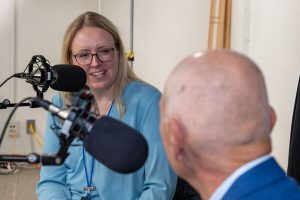


Dr. Kristina Zdanys and Dr. Anthony Alessi discuss dementia on the latest “Healthy Rounds” podcast.
Preview our 2026 NCAA Tournament TV ad featuring Coach Geno.
Students, residents, postdocs shine at the UConn Musculoskeletal Institute’s 20th Research Day.
Learn how our Health Disparities Institute supported the third annual Black Family Wellness Expo in Hartford.
Congratulations to our medical school’s Office of Community and Continuing Medical Education for earning Accreditation with Commendation!
Meet Dr. Ashton Lemann, who recently joined our ear, nose and throat practice.
Plus, the latest School of Medicine e-newsletter is now available.
Visit The Hub
Note: Unlinked content is only available on The Hub, for which you must be on the UConn Health network to access.