As a recent transfer student from Connecticut State Community College – Manchester in the Fall of 2020, Lucas Ruiz ’23 (CLAS) pursued his interest in history through courses with professors Alexis Dudden and Frank Costigliola – a decision that set him on a path that would eventually lead to publishing in the Bulletin of the Atomic Scientists, becoming the first-ever Fellow with the Oppenheimer Project, and convening meetings of world experts on nuclear weapons policy.
In courses like “War and Diplomacy in East Asia” with Dudden and “The Rise of U.S. Global Power” with Costigliola, the East Hartford native learned not only about contemporary geopolitics, but new ways of thinking and seeing the world. It was during a course with Costigliola, “Personality and Power in History,” that Ruiz became enthralled by the importance of individual policymakers in history. Walking across the Student Union lawn with Costigliola after class, he would ask probing questions about the field of diplomatic history, and together they would ponder the implications of historical insights on contemporary affairs. Over time, Ruiz said their relationship taught him the true value of mentorship.
After expressing interest in graduate school, Costigliola helped Ruiz secure a research grant through the Department of History for the summer entering his senior year of college, working under Dudden’s oversight. He immersed himself in the archives and conducted primary research on the relationship between the Korean independence leader Kim Koo and the U.S. military government in southern Korea during the mid- to late-1940s. With Dudden’s help, he learned that the historian’s task is not just to document, but to interpret to the best of their ability.
“It was kind of like a trial run for grad school,” Ruiz says.
While working on Costigliola’s farm in Storrs as his first job post-graduation – helping care for 14 cows, 4 sheep, a small garden, and 200 acres of land – Ruiz had the mind-opening realization of applying the research and analytical skills he developed during his summer historical research to contemporary affairs.
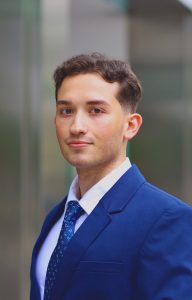
Shortly after that, Ruiz became the first person from UConn to win the prestigious Herbert Scoville Jr. Peace Fellowship. He decided to spend his fellowship at the Henry L. Stimson Center in its Reimagining U.S. Grand Strategy Program. Translating methodologies learned at the UConn History Department to contemporary policy analysis, Ruiz worked across multiple different foreign policy domains such as cultural and regional diplomacy to broader questions on U.S. nuclear weapons policy.
While at the Stimson Center, Ruiz co-authored “Gambling on Armageddon,” a report examining the historical and contemporary influences on U.S. nuclear modernization and strategy.
“Nuclear policy is a deeply particular cultural phenomenon,” Ruiz says. “The way that the United States constructs its nuclear policy is shaped by historical, personal, and societal experiences that are uniquely American, and which cannot be projected onto Russian or Chinese nuclear perceptions. Their nuclear thought is shaped by their own history, culture, ideas, and experiences.”
The “Gambling on Armageddon” report allowed him to publish a follow-up essay in the Bulletin of the Atomic Scientists – a nonprofit and online publication providing readers with information essential in reducing man-made existential threats. It was a shorter essay attempting to incentivize the Trump administration to follow through with the president’s comments that the U.S. and other nations should attempt to denuclearize on a global scale.
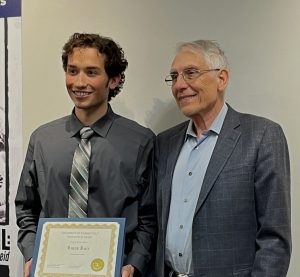
Charles Oppenheimer, founder and co-director of The Oppenheimer Project and the grandson of J. Robert Oppenheimer – the director of the Manhattan Project – read Ruiz’s essay and reached out to him via LinkedIn. After a relationship was established, Oppenheimer was so impressed that he established a new fellowship, with Ruiz as the inaugural recipient.
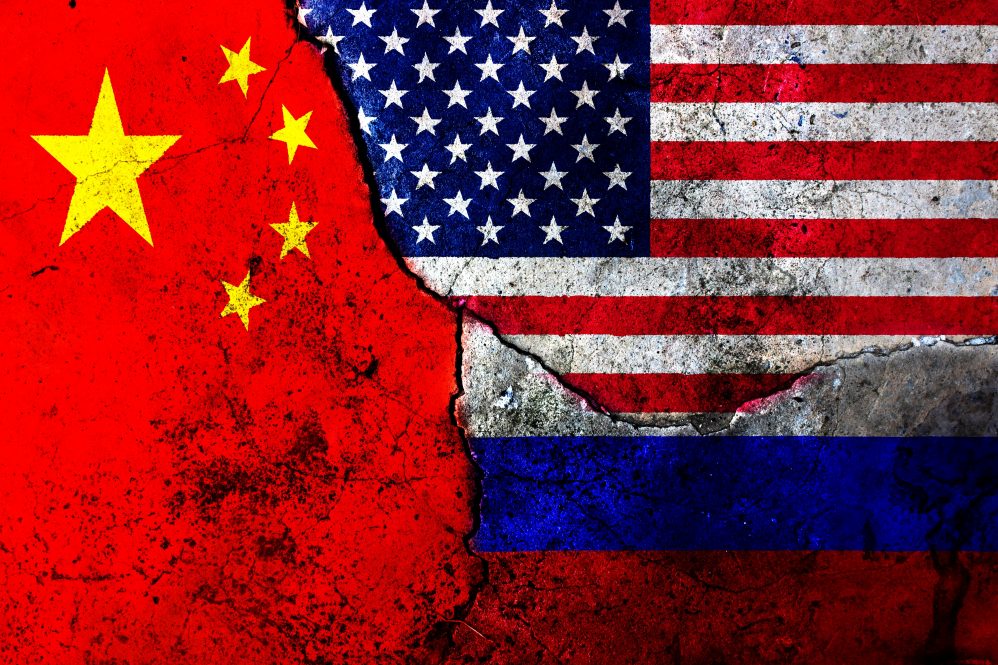
Now, as an Oppenheimer fellow, Ruiz analyzes the complex and often volatile relationship between China, Russia, and the U.S. by examining the leadership of each state.
“I think that the personalities and the individuals that lead these states are of paramount importance,” Ruiz says. “I have found that no two people have the exact same perception of the world. When thinking about how the United States can engage Russia, you have to think about how can the president of the United States engage the president of Russia?”
On Feb. 3, Ruiz combined both the organizations he has experience working in – the Stimson Center and the Oppenheimer Project – to convene an online event covering the expiration of the New Strategic Arms Reduction Treaty (New START) between the United States and Russia on February 5, 2026. The treaty was the last arms control agreement between the two powers, constraining the number of strategic nuclear weapons that each side could deploy. He helped gather three American experts and three Russian experts to have a virtual conversation on the current implications and opportunities heading into the future for renewed engagement. It was the only public event held in the global sphere with Americans conversing with Russians on the topic.
“I was really happy to know that we had about 300 participants, and a number of them were from the National Security Council, the State Department, and the Pentagon,” Ruiz says. “There were also people from the Russian Foreign Ministry who had attended.”
Ruiz is actively building on his initiative for policy dialogue, organizing private gatherings held between experts from each respective country to discuss what the future of their relationship can look like. He is also committed to bringing in cross-partisan, multi-disciplinary voices from emerging generations into the key foreign policy discussions of today and the future.
Ruiz’s goal is to “breathe new life into the nuclear community, trying to position the Oppenheimer Project as a platform and convener for new voices, new ideas, and a new generation of nuclear policy thinking and expertise.”
“Millions of people could die if the relationships [among the major powers] are mismanaged, and a nuclear exchange is initiated even between two of the three,” Ruiz says. “Progression of human civilization could be severely limited by the non-interaction between each state. When we think about technological advancements, breakthroughs in health care, developments in education, life expectancy, and lowering infant mortality, there are a number of things that could be shaped by a mismanaged relationship between these three parties. Ultimately, they are the most powerful countries in the world. The United States and China alone have around 1.8 billion people whose lives matter and who have immense resources they can use to propel human civilization toward a more prosperous future, or to impede it. My goal is to make sure they choose the first option.”
Looking back on his journey from transfer student to foreign policy scholar, Ruiz says similar paths are open to any student with dedication and passion.
“You have perspectives, you have knowledge, you have experiences that other people don’t. Those are all advantages that you have. Even when it seems like the odds are stacked against you, you have to give yourself a chance to leverage what advantages and experiences you do have to do the kind of work that you are passionate about.”