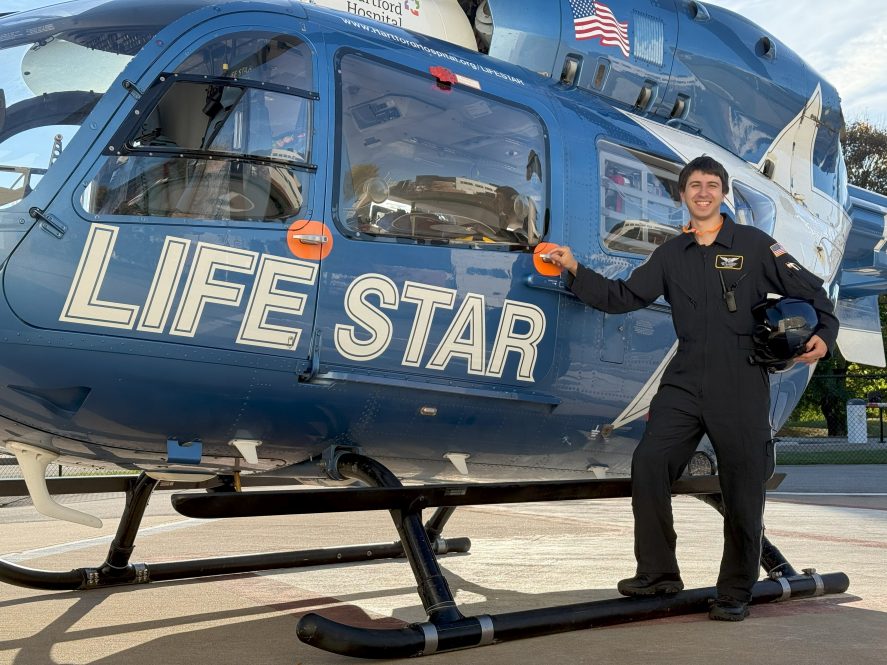
Since high school, Elisabeth DeLuca School of Nursing alumnus Justin Pedneault, RN, CFRN, FP-C, has dreamed of becoming a flight nurse. Now in his second year with Hartford HealthCare’s LIFE STAR program, that dream has become a reality.
“My path to becoming a flight nurse began in my freshman year of high school, when I wrote a research paper about Helicopter Emergency Medical Services pilots,” says Pedneault. “While writing that paper, I had the honor of interviewing Richard Magner, ‘Rocky 1,’ the first pilot of Hartford Hospital’s LIFE STAR program. From that moment, I set my sights on becoming a flight nurse for LIFE STAR.”
Growing up, Pedneault was exposed to the healthcare field and emergency medicine, as his father was an Emergency Medical Technician (EMT). He followed in his father’s footsteps, completing his EMT training at 16 after spending time as an Emergency Medical Services (EMS) explorer with the Suffield Volunteer Ambulance Association.
He then decided to pursue his bachelor’s degree at the Elisabeth DeLuca School of Nursing while continuing to volunteer as an EMT. To jumpstart his path to becoming a flight nurse, he joined the LIFE STAR mentorship program—a program designed to help healthcare providers prepare for careers in critical care transport.
After graduating from UConn Nursing in 2019, he worked as a registered nurse (RN) in the Medical Intensive Care Unit (MICU) at Hartford Hospital. When the COVID-19 pandemic hit, he returned to paramedic school through Hartford Hospital’s Center for Simulation, Education, and Innovation.
Working alongside his father—an EMT and adjunct faculty member in the UConn Master of Science in Accounting Program—Pedneault gained valuable real world experience as a paramedic, training and practicing in Suffield , while continuing to work in the MICU as a nurse. In April 2024, he applied to join LIFE STAR and was selected as a flight nurse across all three flight bases: Meriden, Norwich, and Westfield Massachusetts.
“As a flight nurse with LIFE STAR, I work three 12-hour shifts a week, similar to nurses working in-house,” says Pedneault. “Some shifts include numerous flights, while others involve ground-only transports due to bad weather. We also participate in outreach and educational events while on shift and occasionally have shifts with no calls for assistance.”
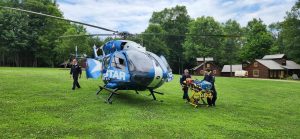
A typical shift for Pedneault includes reviewing the previous shift with the outgoing crew, exchanging radios and keys, checking aircraft equipment, and attending a virtual briefing with team members across the program. After the briefing, he and his partner complete daily tasks, fulfill required education, review recent patient cases, and prepare for the day ahead.
“Outside of the 36 hours of flight shifts, we have biweekly education and case reviews, as well as annual safety and skill days. Each year, we also complete clinical rotations across the hospital system to stay up to date on the latest treatments,” he says.
Pedneault attributes his success in becoming a flight nurse to UConn Nursing. During his time as an undergraduate, he took advantage of many opportunities offered by the school and university, including the Healthcare Simulation Society, the Nursing Learning Community—serving as a Nursing Class of 2019 officer—and the Student Nurses’ Association (SNA).
Through SNA, the chapter was recognized by the National Student Nurses Association (NSNA) as a Stellar School—a distinction awarded to chapters demonstrating sustained involvement and a strong commitment to professional development and shared governance.
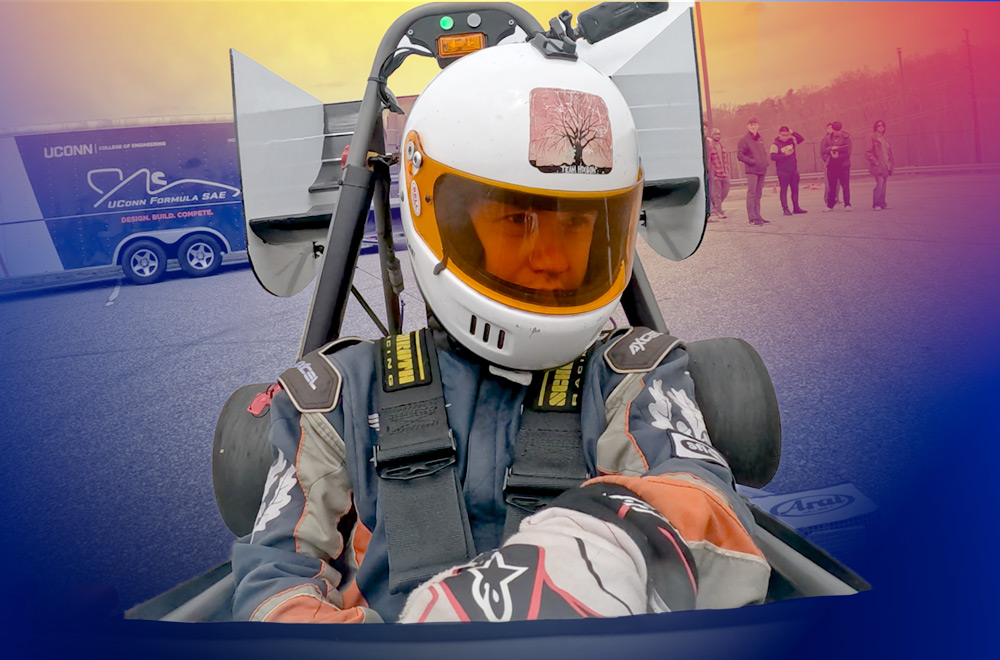
His commitment to the UConn community extended further through UConn Rescue, a student-run nonprofit organization, where he developed and launched a training program providing CPR/AED/Stop the Bleed (STB) classes to students, faculty, and staff.
Throughout his academic career, he built strong mentorship connections, including Associate Clinical Professor Carrie Eaton, Ph.D., RNC-OB, C-EFM, CHSE, who worked with him when he served as a Resident Assistant for the Nursing Learning Community.
“Through my work with Dr. Eaton and my extracurricular activities, the University launched a project to place AEDs and STB kits across campus, forming the University AED Committee,” Pedneault says. “Through this committee, we placed hundreds of AEDs and STB kits in buildings across all UConn campuses. These achievements were possible because the opportunities were there, and I was supported in pursuing them.”
In addition to his involvement outside the classroom, Pedneault is grateful for the clinical instruction and training he received, which helped him complete his capstone clinical in the MICU at Hartford Hospital. These experiences accelerated his ability to gain critical care expertise and qualify for a flight nurse position.

Pedneault continues to stay involved in the nursing and emergency response community. He volunteers as a paramedic in Suffield, serves on the Board of Directors, chairs the Clinical Care Task Force, and provides medical oversight for his Boy Scout troop.
“I am also an alumni advisor and the AHA Training Site Coordinator for UConn Rescue, continuing to support student leaders running the nonprofit organization,” he says. “I am currently in my second semester at Post University’s American Sentinel College of Nursing, where I am enrolled in the MSN/MBA dual-degree program.”
With a demanding job and a growing family, returning to school was not an easy decision. However, he remains motivated by his goals of leadership and continued education, aiming to better understand the healthcare system and improve patient care.
“My motivation to become a nurse was part of my goal to become a flight nurse and is ultimately rooted in my desire to be the best part of someone’s worst day. I want the skills, experience, and autonomy to provide the highest level of care, doing whatever is necessary for the patient I am caring for,” says Pedneault.
Every day, he is inspired by his work, his colleagues, and the patients he serves—driving him to continue learning, growing, and striving to be the best healthcare provider he can be.
“For students interested in becoming flight nurses and entering the field of critical care transport, I recommend gaining as much critical care experience as possible,” says Pedneault. “As my career path shows, many factors contribute to success and achieving your goals. I encourage every student to take advantage of every opportunity available to grow and learn.”