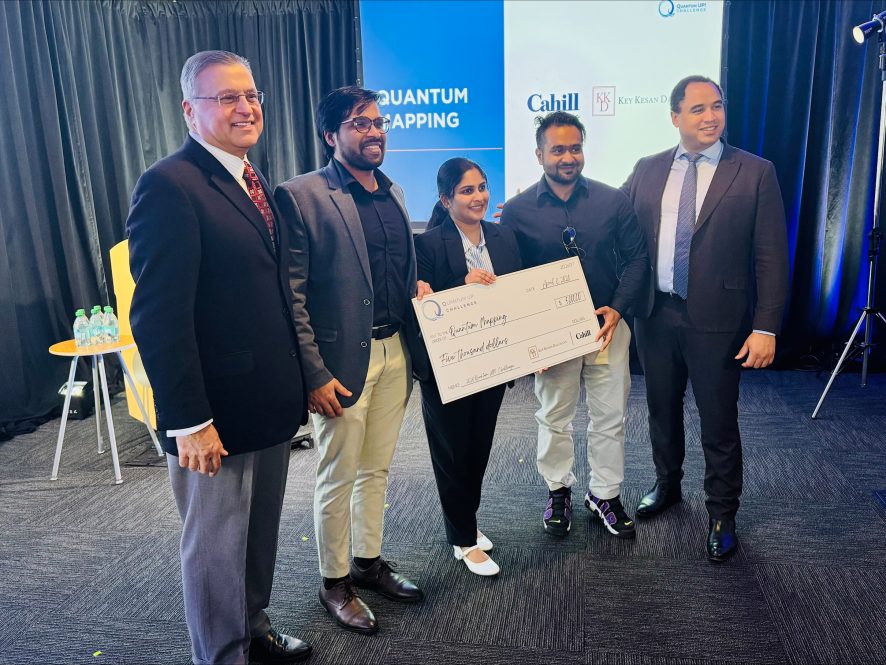
Two student teams from the UConn School of Business’s Business Analytics and Project Management (MSBAPM) master’s program won competitions at the QuantumUP! hackathon at the UConn Graduate Business Learning Center in Hartford on April 8, combining cutting-edge technologies, innovation, and collaboration to solve complicated transportation issues. Both teams will be awarded $5,000 prizes.
The hackathon, co-hosted by UConn’s Technology Commercialization Services (TCS) and QuantumCT, aimed to engage UConn students and peers across the state in conversations about how advancements in technology are poised to transform Connecticut’s economy. Sponsors included national law firms and industry partners who provided real-world challenges for the teams of students. Areas included business applications, policy, legal and intellectual property considerations, ethical and social implications of quantum technologies, and quantum adoption strategies.
“In simple terms, our project is like a smart-navigation system for logistics companies,’’ said Aditya Raj, who competed on a team with Uday Pandey and Suhas Narahari. “Instead of just finding the shortest route, it considers multiple factors like cost, time, and resource usage all at once.
“We used advanced techniques inspired by quantum computing, along with machine learning, to make better decisions faster. We also built a live dashboard where users can change inputs, like demand or routes, and instantly see the best possible results,’’ he said.
Meanwhile another team, composed of Trishan Kundu, Maria Abraham and Eldhose Kochakkan Varghesekutty, addressed challenges around traffic patterns, public transportation intervention, and city logistics in Manhattan. They devised a hybrid classical and quantum approach to improve traffic flow, public transit coordination, and emergency response caused by real-world disruptions.
“What I enjoyed most about the project was how interdisciplinary it was,’’ Kundu said. “It brought together transportation, data, AI, optimization and emerging technology in a way that felt both technically exciting and socially meaningful,’’ he said. “I especially liked that the challenge pushed us to think beyond theory and focus on practical impact, such as reducing congestion, improving transit reliability, and helping emergency services respond faster.’’
Professor: Quantum’s Time Has Arrived
For professor Jennifer Eigo, who teaches in the MSBAPM program, the combination of quantum skills and real-world problem solving highlights the potential of the emerging technology’s impact.
“The innovative work of these students shows us that we are entering a time where the quantum advantage is no longer just theoretical,’’ Eigo said. “They were able to build tangible solutions to real-world problems leveraging quantum as a key driver of progress. I’m so impressed with their double wins!”
Associate Dean David Bergman, who also teaches in the program, agreed.
“The UConn School of Business, and the OPIM department in particular, have always been committed to integrating the latest technology training into the classroom, and that commitment gives our students skills they can apply right away,’’ he said.
The students said they are enthusiastic about quantum technology’s promise.
“For people who only have a brief introduction to quantum, I would say this: quantum computing is not about replacing everything we already use today. Its real promise is in helping solve certain classes of very hard problems, especially optimization and simulation, while working alongside classical computing. That hybrid approach is what makes the technology especially exciting right now,’’ Kundu said.
“Quantum computing is a new way of solving problems where, instead of checking one solution at a time, it can explore many possibilities simultaneously,’’ Raj said. “This makes it especially powerful for complex problems like routing, scheduling, and large-scale optimization.’’
Manhattan Mobility Synchronization Engine Improves Traffic Flow
The Manhattan Mobility Synchronization Engine, created by Kundu, Abraham and Varghesekutty, focused on transportation and city logistics problems, including challenges around traffic patterns, public transportation, emergency response and other city logistics. Their findings could be applied to other cities beyond the Big Apple.
“The main value of our project came from combining classical prediction with quantum optimization in a practical way,’’ Kundu said.
For Varghesekutty, whose background is civil engineering with eight years in construction, the transportation and logistics problem felt very familiar.
“Quantum, however, was completely new to me,’’ he said. It took a great deal of research, over the 2 weeks from prompt to presentation, to figure out how to maximize the different technologies and integrate taxi trip data. They even factored in weather conditions because they wanted a solution that would not just work on paper but beyond the competition, he said. A combination of great professors and strong teammates was the key, he added.
“This experience showed me that domain expertise, teamwork and emerging technology are stronger together, and that is exactly the direction I want to take my career,’’ he said.
Abraham also said the event opened new doors for her.
“It provided a great opportunity to network with professionals and peers, which I believe will be very beneficial as I continue to grow in my career,’’ she said.
The team praised professors John Wilson, Anna Radziwillowicz, Jennifer Eigo, David Wanik and David Bergman for teaching them both the technical and presentation skills that enhanced their success.
Coursework Provided a Solid Basis for Problem Solving
UConn’s other winning team addressed the challenges of fleet travel and used quantum technology to reduce costs, improve efficiency, and enhance sustainability. After three weeks of preparation, the team won the top award in their category after competing with teams from Yale, Fairfield, and the University of Hartford.
“I enjoyed working on the optimization logic and seeing how small changes in inputs could significantly improve outcomes,’’ Pandey said. He added that the team felt well prepared by their academic experiences and that competition experience will help him deliver in other data-driven, problem-solving roles.
Narahari said he enjoyed the collaborative aspect of bringing together different ideas and turning them into a cohesive, working solution.
“Our coursework gave us a solid base, but the competition pushed us to apply it practically,’’ he said. “It has definitely prepared me for tackling complex business problems in my career.’’