What started as a casual conversation among faculty and students has grown into one of the most hands-on learning experiences in UConn Engineering.
Every Friday afternoon, faculty, staff, and students gather on the third floor of the Information Technologies Engineering (ITE) Building on the UConn Storrs campus for “Coffee ½ Hour,” an informational space where ideas flow freely. It was here that a simple question sparked something bigger.
 “Students had been consistently asking for a course on printed circuit board design,” says Ali Gokirmak, an electrical and computer engineering professor. “It’s something employers are looking for and students are excited about.”
Printed circuit boards, or PCBs, are the backbone of modern electronics. They have compact, high-performance systems that connect and power everything from consumer devices to advanced engineering systems.
There was no dedicated course at UConn focused on designing and building PCBs – that changed when students decided to take matters into their own hands.
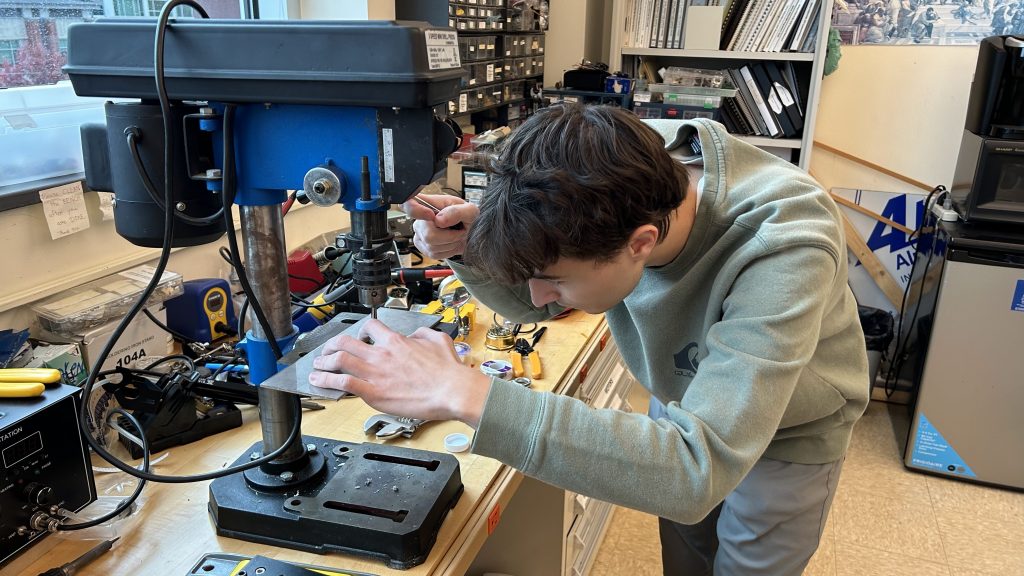
For Matthew Marczak ’26 (ENG), a senior electrical engineering student pursuing his bachelor’s degree, the motivation was personal. He came to UConn eager to design and build PCBs, having built his first one in high school, but he noticed a gap.
“I was excited to go deeper into PCB design, but when I started my undergraduate degree, I realized there were no courses focused on it and few resources available,” says Marczak. “During Coffee Hour, I asked, ‘Why don’t we have a course for this?’”
Rather than waiting for change, Gokirmak encouraged action. He suggested that Marczak and fellow undergraduate student Samuel Dinerman ’26 (ENG), a senior electrical and computer engineering student pursuing his bachelor’s degree, should build the course themselves.
Within a few weeks, Marczak and Dinerman developed a course plan. Word spread quickly, garnering around 40 interested students.
“It became clear that this was much bigger than a small independent study,” says Marczak. “With support from faculty and department leadership, our idea evolved into a special topics course, officially launching in fall 2025.”
From the beginning, the course didn’t follow a traditional lecture-based model. Students took turns leading lessons, teaching each other the fundamentals of PCB design, fabrication, and testing. Their lessons were recorded, building a foundation to improve future iterations of the course.
By spring 2026, the course had evolved into a fully lab-based experience, with students working in small groups under the guidance of undergraduate teaching assistants, many of whom had taken the course themselves.
“The shift to a lab-based format made the course much more hands-on,” Marczak says. “It’s been extremely effective for students to have almost one-on-one guidance.”
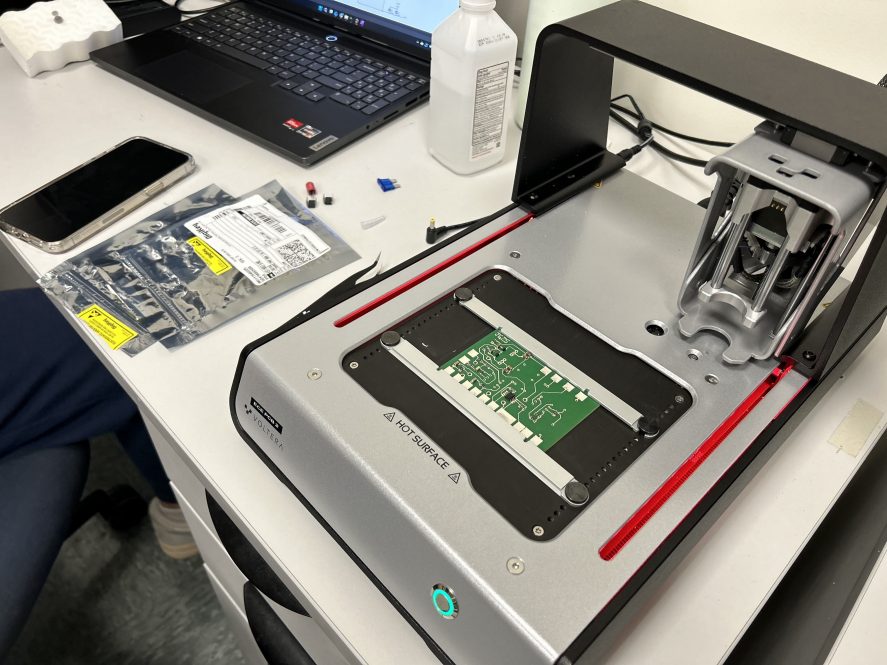
Students gain experience with designing circuits, fabricating boards using Voltera PCB printers, assembling components, and troubleshooting hardware. They work on projects ranging from LED oscillators and light sensors to two-way audio transmitters with amplifiers.
The course’s success didn’t come without some challenges. In its early stages, students lacked access to a dedicated space and reliable fabrication tools.
“Printing reliable PCBs was a challenge, especially since the circuits were fairly complex,” says Marczak. “It took me around 15 prints to get one working.”
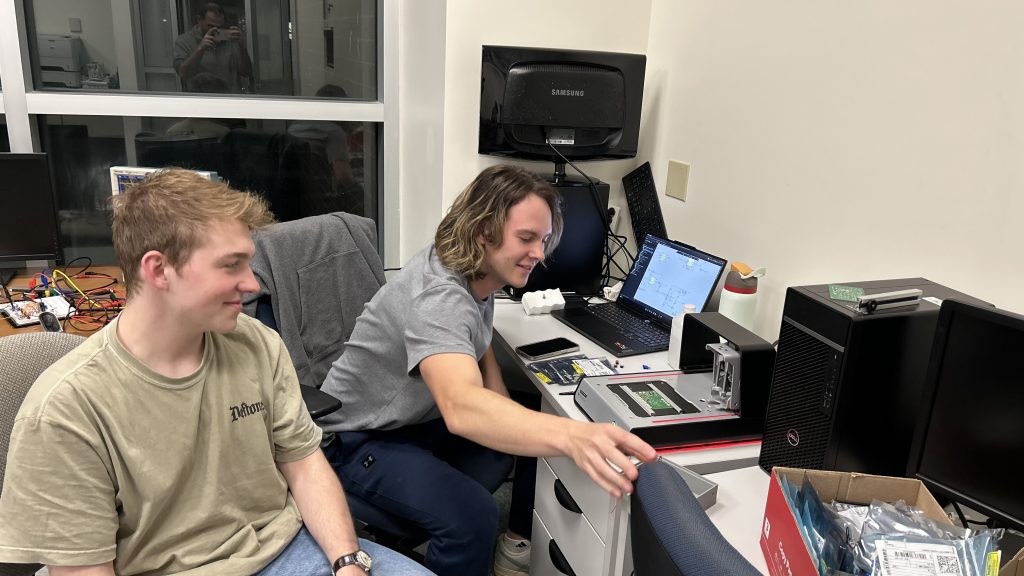
With support from the College of Engineering, faculty, and the Connecticut Power Electronics Center of Excellence (CONPEX), the students secured funding for the proper equipment and established a dedicated PCB laboratory in the ITE building.
Today, the lab is open throughout the week, allowing students to work on their projects between classes and refine their designs through iteration.
Beyond technical skills, the course is equipping students with real-world experience that directly translates to careers in electrical engineering and hardware design.
“PCB design is an extremely valuable skill,” says Marczak. “It’s something that employers are actively looking for.”
Marczak credits the course with helping him stand out in job interviews. In one of his final round interviews, Marczak was given a complex PCB and told that he had to figure out why it didn’t work. He used the experience gained in this course to solve the problem. In the end, he secured multiple full-time job offers, including a position at SpaceX.
As the course continues to grow and evolve, it remains rooted in the same collaborative spirit that brought it to life. Students who complete the course often return as teaching assistants, creating a student-driven model that progresses each semester.
“We now have a design laboratory where students can use their creativity, gain hands-on experience, and truly apply the concepts they’ve been introduced to in this course,” says Gokirmak.