Fifteen current and former UConn students have received Graduate Research Fellowships from the National Science Foundation. UConn’s recipients include three members of the senior class of 2026, four graduate students, and eight recent alumni. In addition to these 15 students, one participant in UConn’s NSF-funded Research and Mentoring for Postbaccalaureates Program (RaMP) also received an award.
The oldest graduate fellowship of its kind, the National Science Foundation Graduate Research Fellowship (NSF-GRFP) was first awarded in 1952. The program recognizes and supports outstanding students in NSF-supported disciplines who are pursuing research-based master’s and doctoral degrees at accredited institutions in the United States. In addition to a three-year annual stipend of $37,000, plus another $16,000 paid to the student’s home institution, fellows have access to a wide range of professional development opportunities over the course of their graduate careers.
A total of 2,597 Graduate Research Fellowships were awarded this year from an application pool of nearly 14,000.
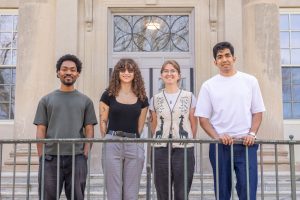
The UConn graduate students who earned a fellowship are:
- Franklin Bray, a doctoral student in psychological sciences with a concentration in language and cognition
- Isabella Perez ’25 (CLAS), a doctoral student in statistics from Windham
- Laurel Schmidt, a doctoral student in ecology and evolutionary biology
- Akshay Zaveri ’25 (ENG), a doctoral student in mechanical engineering from Bethel
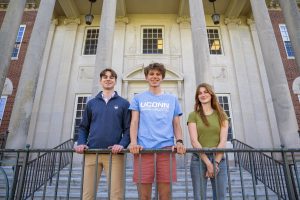
The UConn undergraduate students who earned a fellowship are:
- Nicholas Bailey ’26 (BUS/ENG, CLAS), an honors student pursuing dual degrees in management engineering for manufacturing and mathematics
- Wyeth Haddock ’26 (ENG), an honors student majoring in materials science and engineering
- Martina Jagielski ’26 (ENG), an honors student and chemical engineering major from Bristol
In addition to these students, RaMP Scholar Jillian Taormina, a researcher the Department of Anthropology, also received a fellowship.
“This year’s Graduate Research Fellowship results once again demonstrate not only the exceptional quality of our students, but also UConn’s deep institutional commitment to graduate education and preparing the next generation of great research scientists,” says Leslie Shor, vice provost for graduate education, dean of the Graduate School, and professor of chemical and biomolecular engineering.
Bailey’s research sits at the intersection of stochastic modeling, optimization, and industrial systems, with a current focus on developing rapidly deployable digital twin frameworks for compressed air systems in small and medium-sized manufacturing facilities. He works closely with professor of electrical and computer engineering Liang Zhang and plans to pursue a doctoral degree following graduation.
“The GRFP is an incredible validation of the idea that problems from the factory floor are worth rigorous scientific attention,” says Bailey. “Industrial energy efficiency is often framed as an engineering or policy problem, but there’s genuinely novel science in how physical systems degrade, how uncertainty propagates through those systems, and how to make optimal decisions under that uncertainty.”
Bray’s research is aimed at understanding why smell experiences appear more peripheral to object knowledge by exploring the structure of the neural systems underlying olfactory perception and the relevance of smell to interactions with objects. Bray feels the knowledge of objects is vital to the comprehension of language.
“Compared to vision and audition, the perception and memory of smells have been famously understudied for decades,” says Bray, whose faculty mentor is associate professor of psychological sciences Eiling Yee. “I take this award as validation that the scientific community sees the importance of filling this research gap. I’m also excited to be able to contribute to an understanding of the kinds of sensory experiences that contribute to a person’s knowledge of an object.”
Haddock has pursued extensive undergraduate research, including his University Scholar project that focused on the synthesis and characterization of a novel alloy system and an NSF Research Experience for Undergraduates (REU) at UC Berkeley and the National Center for Electron Microscopy. He is the co-author (with materials science and engineering professor Seok-Woo Lee) of “Materials Matter,” a text designed to introduce materials science to high school seniors and first-year undergraduate students, as well as several scientific publications and poster presentations. Following graduation, he will pursue a Ph.D. in materials science at Stanford.
“I’m incredibly grateful to have received such a prestigious honor,” says Haddock. “I was totally unfamiliar with the GRFP until I chatted with a first-year fellow at my summer Research Experiences for Undergraduates. Submitting the application felt like a shot in the dark, so when I received notice that I was an awardee, I was honestly quite surprised.”
Jagielski has always been passionate about research grounded in the water-energy nexus. When she first came to UConn, she was most interested in desalination solutions that addressed our water crises, which led her to join the lab of professor of chemical and biomolecular engineering Jeffrey McCutcheon. Over time, she began to explore various materials independently and evaluated the resistance of these structures. She will pursue a doctoral degree in chemical engineering from the University of Delaware following graduation.
“I have always been passionate about sustainability research, but it was always natural to question whether it was the right path for me,” says Jagielski. “This award makes me feel more like I belong on this path, and because of that, it motivates me to work harder in my career.”
Perez’s research focuses on high-dimensional time series analysis, statistical machine learning, and the integration of deep learning with classical statistical models. She is especially interested in developing methods that can both make accurate predictions and remain interpretable, to help generate actionable insight that can have real-world impact. In her doctoral work, she hopes to continue developing tools that help make sense of complex, real-world data and support better decision-making in science and society.
“Being awarded the NSF-GRFP is both an honor and a meaningful milestone in my academic journey,” says Perez. “It validates the direction I have taken in my research and gives me the confidence to continue pursuing challenging, long-term problems in statistics and machine learning. It reinforces my commitment to growing as a researcher and contributing meaningfully to the field.”
Schmidt’s main research goal is to better understand the ways that fungi influence forest communities, and how environmental change may alter that balance. Fungi are particularly important in regulating tropical forests, which have global implications particularly as the tropics are threatened by climate change.
“Being awarded the NSF-GRFP is an incredible honor,” says Schmidt. “It feels rewarding to be recognized for the many hours I have put into lab and field work, and I am grateful for the freedom this award gives me to continue pursuing my interests. Pursuing ecological research can sometimes feel challenging today and it is reassuring to know that questions regarding our influential natural ecosystems can still be pursued.”
As a RaMP Scholar, Taormina is working in the Anthropological Genomics Lab under the direction of professor Deborah Bolnick, where she prepares ancient DNA samples from Fuego-Patagonia for sequencing. Once sequenced, the samples can be examined for signatures of selection and adaptation to the environment over time. These findings can then be shared with the Indigenous descendants of these ancestors.
She also is involved in a project to characterize the diet of the little brown bat, as well as determining how the bacterial and fungal composition of bat guano changes over time. Taormina will begin her master’s and doctoral studies at the University of Massachusetts-Amherst this fall.
“Being awarded an NSF-GRFP means that there is still faith in the sciences,” says Taormina. “I have hope that the awards this year are going to produce good, trustworthy science that reiterates the importance of the social sciences.”
Zaveri’s research focuses on developing a carbon fiber 3D printer to manufacture novel, complex composite parts that are difficult to produce using current methods. In the future, he plans to apply the knowledge and experience gained during his doctoral studies to become an entrepreneur in the manufacturing industry.
“Being awarded the NSF-GRFP meant a lot to me because it felt like a real acknowledgment of the work, persistence, and passion I have put into getting to this point,” says Zaveri. “Research is very challenging, so receiving the fellowship gives me confidence in both my abilities and the value of the work I am doing.”
Eight recent alumni also earned Graduate Research Fellowships this year: Danya Alboslani ’24 (CLAS), Katelynn Horvath ’25 (ENG), Cameron Hubbard ’25 (ENG), Giuliana Judge ’24 (CLAS), Neo Lin ’25 (CLAS), Jocelyn Phung ’23 (ENG), Shawn Carter Shay ’25 (CLAS, ENG), and Michael Vrionides ’25 (CLAS).
In addition, six current and former students received honorable mention in this year’s competition: Asher Coello ’23 (CLAS), Laurel Humphrey ’24 (CLAS), Charlotte Melnitsky ’25 (CLAS), Christian Sabatini ’25 (ENG), Rebekah Sheih, a doctoral student in biomedical sciences, and Lillian Smith ’26 (CLAS).
“All of the students who applied for the NSF-GRFP this year – regardless of the outcome – showed enormous resilience and determination in the face of uncertainty about the deadline, the types of proposals that would be considered, and frankly, the value we as a society place on rigorous scientific inquiry,” says Vin Moscardelli, director of UConn’s Office of National Scholarships & Fellowships. “I’m incredibly proud of them. Their unwavering commitment to science, science communication, and broader impacts should be an inspiration to our entire University community.”
The Office of National Scholarships & Fellowships (ONSF) is a resource for students interested in learning more about the NSF Graduate Research Fellowship and other prestigious scholarships and fellowships that support graduate study in all fields. ONSF is part of Enrichment Programs and is open to all graduate and undergraduate students at the University, including students at the regional campuses. For more information contact Vin Moscardelli, director of UConn’s Office of National Scholarships and Fellowships.