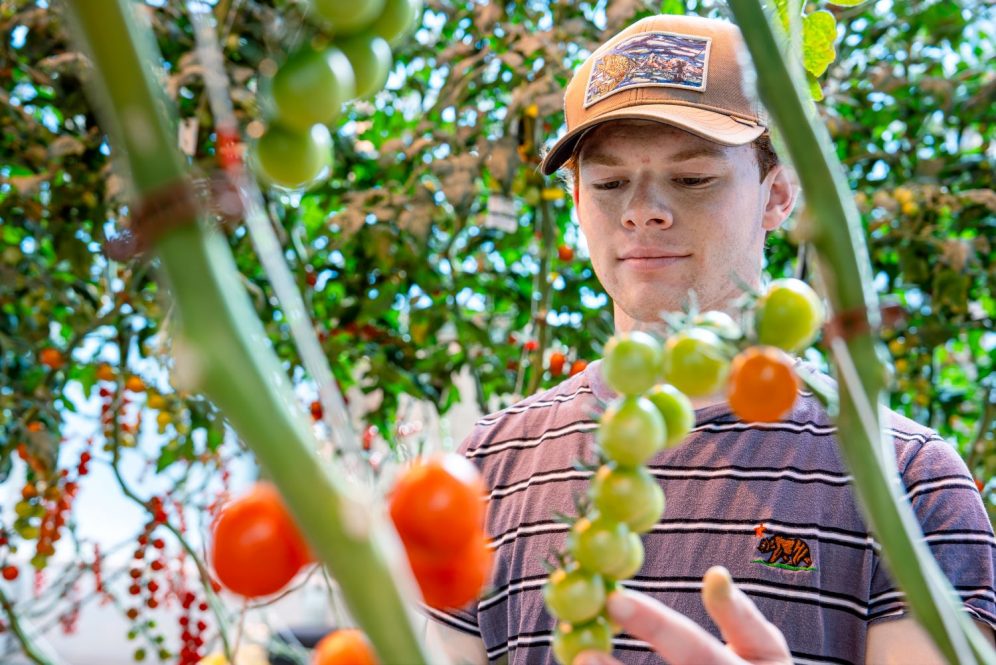
Changhyeon Kim, assistant professor in the Department of Plant Science and Landscape Architecture has established a research program in controlled environmental agriculture (CEA) at the College of Agriculture, Health and Natural Resources (CAHNR).
This program supports graduate and undergraduate research training with an eye towards a more robust agricultural industry in Connecticut.
CEA has been around for decades. Simply put, CEA is a system that controls the conditions in which crops grow. Greenhouses are the oldest and best-known CEA systems.
“Unlike field-based agriculture, it is actually quite an engineering-intensive approach,” Kim says. “But typically, it has a much higher yield and better crop quality.”
CEA allows growers to have a more reliable harvest as they are not subject to environmental conditions in the same way as field-based agriculture. This is a growing concern as climate change is making weather patterns more volatile. CEA can also reduce water and chemical inputs.
Connecticut has a robust greenhouse sector, comprising 48% of the state’s agricultural industry. But the state has been slower to take up CEA for food production due to its larger relative energy demand and tight economic margins.
“The long-term goal is, as there are not many CEA businesses in Connecticut, I want to contribute to the prosperity of that industry within the state,” Kim says.
Kim’s lab is working on refining CEA technologies and labor processes for tomatoes, which have been shown to be particularly well-suited to year-round CEA growing, and strawberries, a promising crop for New England.
One focus of Kim’s research is canopy management. There is a complex balance between the number of leaves that positively contribute to net photosynthesis and sugar accumulation in fruits, and the number of leaves that consume more carbon skeletons than they contribute. Establishing quantitative relationships between contributing organs and consuming organs can help optimize the growing process, a key research focus within Kim’s lab.
Mark Plourde ’26 (CAHNR) is leading research on improving canopy management in high-wire greenhouse tomato systems. His work examines how different leaf pruning strategies influence plant growth, total yield, and labor requirements in CEA.
Plourde is evaluating three approaches: conventional pruning, alongside treatments with increased and reduced leaf retention on each plant.
Preliminary results from Kim and Plourde’s research indicate that reducing leaf pruning does not significantly affect total yield, challenging industry practices that rely on frequent leaf removal.
“CEA is a labor-intensive industry, so anything that reduces labor while maintaining or even improving yield can make a big difference,” Plourde says. “We’re working to better understand that balance and use environmental data to guide more efficient growing practices.”
Plourde says he hopes to pursue his master’s degree after graduation.
“It’s very fulfilling,” he says. “There are still many unknowns with emerging technologies, research at UConn is helping develop more sustainable and productive agricultural systems that can benefit growers in Connecticut and beyond.”
Quinn McGonagle ’27 MS, a master’s student in Kim’s lab, is working on a project focused on canopy management in strawberries.
Their first experiment involved four groups: one in which they removed leaves from each plant, one in which they remove the first and second order flowers, one in which they did both, and one in which they did neither.
Strawberry flowers develop in progressive stages, with every bloom receiving a classification based on the order in which it originates. The first-order flower develops first, and gives rise to two second-order flowers, which in turn each give rise to two third-order flowers, and so on.
“We were hoping to see if we removed the primary and secondary flowers, some of the photoassimilates [compounds formed by plants through photosynthesis] that would normally go to those fruits would end up in the third order fruits and potentially make them heavier or sweeter,” McGonagle says.
Preliminary results indicate that the group with leaf pruning alone yielded the most fruit. The flower thinning treatment, however, yielded higher sugar content and a better ratio of sugar to acidity, which has a big impact on flavor perception. These fruits were also larger. In addition, a higher proportion of the fruits that had the flower thinning or flower thinning and leaf pruning treatments met the USDA marketability standards.
“There’s not a lot of data out there about the best management practices for how to maintain your strawberries in an indoor setting,” McGonagle says. “In time, we’re hoping to produce models that will guide growers toward specific production goals, whether they’re looking to have sweeter fruits, or if they’re just looking to maximize their yield while also minimizing resources.”
The lab is also looking at optimizing irrigation and drainage. An algorithm Kim’s lab is developing can automatically adjust fertilizer and water inputs if it detects an excess or scarcity.
“We are combing horticulture physiology and basic components of engineering to optimize environmental conditions as well as maximize profit for those businesses,” Kim says. “At UConn there will be opportunities to leverage existing technology to enhance the profitability of the controlled environmental agriculture.”
This work relates to CAHNR’s Strategic Vision area focused on Ensuring a Vibrant and Sustainable Agricultural Industry and Food Supply.
Follow UConn CAHNR on social media