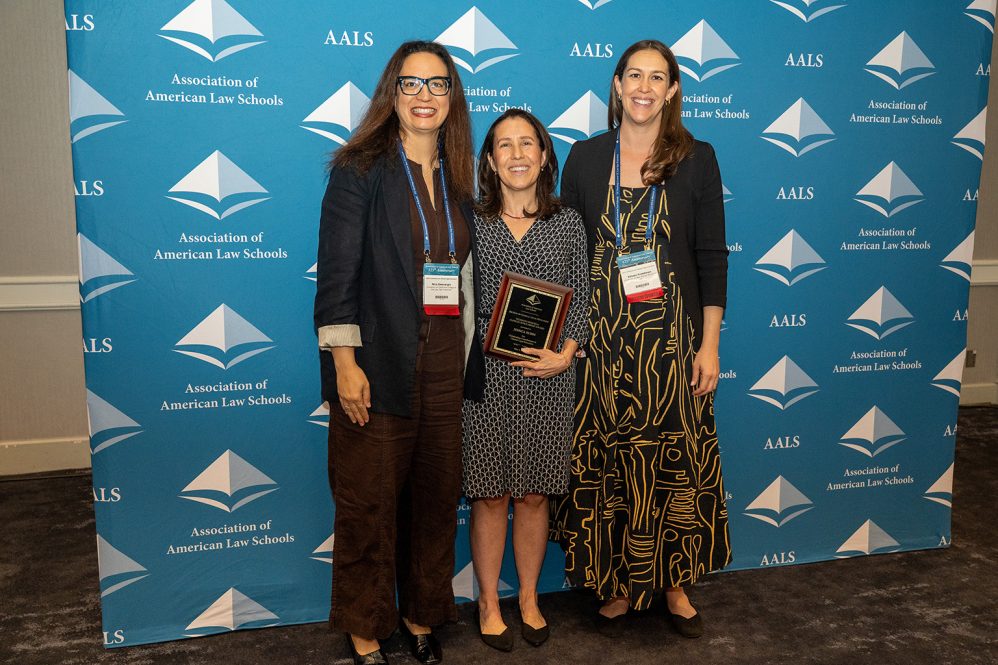
Jessica Rubin, associate dean for Experiential Education and J. Agnes Burns Professor of Law, has been named the 2026 recipient of the Association of American Law Schools Stephen Ellmann Memorial Clinical Scholarship Award. This national honor, awarded by the Section on Clinical Education, recognizes “a mid-career scholar-teacher whose career trajectory is dedicated to clinical and experiential teaching, whose written body of work evinces a concern for justice and a commitment to healing the world, and whose body of work emanates from their clinical commitments.”
The award is named for Stephen Ellmann, a distinguished author, educator, and advocate known for his contributions to clinical legal education. Rubin reflects that legacy through her groundbreaking clinical teaching, advocacy, and empirical research, particularly in the emerging field of animal law.
In 2016, Rubin was instrumental in passing Connecticut’s Desmond’s Law, legislation that allows courts to appoint advocates to represent the “interests of justice” in animal cruelty cases. The law has since become a model for other states. In 2017, Rubin created the Animal Law Clinic at UConn School of Law, the only clinic in the world that effectively operates as a victims’ advocacy clinic for animals. Through court appointments in animal cruelty cases, clinic students conduct factual and legal research and present recommendations to judges to assist with case resolutions.
“I benefited from Stephen Ellmann’s wisdom early in my teaching career,” says Rubin. “I believe that he would be pleased that animal law is a developing field of clinical scholarship, and proud of the efforts of animal law faculty and clinics to challenge animal exploitation.”
Rubin’s scholarship grows directly out of her clinical and advocacy work, beginning with a “how-to” article explaining the birth of the law and clinic, progressing to a 2021 Harvard Law Review article on the early implementation of Desmond’s Law, and expanding into the first large-scale empirical analysis of court appointed animal advocates. That research culminated in her 2024 co-edited book, “Animals as Crime Victims,” which reframes animals as crime victims rather than objects. Rubin commented, “I hope that, taken together, my work is equal parts instruction and inspiration.”
“Dean Rubin’s work exemplifies what clinical legal education can and should accomplish,” said Dean Eboni S. Nelson. “She has built a body of scholarship that is deeply grounded in practice, advances justice in meaningful ways, and provides students with an extraordinary opportunity to engage in work that has real impact. This recognition is richly deserved, and we’re all very proud of her.”
In addition to her teaching and scholarship, Rubin remains actively engaged in animal advocacy nationwide, including filing amicus briefs and writing and speaking to both academic and non‑academic audiences across the country.