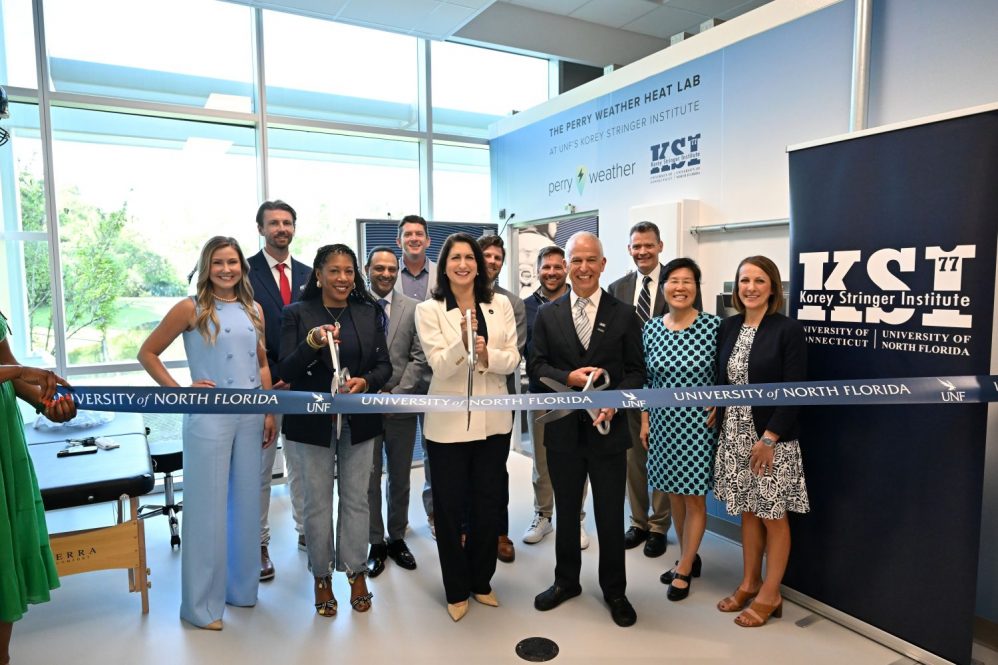
The Korey Stringer Institute (KSI) in the College of Agriculture, Health and Natural Resources (CAHNR) has opened its first satellite location at the University of North Florida (UNF). The Perry Weather Heat Lab will be a hub of research on how extreme heat affects the body, informing real-world protocols and policies.
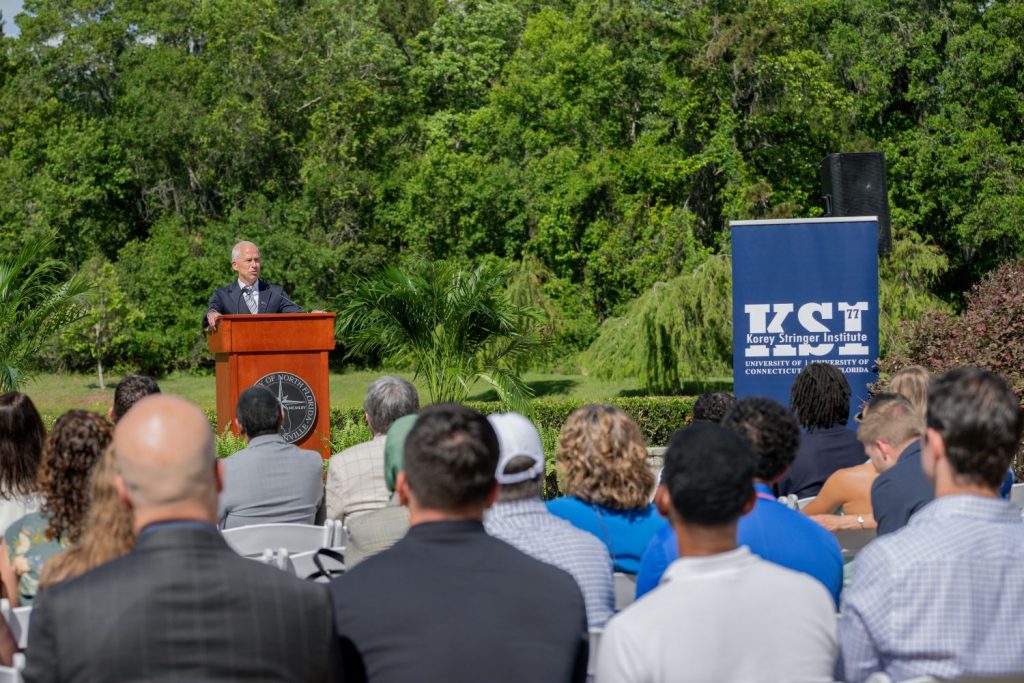
The lab’s opening on May 18 brought together university leaders, researchers, community partners, and athletes on campus in recognition of a new chapter in a national effort to ensure no one dies from a preventable heat-related illness.
The Perry Weather Heat Lab at UNF is KSI’s first expansion beyond UConn, driven by Jacksonville’s year-round heat, large military presence, growing professional sports ecosystem and significant outdoor labor workforce.
“This expansion to the University of North Florida is a defining moment for the Korey Stringer Institute and for the future of heat safety,” says Doug Casa, KSI CEO and Board of Trustees Distinguished Professor of Kinesiology at the University of Connecticut. “We are deeply grateful to the University of North Florida for their partnership and shared commitment to protecting lives. Together, we are ensuring that no one suffers or dies from a preventable heat-related illness.”
First established in 2010 at UConn through a partnership between the University, the National Football League (NFL), and Gatorade, KSI honors the legacy of Korey Stringer, a Pro Bowl offensive lineman for the Minnesota Vikings who died from exertional heat stroke in 2001. His wife Kelci Stringer and agent Jimmy Gould partnered with Casa to create an institute focused on advancing science, education, and policy to prevent heat-related deaths.
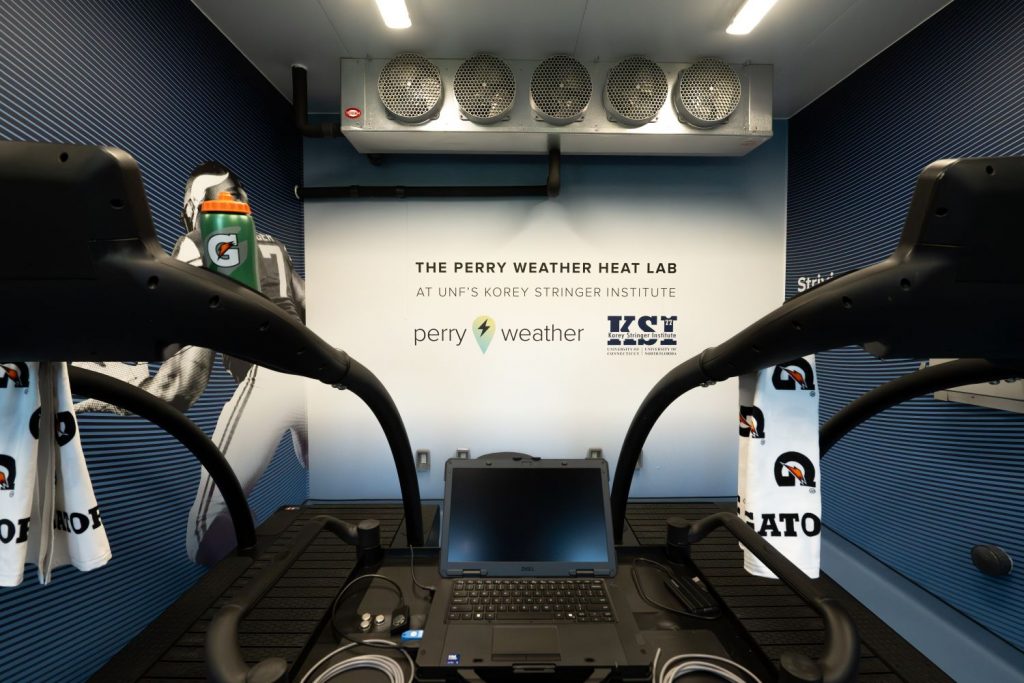
The new Perry Weather Heat Lab is designed to advance the science of thermoregulation, performance, health, and safety through controlled environmental testing. Lab technologies enable researchers to simulate extreme heat conditions and precisely measure the body’s physiological and biochemical responses to physical activity under stress, then translate those findings directly into real-world protocols and policy recommendations.
The lab is led by UNF researchers Michael Szymanski ’23 (CAHNR) and Gabrielle Brewer ’24 (CAHNR), whose work spans methodologies ranging from gut microbiome analysis and nutritional supplementation to wearable technology validation. Szymanski is an assistant professor of kinesiology and Brewer is a post-doctoral associate.
UNF graduate and undergraduate students are training alongside the faculty team, gaining hands-on experience in physiological data collection, biological sample analysis and scientific communication at the regional and national level.
Brewer and Szymanski’s research places particular emphasis on sex differences in thermoregulation. Additionally, Szymanski has secured a principal investigator grant to validate commercially available wearable heat monitoring devices, with the study commencing in fall 2026.
Brewer and Szymanski are also working with UNF Army ROTC cadets, providing educational guidance and physiological support ahead of demanding training events and helping cadets safely maintain military readiness standards. The team is also collaborating with UNF’s Department of Nutrition and Dietetics, providing nutritional recommendations and body composition tracking to professional athletes, with plans to expand those services across the university.
Additional research underway and planned at the lab includes heat acclimation and adaptation strategies; nutritional interventions, including antioxidant and hydration strategies; validation of commercially available wearable devices in heat conditions; occupational heat safety protocols for Jacksonville-area employers; and additional military performance and safety in extreme environments.
“This partnership reflects UNF’s commitment to research that improves lives,” says Angela Garcia Falconetti, UNF interim president. “We are proud to contribute to groundbreaking science that will shape heat safety practices, and we are honored to help carry forward a mission rooted in preventing tragedies before they occur.”
The lab’s naming partner, Perry Weather, brings its real-time Wet Bulb Globe Temperature (WBGT) monitoring and data logging platform to field research, enabling scientists to pair physiological findings with precise, moment-by-moment environmental data. That combination is central to the lab’s mission of producing research that translates directly into actionable safety guidance.
“We’re proud to partner with KSI and UNF to advance the science of heat safety in one of the most demanding climates in the country,” says Colin Perry, CEO and Founder of Perry Weather. “Jacksonville’s heat and the concentration of athletes, warfighters, and laborers in the region make it the right place to do this work. Deploying our real-time monitoring platform alongside KSI researchers will produce science-backed strategies that help policymakers and organizations nationwide protect the people most exposed to heat stress.”
This work relates to CAHNR’s Strategic Vision area focused on Advancing Adaptation and Resilience in a Changing Climate and Enhancing Health and Well-Being Locally, Nationally, and Globally.
Follow UConn CAHNR on social media