UConn Stamford recently hosted a four-day, invitation-only research conference on mixed-integer programming, a major area of mathematical optimization, known as MIP 2026.
The workshop brought leading academic researchers together with representatives from some of the world’s top technology and analytics companies to discuss new theoretical advances, computational methods, and real-world applications of optimization.
Industry participants came from Google, Nvidia, Mitsubishi Electric, SAS Institute, and Uber, as well as specialty software firms, including Hexaly. Seven UConn faculty members, representing the School of Business, College of Liberal Arts and Sciences, and the College of Engineering, were joined by peers from MIT, Purdue University, the University of Southern California, Rensselaer Polytechnic Institute, and other institutions.
Government-affiliated researchers from Argonne National Laboratory and Los Alamos National Laboratory also participated, and the conference received sponsorship from the Air Force Office of Scientific Research.
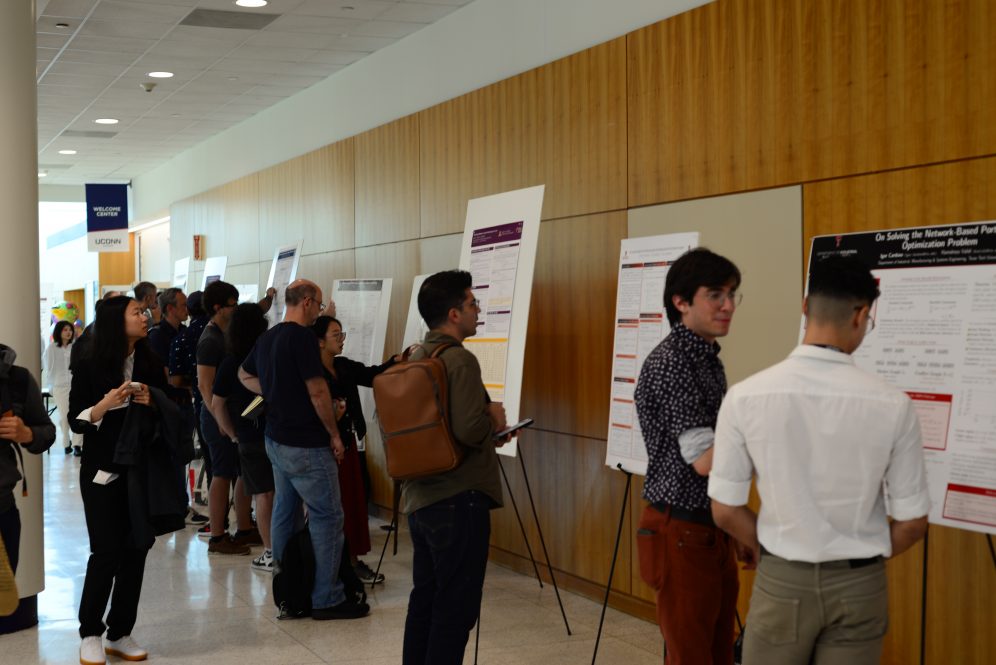
Some 140 people, representing 70 organizations, attended the research conference. Participants discussed current research directions in mixed-integer programming and broader optimization, including algorithm design, artificial intelligence, high-performance computing, and applications in energy, transportation, manufacturing, and health care.
Researchers Discussed Everything from Electricity Delivery to Medical Resident Scheduling
“As you’d expect in a computational research event today, AI and its many applications were on full display,” says Professor Bob Day, Interim Dean of the School of Business. “We’ve had discussions on topics as diverse as polyhedral geometry and planning in the steel-manufacturing industry. There were talks on optimizing electricity delivery, vehicle routing, the schedules of medical residents, and more. The wide array of topics was truly inspiring.
“This event highlights the interplay of AI and more traditional computational and mathematical research methods in optimization,” Day says. “We have a broad cross-section of researchers specializing in theoretical research, technical algorithmic development, and the practical application of advanced algorithms.”
Organizers Hope to Host Future Conferences
Professor David Bergman, Associate Dean of Faculty and Research at the School of Business and the chair of the event, said MIP 2026 reflected both the strength of UConn’s optimization community and the university’s commitment to collaborative research.
“Mixed-integer programming is one of the core technologies behind many of the optimization systems that make modern organizations work,” Bergman says. “Hosting MIP 2026 at UConn gave our faculty and students a chance to engage directly with the researchers who are advancing the field, from foundational theory to algorithms that solve real industry problems.”
The collaboration was distinctive because the conference created many opportunities for researchers from different institutions, disciplines, and sectors to brainstorm and work closely together, organizers say.
“This event came together because faculty across UConn were already having serious conversations about how to build a stronger optimization research community here,” Bergman says. “Our hope is that this becomes a model for future interdisciplinary research conferences at UConn.”
“This collaboration is the first among what we hope will be many,” Day says. “Our discussions as a leadership group have included a desire to align our Ph.D. courses on optimization across UConn, building a more fertile ground for discipline-crossing innovation. We’re proud that UConn and the Stamford campus provided the backdrop for this world-class intellectual event.”
Professor Laurent Michel, a faculty member in the College of Engineering’s Computer Science and Engineering program, said the event was well attended, with participants coming from both the U.S. and abroad.
“The workshop was akin to a focused small conference, with a variety of topics related to combinatorial optimization, including solving industry problems such as power flow, tapping GPUs to accelerate code bases, and exploring techniques such as dynamic programming and decision diagrams,” Michel says.
Professor Nicholas Lownes, of the School of Civil and Environmental Engineering at UConn, says the program was not only fascinating but also extremely beneficial.
“It’s been great to participate in this smaller environment with both theoretical and applied research sharing the stage,” he says. “I’ve been able to connect directly with work ongoing in transportation networks and learn new ideas from applications in other domains. It’s an excellent venue for this community and a strong start to our collaborative initiative in optimization at UConn.”