Connecticut and the nation are facing a growing demand for a skilled, science-literate workforce, and UConn Extension is investing in hands-on learning opportunities that help young people see themselves in future STEM careers. Through UConn 4-H, youth across the state are experiencing emerging fields like biotechnology, while building the confidence, curiosity, and life skills needed to succeed in whatever path they choose next.
The UConn 4‑H Biotechnology Club program introduces middle and high school students to real-world applications of science while supporting UConn 4‑H’s Beyond Ready mission: preparing youth for college, careers, and civic life.
Each year, over 29,000 youth ages 5 through 18 participate in 4-H programs across Connecticut.
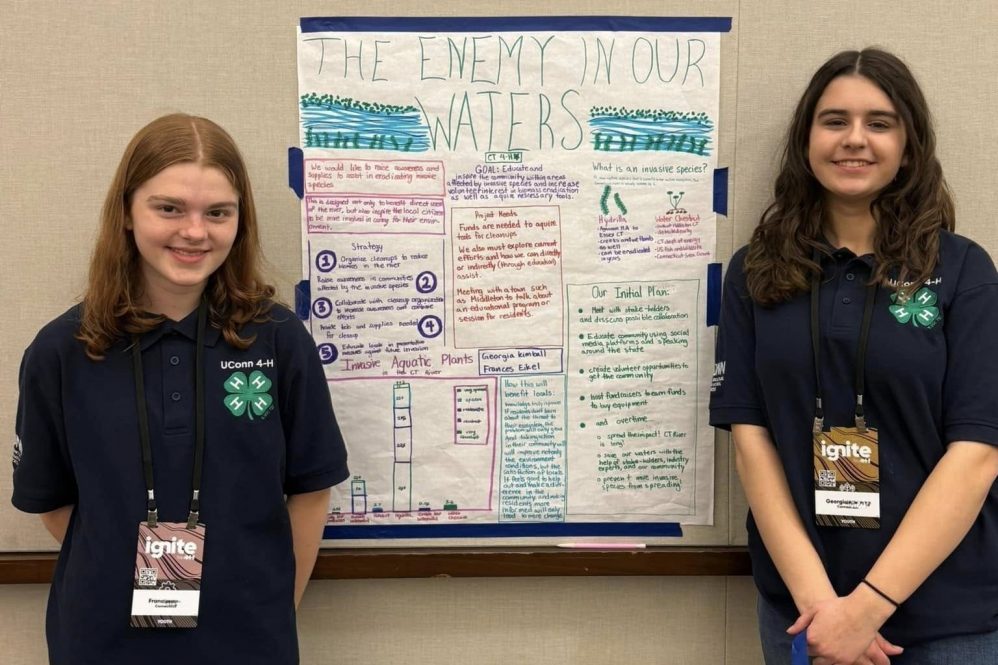
For Georgia, a West Hartford high school sophomore, 4-H is a defining part of her life. She was introduced to the program seven years ago, and has grown up within the 4-H community, participating in a wide range of activities that have shaped both her interests and her outlook on the future.
“I like the sense of community and the lifelong friendships,” Georgia says. “It’s an amazing program.”
That sense of belonging is paired with opportunities for exploration, particularly in science-based programs like the Biotechnology Club. Through these experiences, Georgia is connecting her academic interests to possible careers, especially in healthcare.
“I’m interested in anatomy, something in healthcare,” she says. “I love taking care of things.”
Georgia credits 4-H with helping her think more deeply about who she is, what she values, and how her interests fit into the larger world.
“It makes me think about what the future will become and what society will be like,” she says. “UConn 4-H is kind of everything. I’ve learned so much and met so many great people. It taught me things I carry over to my work and school lives.”
Another Biotechnology Club member, Jx, is also a high school sophomore from West Hartford. Jx joined 4-H shortly after the pandemic, becoming involved through the Auerfarm 4-H Club. For Jx, 4-H provided not only academic enrichment, but also a renewed sense of connection after a period marked by isolation for many young people.
“It’s a great community experience,” Jx says. “We learn things in school, but at the biotech club we learn life skills and really open career paths.”
The Biotechnology Club is intentionally designed to complement classroom learning. Youth participate in hands-on lessons modeled on real-world scientific practices, exploring genetics, biotechnology applications, and the ethical and societal implications of emerging technologies. These experiences help participants see how science extends beyond textbooks into everyday life, and future careers.
For Jx, the connections between the club and school coursework have been especially meaningful.
“The bio curriculum connects a lot to the club,” Jx says. “I’ll be taking chemistry and physics next.”
While Jx is still undecided about a specific career path, participation in 4‑H has strengthened an interest in STEM and encouraged continued exploration.
“I want to do more science courses,” Jx says. “I’m interested in STEM and want to keep taking courses.”
Within the club itself, Jx has particularly enjoyed learning about complex and timely biotechnology topics.
Beyond technical concepts, both youth participants emphasized that 4‑H has helped them develop transferable skills such as teamwork, communication, leadership, and critical thinking that are essential across careers and industries.
One experience that stood out for both Georgia and Jx was a UConn 4‑H trip to Washington, D.C. in 2025. There, the participants engaged with national issues, met new people, and saw how science, policy, and civic engagement intersect.
“I learned a lot and met a lot of people,” Georgia says. “Then I came home and taught other people about it.”
That opportunity to take what they learned and share it with others reflects a key component of 4‑H programming: empowering youth not only to gain knowledge, but to apply it, communicate it, and lead.
According to Jen Cushman, state 4‑H program leader and principal investigator for the grant supporting the Biotechnology Club, programs like this are intentionally designed to help youth envision futures they may not have previously considered.
“Exposure to biotechnology and STEM careers is critical to helping youth see what’s possible for their future. The UConn 4-H Biotech grant allows youth to explore their spark, build technical and transferable skills, and guide young people toward career exploration, ensuring they are Beyond Ready for college, career, and meaningful participation in life,” she says.
Cushman notes that by introducing youth to fields such as biotechnology, often before they encounter them in traditional academic settings, UConn 4‑H helps level the playing field and expands what young people believe is possible for themselves.
For Jx, that space to explore and ask questions has been especially meaningful.
“4‑H is about exploring and curiosity,” Jx says. “I think that’s really valuable, to express your individuality and creativity, and you’re given a space to succeed.”
Georgia echoes that sentiment, emphasizing how 4‑H has shaped her growth over time.
“It’s helped me think about who I want to be and what I want to do.”
Together, Georgia and Jx’s experiences reflect the broader impact of UConn 4‑H’s workforce development efforts across Connecticut. By combining science education with mentorship, community, and hands-on learning, programs like the Biotechnology Club help youth move beyond career awareness toward confidence, curiosity, and readiness.
This work is supported by the Food and Agriculture Nonformal Education program, grant no. 2022-68018-36094 from the USDA National Institute of Food and Agriculture.
UConn Extension is part of the College of Agriculture, Health and Natural Resources and fulfills the land-grant mission of translating the university’s research for the public. UConn Extension’s statewide locations and programs help serve all 169 Connecticut municipalities. Programs include health and wellbeing, agriculture, horticulture, natural resources, and positive youth development. UConn Extension provides answers you can trust on issues ranging from health and wellness to agriculture, horticulture, natural resources, and positive youth development.
Follow UConn CAHNR on social media