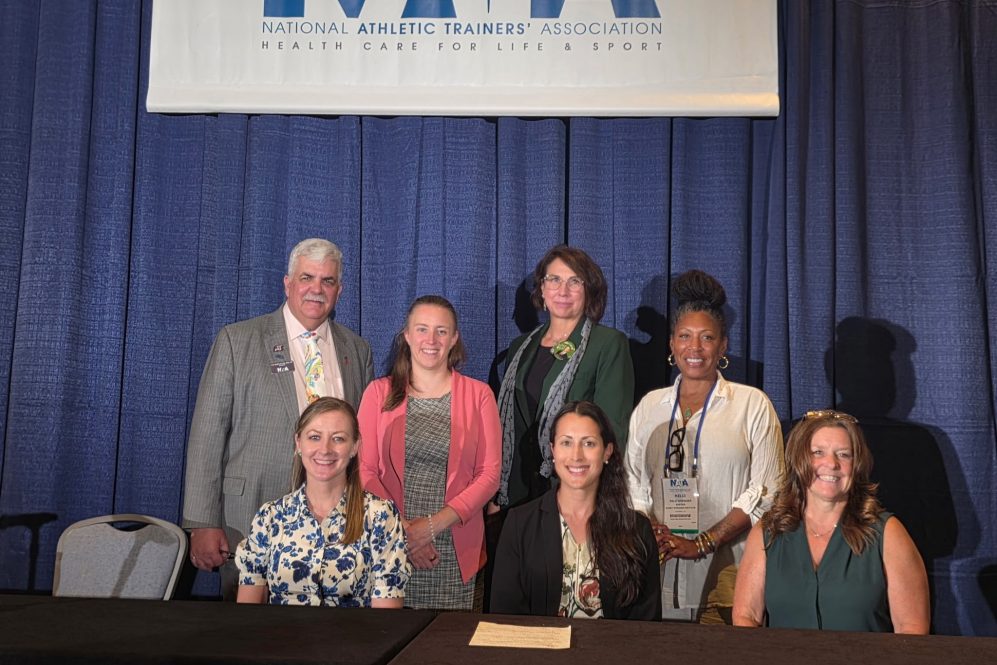
Researchers and leaders from UConn’s Korey Stringer Institute (KSI) helped unveil new national recommendations aimed at preventing exertional heat illness and saving lives among athletes and workers exposed to extreme heat.
The recommendations were presented at the National Athletic Trainers’ Association’s 77th Clinical Symposia & AT Expo in Philadelphia and stem from two national task force statements led by KSI experts. A full event recording is available.
“Exertional heat stroke (EHS) is a leading cause of sudden death in sport and especially among American football lineman. Additionally, occupational heat stress is a growing public health concern,” says AJ Duffy, NATA president. “Athletic trainers are uniquely qualified experts in heat safety. The two new NATA Task Force statements demonstrate how their competency in this area translates directly to protecting football players and workers alike.”
The guidance addresses two growing concerns: exertional heat stroke among football athletes – particularly linemen – and heat stress in occupational settings. Together, the recommendations provide evidence-based strategies for improving safety, emergency preparedness, and heat mitigation practices across schools, sports programs, and workplaces.
“This work reflects years of research focused on understanding who is most at risk and how we can better prevent heat-related tragedies,” says Rebecca Stearns, chief operating officer of the Korey Stringer Institute and associate professor-in-residence of kinesiology at UConn. “When organizations implement comprehensive prevention, monitoring, and emergency response strategies, we can significantly reduce the risk of exertional heat stroke fatalities.”
Stearns chaired the task force behind Preventing Exertional Heat Stroke Death in American Football Linemen, which highlights the unique risks faced by this population. According to the statement, linemen account for more than 90% of exertional heat stroke fatalities at the secondary school and collegiate levels. The recommendations call for position-specific conditioning, structured acclimatization periods, environmental monitoring, and stronger emergency action planning.
Among the key strategies is the use of Wet Bulb Globe Temperature (WBGT), a measurement that combines temperature, humidity, wind speed, and solar radiation to assess environmental heat risk. Stearns noted that Texas recently adopted a WBGT policy for all University Interscholastic League schools, expanding heat-safety protections to millions of student-athletes.
A second task force statement, led by Christianne Eason, president of sport safety and education at the Korey Stringer Institute and assistant professor-in-residence in UConn’s Department of Kinesiology, focuses on heat stress in occupational settings.
The statement outlines recommendations to help employers protect workers as extreme heat events become more frequent and intense. The guidance includes environmental monitoring, heat acclimatization protocols, hydration and cooling access, emergency planning, and safe return-to-work procedures following heat illness.
“Heat stress affects not only health and safety, but also workforce sustainability and productivity,” Eason says. “Employers can take practical steps now to reduce risk and better protect workers, particularly in high-heat environments.”
The event also featured Kelci Stringer, founder of the Korey Stringer Institute and wife of former Minnesota Vikings player Korey Stringer, whose death from exertional heat stroke in 2001 inspired the creation of the institute. Since its founding, KSI has become a national leader in research, education, advocacy, and policy development related to exertional heat illness and sudden death in sport.
“We all have a role as parents, coaches, sports medicine team members, and school representatives to ensure youth athletes have the best care and that continued health and safety guidelines are reviewed, adopted and implemented,” says Stringer. “This then extends to every level of sport and ensures best protocols are in place.”
The Korey Stringer Institute (KSI), established in 2010 at the University of Connecticut (UConn) in memory of NFL player Korey Stringer, provides research, education, advocacy, and consultation to maximize performance, optimize safety, and prevent sudden death for the athlete, warfighter, and laborer. The institute is housed within UConn’s College of Agriculture, Health and Natural Resources (CAHNR) in the Department of Kinesiology, and includes a satellite laboratory, KSI at the University of North Florida in the Brooks College of Health (KSI at UNF), to extend its research and outreach impact.