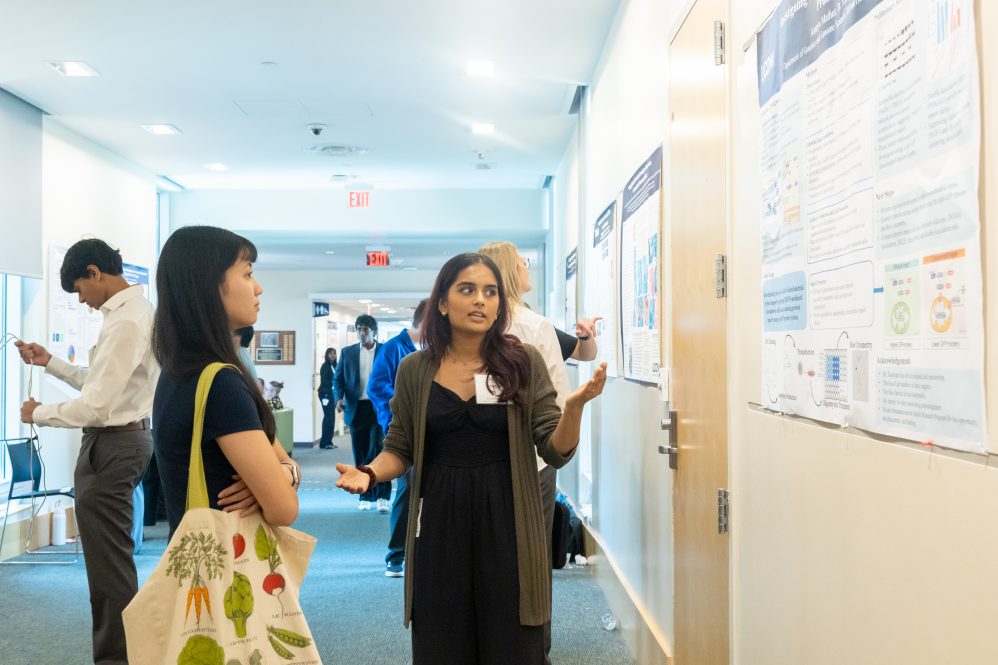
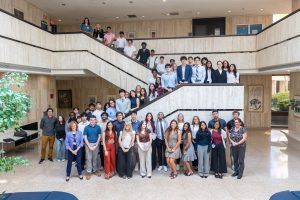
The academic rotunda at UConn Health was abuzz with activity on Summer Research Day, as attendees flooded the halls to hear poster presentations by undergraduate researchers.
Some 44 students ranging from first-year to rising seniors completed the Health Research Program (HRP), a 10-week, 360-hour research experience offered through UConn’s Office of Undergraduate Research (OUR). An additional 12 undergraduate or masters’ degree students taking part in the summer-long Technology Incubation Program (TIP) Innovation Fellowship Program also gave poster presentations or short talks.
OUR Director Micah Heumann noted the increased interest in the HRP program over the last two years. The number of applicants has more than doubled, he says, from 106 in 2024 to 240 this year.
“There is clearly a desire,” says Heumann. “Students are coming to college now wanting to do research. What makes UConn special is these experiences.”
HRP students were matched and mentored by researchers at UConn Health. Students in the TIP Innovation Fellowship program were paired with university startup companies for mentored technology development experience leading to possible internship or part-time employment within the company they are matched with.
“It’s through the process of synthesizing these experiences that students have ‘aha’ moments,” says Caroline Dealy, director of the TIP Innovation Fellowship Program, and a professor in the departments of Orthodontics, Orthodontic Surgery, Biomedical Engineering, and Cell Biology at UConn Health. “Not only do they do research, they synthesize what they’ve learned into a presentation that non-experts will understand. That’s where they gain a higher level of understanding and real pride in their project.”
It’s about learning to market, commercialize research, and more, adds Paul Parker, director of TIP Farmington. “We’ve had students change majors or come back to get a Ph.D. as a result of this program.”
Patrick Lonergan ’27 (ENG), was one of the many HRP students presenting in the first poster session. A biomedical engineering major from New Jersey, Lonergan says he jumped at the chance to work in the lab of Dr. Liisa Kuhn, professor of biomedical engineering at UConn Health.
“This one was by far the one that interested me most because I had a lot of experience with computer modeling in the past,” says Lonergan. His project with Kuhn was, “to create an anatomically accurate breast prosthetic for women who have undergone mastectomies that addressed long-standing issues with commercial prosthetics.” The project involved using digital imaging, CAD modeling and advanced 3D printing to create a lighter-weight, more personalized prosthetic.
“The way it turned out, it’s been really great,” says Lonergan. “I’m using skills I already have and I’m not just doing experiments. I’m actually helping, from the reaction of Dr. Kuhn’s patients. It’s been really amazing.”
Nearby, Nabil Mardhy ‘28 (CLAS), pointed to a poster illustrating his project, “Testing and Troubleshooting Mathematical Models or Biological Systems.” A neurobiology major, Mardhy worked under Michael Blinov, an associate professor of genetics and genome sciences. His research involved figuring out if mathematical models created for specific tools – to track COVID, for example – can be customized for use with another tool – say, one for chronic traumatic encephalopathy (CTE).
“Computational modeling is very important,” explains Mardhy, who plans to go into biomedical research. “To work in neurobiology, for example, with issues like CTE, the research uses a lot of models.”
Adonis Smith ’27 (SFA), a digital design major at UConn Stamford, was among the TIP Fellowship Program students giving presentations. Working with Valentina Gutierrrez ‘27 (CAHNR), an allied health sciences major, he created a digital presentation promoting a rapid at-home test for Lyme disease and other tick-borne illnesses under development by TIP startup Therapeutic Bandage Products.
Participating HRP students received stipends funded through the Barbara C. Setlow Health Research Program. Support for the TIP fellows program comes from UConn’s Technology Commercialization Services (TCS) and the UConn schools and colleges partnering with the program.
“With recent cuts in funding, particularly the student experience, support from UConn is critical for career-building experiences such as these,” says Dealy. “There is no replacement for a hands-on experience.”