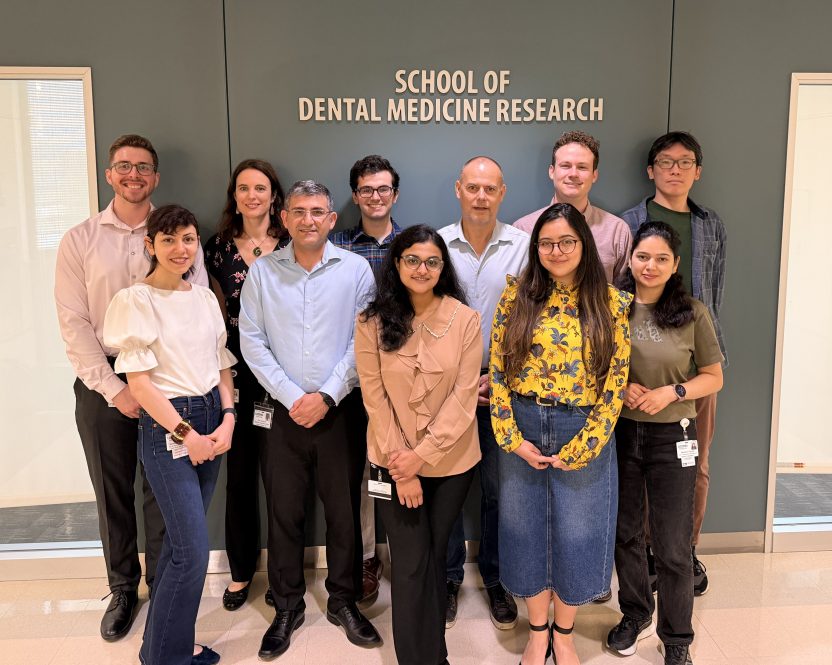
Researchers in the School of Dental Medicine received the 2026 Military Health System Research Symposium Award for Excellence, Outstanding Research Accomplishment Award for their work in developing a multifunctional biomaterial platform for combat casualty care—uniting hemorrhage control, tissue regeneration, and pain management within a single, adaptable platform.
Dr. Ivo Kalajzic, professor of regenerative medicine and skeletal development, and Dr. Ali Tamayol, professor of biomedical engineering, lead a team of researchers from UConn Health with Dr. Sangamesh Kumbar from University of Nebraska Medical Center on this award-wining project.
“This well-deserved recognition demonstrates the highly innovative and clinically relevant work being done by our researchers” says Rajesh V. Lalla, DDS, PhD, Associate Dean for Research at the UConn School of Dental Medicine. “The notable success of this multidisciplinary team, including trainees and faculty at various career stages, also speaks to the excellent scientific and educational environment at UConn Health.”
Complex combat-related injuries frequently involve simultaneous damage to multiple tissue types, including bone, muscle, and skin, and are often compounded by uncontrolled hemorrhage and prolonged pain. Current treatment strategies typically address these challenges in isolation, requiring multiple interventions that increase logistical burden and delay recovery. There remains a critical need for integrated, field-deployable solutions capable of stabilizing acute injuries while promoting coordinated, long-term tissue regeneration.
The team of researchers engineered rapidly deployable, tissue-specific foams that enable immediate hemorrhage control while promoting bone and muscle regeneration. Using a murine bone-muscle defect model, which captures the biological interplay between tissues normally absent in traditional single-tissue studies, the researchers demonstrated that compartment-specific therapeutic strategies are more effective than uniform treatment approaches. The tissue-specific scaffolds are tailored to the distinct regenerative requirements of both bone and tissue. The materials are also highly adaptable, capable of injection, printing, or spray-based delivery, and conform to irregular wound geometries and adhere to wet tissue surfaces without external triggers.
A key advancement of innovation included the discovery that the materials that make up the foams not only support bone growth, but also exhibit intrinsic hemostatic properties, significantly accelerating clot formation and stabilizing bleeding at the wound site. This finding enabled the extension of the platform to acute hemorrhage control, allowing immediate injury stabilization prior to regenerative intervention, without introducing additional materials or complexity.
The impact of this work lies in its ability to address multiple unmet clinical needs simultaneously and represents a significant step towards adaptable, field-ready solutions for improving warfighter outcomes.
The funding for this research is supported by two United States Department of War grants, HT9425-24-1-0944 and HT9425-25-1-0772